
Share this @internewscast.com
Could a twice-daily application of lotion finally put an end to the dreaded bald patch that affects so many men? This hopeful prospect emerges from two recent clinical trials that have shown remarkable results. A novel treatment, initially designed for acne, has demonstrated an impressive capacity to enhance hair growth by more than 500 percent over a six-month period.
The promising outcomes of these trials have had a significant impact on the market, causing shares of Cosmo Pharmaceuticals, the company responsible for this innovative lotion, to soar by 40 percent in a single day this past December.
Dermatologists are hailing this new product, known as clascoterone, as a ‘gamechanger.’ It represents the first genuine advancement in the treatment of male pattern baldness in over thirty years.
Male pattern baldness, or androgenetic alopecia, is the most prevalent form of hair loss in the UK, affecting approximately 6.5 million men. It typically manifests as a bald patch atop the head or a receding hairline and is often hereditary.
The condition is caused by dihydrotestosterone (DHT), a derivative of the hormone testosterone, which progressively shrinks genetically predisposed hair follicles. This process results in increasingly finer hair until the follicles eventually cease to produce hair altogether.
It is triggered by a derivative of the hormone testosterone, dihydrotestosterone (DHT), which gradually shrinks genetically sensitive hair follicles, making hair progressively finer. Ultimately the hair growth mechanism in the follicle is switched off altogether.
The new lotion aims to combat this in a completely different way from the pills and potions currently available.
Existing treatments include minoxidil – better known by the brand name Regaine, which comes in foam or liquid form – which is thought to improve blood flow to hair follicles.

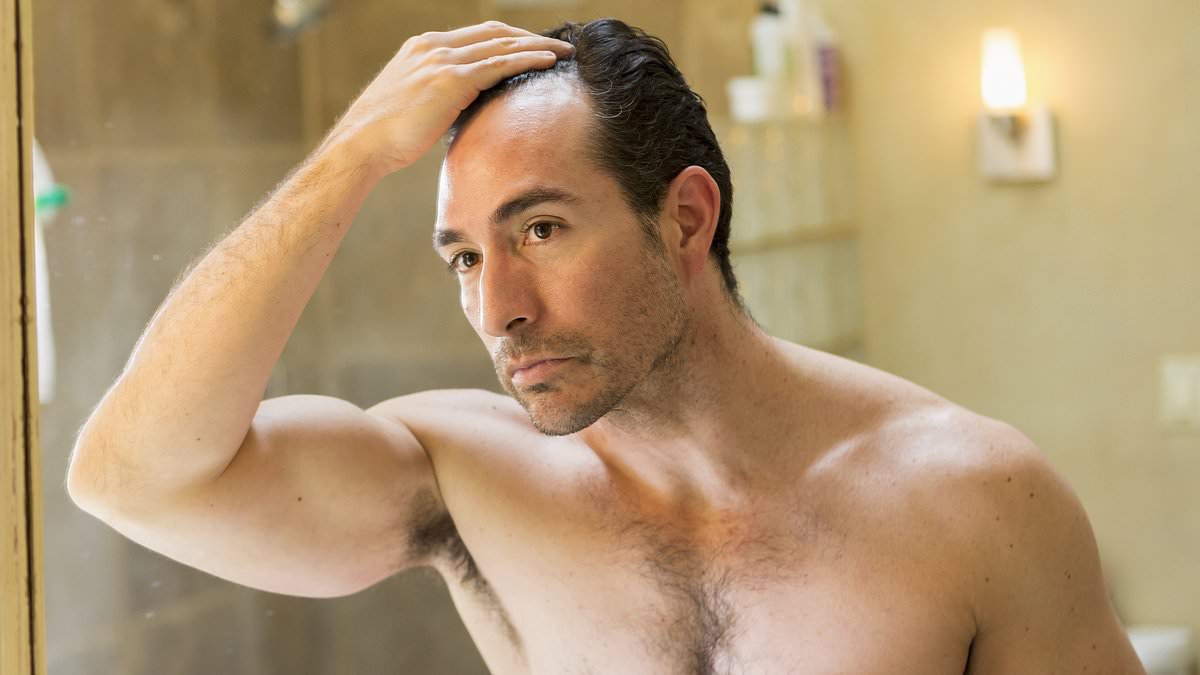
Male pattern baldness typically causes a bald patch or a receding hairline. It is triggered by a derivative of the hormone testosterone, dihydrotestosterone (picture posed by model)
But it doesn’t work for everyone. Around 40 to 50 per cent of men experience limited benefit, and any gains fade once the man stops using the treatment.
Other options include finasteride and dutasteride, which are pills that lower DHT levels – but as DHT also supports libido and prostate function, they come with off-putting potential side-effects such as a lower sex drive.
Clascoterone is different as it blocks the action of DHT in the follicle itself, without causing these body-wide side-effects.
The formula used is five times stronger than that used for acne (marketed under the brand name Winlevi). The latter works by blocking the effect of hormones in the skin’s oil glands, reducing oil production and inflammation.
The two recent trials of clascoterone for baldness – called SCALP 1 and SCALP 2 – involved 1,465 men across Europe and the US and are said to be the biggest hair-loss studies ever run for a topical treatment.
Each participant was treated with either the new lotion or a dummy version. The effects were measured by photographing and counting hairs in a tiny, tattoo-marked spot on the scalp, in order to compare the same patch each time.
After six months, one study showed a 539 per cent improvement in hair count in those using clascoterone lotion. In the other study, there was a 168 per cent improvement – but there was no similar benefit in the men using the dummy lotion.
The side-effects were limited to mild skin reactions, including redness or itching (but these also occurred in the men using the dummy product).
‘That’s a major point, because concerns about libido, erectile function and mood are significant barriers for many men considering oral finasteride or dutasteride,’ says Professor Maria Hordinsky, chair of the department of dermatology at the University of Minnesota, who led the trials.
‘Given how many men are affected and how many avoid treatment because current options don’t fit their needs, the prospect of a novel, biologically targeted, well-tolerated topical therapy is genuinely exciting,’ she says.
Professor Desmond Tobin, a dermatologist at University College Dublin, believes the results are ‘a very significant breakthrough’, but notes that men ‘have to commit to taking the treatment regularly and that cessation of use would likely restart the balding process again’.
Other experts urge caution in reading too much into the results.

Professor Maria Hordinsky, chair of the department of dermatology at the University of Minnesota, led the trials on clascoterone
‘The 539 per cent figure can be very misleading if taken at face value,’ says Spencer Kobren, a hair-loss expert and founder of the American Hair Loss Association.
‘It does not mean five times more hair. It simply means the treatment performed better than the placebo in a very small, measured target area.’
But that might still be enough to please some men, adds Professor Hordinsky. ‘Patients tended to see fuller coverage and better density in the target area, not just a few extra hairs on imaging,’ she says.
And crucially, she says, the men using clascoterone noticed the visible difference themselves.
Like all hair-loss treatments, it works best early on – when you’re thinning rather than completely bald.
Professor Hordinsky believes those who would benefit most include younger men with early-stage hair loss, those who’ve said no to finasteride because of side-effect fears and others who haven’t responded to minoxidil or want something that actually targets the underlying cause.
The treatment, which would almost certainly be prescription-only, isn’t available yet. Cosmo plans to file for approval with medicines regulators in the US and Europe in the spring, meaning it could reach UK pharmacies later this year.
But Spencer Kobren has a warning.
‘When a hair-loss treatment gets media attention before it becomes widely available through pharmacies, we typically see unregulated grey-market versions surface quickly,’ he says.
‘These products often have unknown concentrations, no quality control, and can put consumers at real risk.’ His advice is to wait for the real thing.
This isn’t the only new hair-loss treatment in the pipeline.
Another similar rub-on lotion called KX-826, which also blocks the action of DHT at the hair follicle, is in final trials – but so far has not produced the same benefit as clascoterone. In its most advanced study, men using the drug did grow more hair, but the increase was not significantly better than that seen with a dummy cream.
Another promising rub-on lotion is GT20029, which goes a step further than simply blocking male hormones. Instead, it is designed to break down the androgen receptor – the tiny ‘docking point’ on hair follicles that male hormones latch on to, triggering hair thinning.

Existing treatments include minoxidil – better known by the brand name Regaine, which comes in foam or liquid form – which is thought to improve blood flow to hair follicles
In early trials, men using it experienced increased hair counts and few side-effects. But it is still several years behind clascoterone, and will need much larger studies before it can be considered for approval.
Other promising ways to banish baldness include tablets used on the NHS to treat rheumatoid arthritis. Known as JAK inhibitors, these have been found to trigger new hair growth in men and women with alopecia areata, a condition where the immune system mistakenly attacks healthy hair follicles, which affects around 400,000 people in the UK.
In 2024, the NHS approved the use of one of these drugs – ritlecitinib – for alopecia, after studies showed it blocked the effect of enzymes that stop hair from regrowing.
Even discarded umbilical cords could hold the secret to regrowth.
That’s because they are rich in stem cells (master cells that can turn into a range of different cell types) – and, according to lab experiments, these have the capacity to power the growth of healthy new hair when implanted into the scalp.
A recent study in China, published in Stem Cell Research & Therapy, found that stem cells extracted from umbilical cords at birth stimulated the growth of human hair follicles in balding men. Now a trial, involving 100 men and women with hair loss, is under way in the US to test the treatment.
For the first time in a generation, men worried about thinning hair may soon have something genuinely new to consider.