
Share this @internewscast.com
Recent research suggests that observing specific sleep patterns could be instrumental in predicting whether a child is or may become autistic.
A team of scientists at the University of East Anglia in the UK conducted a study focusing on infants with a higher risk of autism, identifying five key sleep attributes that may indicate a future autism diagnosis.
The identified sleep traits include shallow deep sleep, disrupted deep sleep in noisy settings, a brain that remains responsive to sounds even during deep sleep, shallow sleep in complete silence, and heightened sensory sensitivity.
To gather data, researchers tracked the brain activity of 44 infants during daytime naps, both in silent conditions and with soft background noises.
Prior to these nap sessions, parents filled out comprehensive questionnaires detailing their child’s daily behaviors. They provided insights into whether their child is easily startled by loud noises, shies away from unexpected touch, or reacts strongly to sounds such as a vacuum or blender.
Some parents noted that their children resisted being held or cuddled, while others expressed distress during grooming activities like hair brushing or nail trimming.
Babies who showed these behaviors during waking hours had less restorative sleep even in perfect silence.
The researchers concluded that these traits, which, as a group, are called sensory reactivity – and closely linked to autism – fundamentally change how an infant’s brain handles sleep.

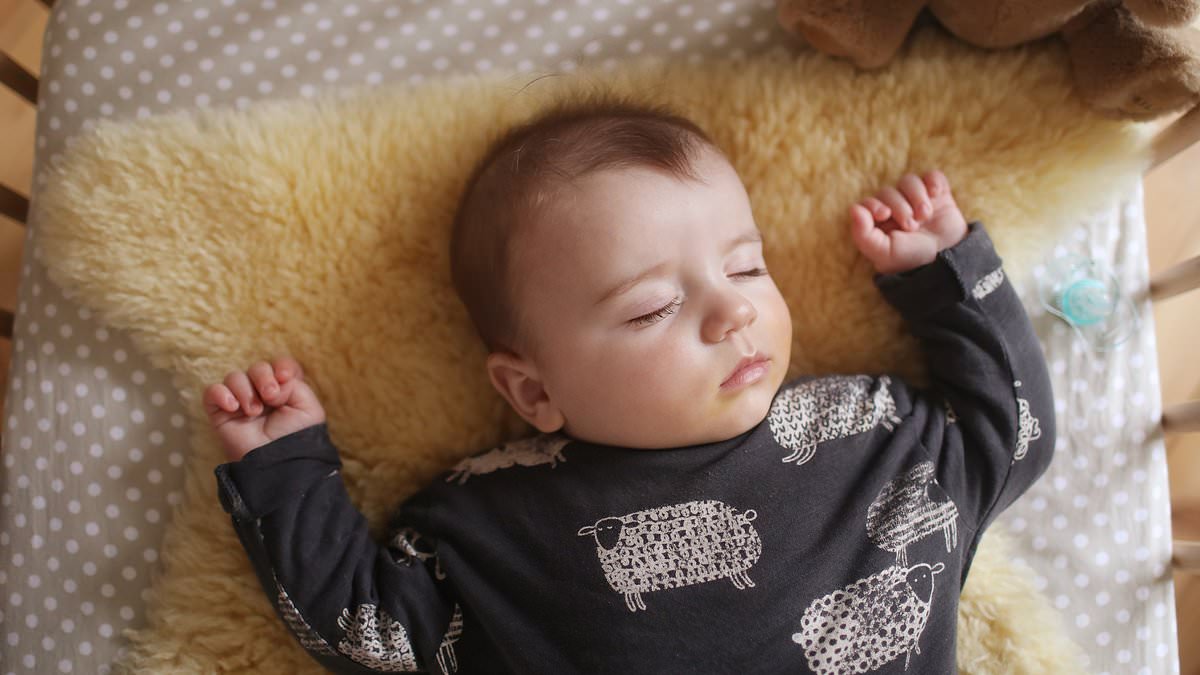
Babies who are easily startled or sensitive to sounds during the day show lighter, less restorative sleep, especially when there is background noise, suggesting their brains struggle to disconnect from the world at night (stock)
Dr Anna de Laet, the first author on the study, said in a statement: ‘These sensitivity traits don’t mean a baby will develop autism, which we can’t diagnose reliably before the age of three, but they help us study how early sensory differences might shape sleep in infancy.’
For autistic individuals, sensory processing difficulties and sleep problems often go hand in hand, and both tend to emerge in the first years of life. Understanding this link could eventually help identify autism risk earlier, potentially before other traits become apparent.
One in 31 children in the US have been diagnosed with autism spectrum disorder (ASD), and while it can be spotted as early as 18 months, most are not diagnosed until age four. Diagnosis takes time because it is based on behavior, not a lab test, and many children do not show clear signs until they get older.
Researchers recruited 44 babies, eight to 11 months old. Some of them had an older autistic sibling, placing them at a higher likelihood for autism, and some did not.
Each baby came to the University of East Anglia sleep lab for two daytime naps, once in silence, once with gentle background sounds. This allowed researchers to compare how the same baby’s brain handled sleep in different environments.
Parents settled their babies as they would at home, while the infants wore soft caps fitted with 32 electrodes that tracked their brain activity.
During the nap, speakers positioned near the baby’s head played pairs of 60 decibels (dB) pure tones, roughly the volume of a normal conversation, every 12 to 18 seconds.
The volume was deliberately set below the level that would typically wake an infant, as arousal thresholds tend to be 70 dB or higher. This allowed researchers to observe how sensitive babies’ brains responded to noise without fully disrupting sleep.
Across all babies, naps were shorter when sounds were played—averaging 50 minutes compared to 62 minutes in silence. While this happened for all infants to some degree, the effect was more pronounced in those with sensory sensitivities.
The study, published in the journal Sleep, found that even in total silence, highly sensitive babies struggle to reach deep, restorative sleep. Their brains produce fewer slow waves, or the oscillations that block out the outside world, leaving them more easily disturbed even in ideal conditions.
Even in those ideal conditions, sensitive babies showed brain activity suggesting they spend less time in truly deep, restorative sleep.
Researchers saw this by measuring slow waves in the babies’ brains. This could make these babies particularly light sleepers.
Researchers also found that sensitive babies’ brains could not maintain deep, disconnected sleep when the environment was not perfectly quiet.
When sounds played during naps, highly sensitive babies showed an even bigger drop in both slow waves and sleep spindles, the brief bursts of brain activity that act like a shield to block out noise and protect sleep.
While the babies did not wake up more often or have more micro-arousals – the split-second partial awakenings that can fragment sleep without fully rousing a baby – the noise appeared to interfere with their brain’s ability to enter those disconnected sleep states at all during the entire nap.
Sensitive babies also produced fewer K-complexes, which act as a ‘sleep-protecting’ mechanism, preventing awakening from light sleep. This means each little sound, such as a dog barking or a door closing, has more potential to disturb them.
Sensory processing differences are among the earliest and most common traits of autism. Studies estimate that up to 90 percent of autistic individuals experience some form of sensory sensitivity – being easily overwhelmed by sounds, lights, textures or touch.
Dr Teodora Gliga, a psychologist at the University of East Anglia, said: ‘Reducing noise may help particularly sensitive babies, but it’s not enough on its own. Their sleep was still shallower in quiet environments.
‘Good sleep is vital for brain development and emotional well‑being, so understanding these differences is key to providing better support for families.’
Both sensory differences and sleep difficulties emerge long before more recognizable autism traits, such as social or communication delays, become apparent. Understanding this link could help identify children who might benefit from early support, potentially before other traits even show up.