
Share this @internewscast.com
There are several reasons why you might find yourself drooling during sleep. These can range from mouth breathing and consuming food or drinks right before bed to simply being overly tired.
While it’s not uncommon to occasionally wake up to a damp pillow, medical professionals are highlighting when this might be a cause for concern and when it might be time to consult a healthcare expert.
Typically, drooling during sleep can be attributed to harmless factors. For instance, if you’re prone to breathing through your mouth, this can naturally lead to drool escaping, particularly when the mouth remains open.
Your sleeping position might also play a role. Resting on your side or stomach allows gravity to assist in drawing drool out of the mouth and onto the pillow.
Additionally, a common cold that clogs your nasal passages might compel you to breathe through your mouth, increasing mucus production and making drooling more likely.
Drooling can also result from benign medical conditions such as acid reflux or dental issues. With acid reflux, the body’s response includes producing excess saliva and mucus, which may lead to drooling overnight.
In people who grind their teeth or have misalignment, this may affect the way their mouth closes, leading to drool escaping.
While these reasons for nighttime drooling are nothing to be concerned over, there are two more serious medical conditions to consider if you’re waking up to excessive drool in the morning – especially if it has become a new habit.

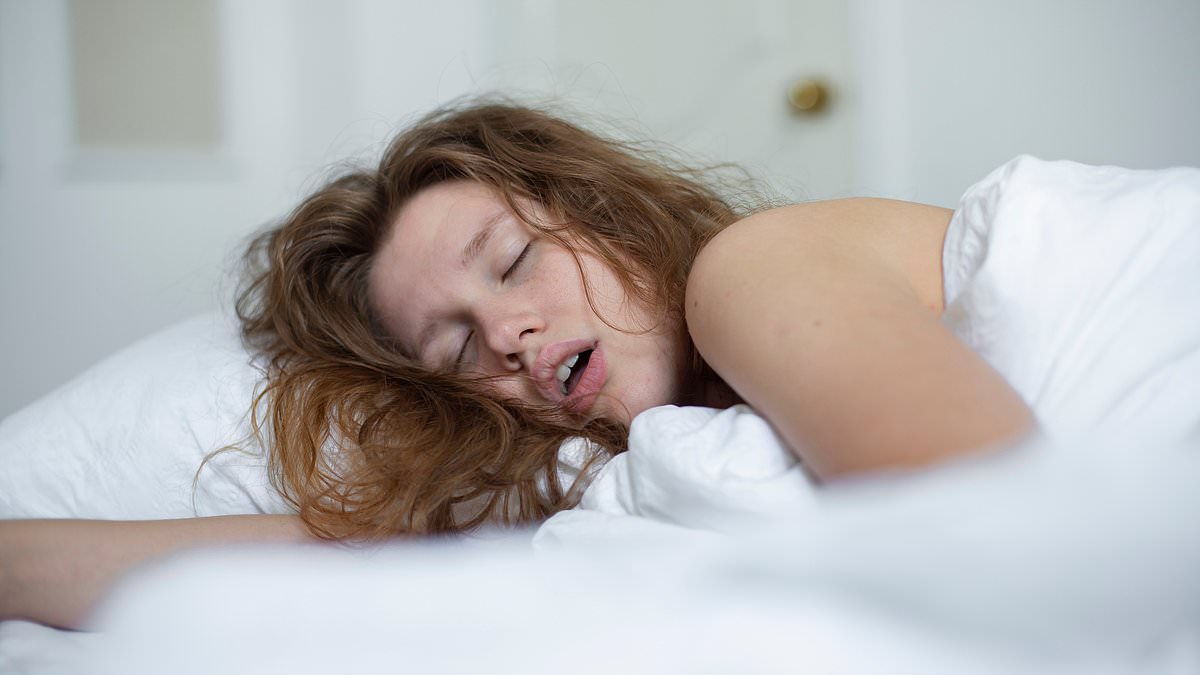
There are plenty of benign reasons you may drool in your sleep, including being a mouth breather, which allows drool to naturally escape through an open mouth (stock image)
Dr Landon Duyka, a clinical assistant professor of otolaryngology at Northwestern University in Chicago, told CNN: ‘Everyone drools at one time or another when we have too much to drink the night before or fallen asleep on the couch after a big holiday dinner.
‘If this is more of a persistent thing — you’re waking up every night and your pillow is drenched — we want you to see a doctor, especially if it’s recent.
‘It could be a sign of a more serious sleep disorder or even a neurological condition such as Parkinson’s.’
One serious sleep disorder that causes drooling is sleep apnea.
An estimated 25 to 30 million Americans have obstructive sleep apnea (OSA), a condition that causes a person to snore, stop breathing, and choke dozens of times throughout the night, making it impossible to have an uninterrupted night of sleep.
The gold-standard treatment for OSA is to wear a CPAP machine, which gently pumps air into a mask over the mouth or nose while sleeping. It prevents muscles in the back of the throat from narrowing, which constricts the airway and causes the snoring and choking.
Between 8 and 10 million Americans use a CPAP machine at night, though many people with OSA find the machines uncomfortable and difficult to get used to. Some research suggests that at least one-third of people with the dangerous condition quit their CPAP for a variety of reasons, including discomfort.

The above graph shows the increase in Parkinson’s deaths in the US by number (bars) and rate (line)
The effects of untreated OSA can be serious, leading to anxiety, daytime tiredness that increases the risk of accidents and low productivity.
OSA has also been tied to an increased likelihood of heart attack, high blood pressure and stroke.
Sleep apnea also puts a person at risk of entering a state of hypoxia, the result of insufficient oxygen levels in the blood, sometimes to dangerously low levels.
The brain wakes the sleeping person up when it happens, but repeated bouts of hypoxia can reduce focus while awake, kill brain cells and cause dizziness, headaches, impaired judgement and memory problems.
People with sleep apnea often drool because as they repeatedly stop breathing, they may resort to breathing out of their mouth instead of their nose to get more air, which allows saliva to pool and escape.
Even more concerning, Duyka said nighttime drooling may be an early warning sign of Parkinson’s disease.
He told CNN: ‘I don’t want to instill fear in everyone, but there are rare instances where someone presents with difficulty swallowing and you ask them to walk and notice they’re shuffling a little bit or their facial expressions are somewhat blunted, which can be some of the first signs of Parkinson’s or some other neurodegenerative disease.’
Parkinson’s is an incurable neurological disorder that gradually robs patients of their ability to control movement, causing tremors, stiffness and severe disability.
People with the disease experience Parkinson’s dysphagia, or swallowing difficulties. This is estimated to impact 90 percent of patients due to their weakened muscle function and coordination, which impairs their ability to swallow.
This leads to the accumulation of excess saliva and drooling.
In the US, about 1.1 million people are estimated to have been diagnosed with Parkinson’s disease, a number that is set to double by 2040.
Parkinson’s disease is caused by the loss of dopamine-producing cells in the brain, triggering irregular brain activity and the symptoms linked to the disease.
It is not clear why this happens, but previous research suggests these cells may be eliminated by the immune system misfiring. This could be caused by genetics and exposure to certain toxins or pesticides.
People at the highest risk of Parkinson’s are individuals aged over 60 years old and men, who are 50 percent more likely to develop the condition than women.
There are no treatments available to cure the disease, although doctors do have drugs available that can slow the condition’s progression.
Anyone who is concerned by their bedtime drooling should consult a sleep specialist or an ear, nose and throat doctor, known as an ENT. They can order a sleep study and other tests to determine the cause of your drooling.