
Share this @internewscast.com
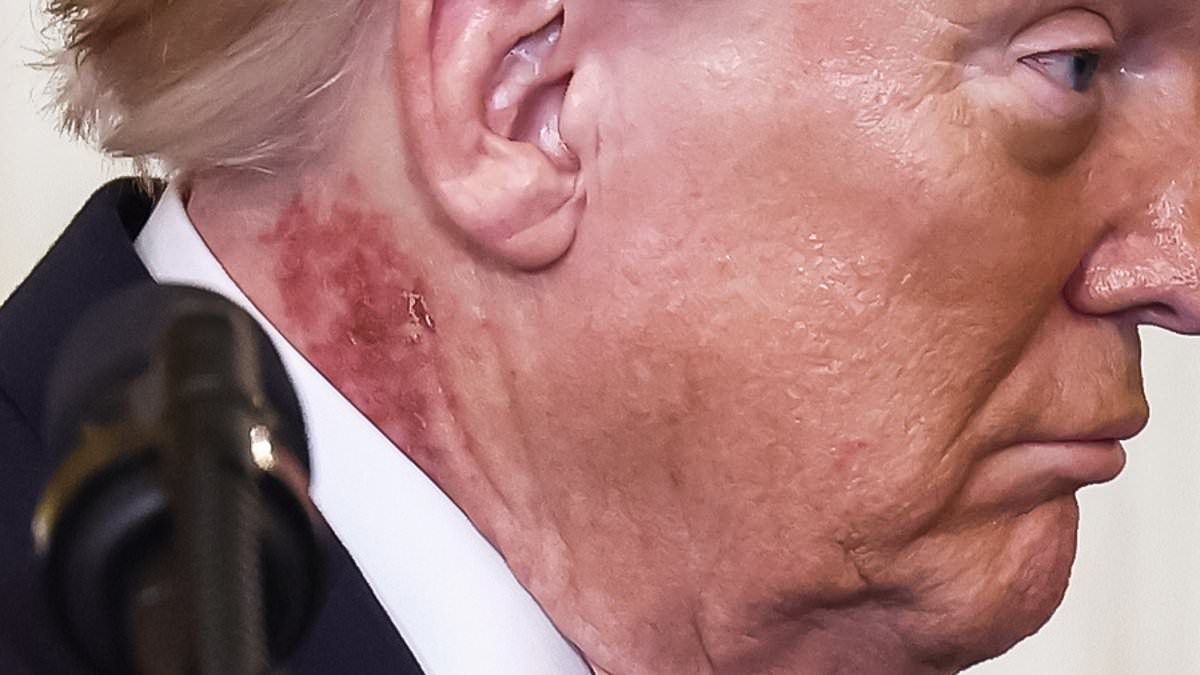
The internet has been buzzing with fervent speculation recently. On Tuesday, questions about Donald Trump’s health resurfaced when observant viewers noticed a prominent red rash on his neck.
This skin irritation became apparent during the 79-year-old US President’s update on the conflict with Iran, sparking discussions about its origins and any potential treatments he might be undergoing.
In response, Trump’s physician, Dr. Sean Barbabella, released a statement explaining that the President was applying a ‘very common cream on the right side of his neck’ as part of a ‘preventative treatment.’ Dr. Barbabella noted that the redness should fade in a few weeks.
Social media platforms quickly became a hub for various theories about Trump’s unconfirmed condition.
Some speculated that the rash could be contact dermatitis, possibly from the chemicals used in dry-cleaning his suits. Others suggested it might be rosacea, a known condition of the President’s that leads to facial redness and flushing.
Another theory circulating was that the rash’s crusty appearance might be indicative of shingles, a painful rash of blisters triggered by the chickenpox virus.

Experts are speculating that Donald Trump is suffering from actinic keratoses, an unsightly skin condition that increases the risk of skin cancer

The skin irritation was visible as he delivered an update on the war against Iran , prompting online debate about his health and what treatment he might be undergoing
But experts speaking to the Daily Mail confirmed the most likely cause of Mr Trump’s rash is a common skin ailment that will affect roughly a quarter of all adults, particularly in middle age and beyond.
Actinic keratoses – also known as solar keratoses – are dry, scaly patches of skin that tend to appear on areas frequently exposed to sunlight, such as the face, scalp, ears, neck, backs of the hands and forearms.
Caused by long-term sun exposure, the brown or pink patches often occur on the scalps of bald men or the chests of women.
According to the NHS, the condition is not usually serious. But there is a small risk that, without treatment, the patches can develop into squamous cell carcinoma, a type of skin cancer that begins in the top layer of the skin.
Dr Paul Farrant, consultant dermatologist and director at the Devonshire Clinic, told the Daily Mail: ‘This kind of red very angry rash on the right side of Mr Trump’s neck could definitely be caused by the treatment for actinic keratosis, a precancerous skin condition caused by sun damage.
‘When these creams are applied we would definitely expect long lasting redness and irritation, which looks like what’s going on underneath Trump’s collar.’
So, what can you do if you think you’re suffering from the same unsightly skin patches as Donald Trump?
First, say experts, it’s essential to rule out anything more sinister.
Not all scaly or crusty rashes will be actinic keratosis – and most brown patches on the skin are nothing to worry about, says dermatologist at Dr Ducu Clinics, Dr Anna Andrienko.
Growths that appear waxy and slightly raised, usually ranging in colour from pink to brown to almost black, are likely seborrheic keratoses, or age spots – benign growths affecting half of men and more than a third of women.
They can grow, but are harmless and don’t need treatment, but can be removed for aesthetic reasons.
However, if they appear very dark, get them checked to rule out melanoma, the most dangerous type of skin cancer.
Actinic keratosis, meanwhile, tends to present as rough, gritty patches that feel like sandpaper.
‘They may be pink, red, skin coloured or slightly brown, and commonly appear on sun exposed areas such as the face, scalp in balding men, ears, forearms and backs of the hands,’ said Dr Andrienko.
‘It’s crucial to differentiate them from other lesions, such as seborrhoeic keratoses, psoriasis, eczema or early squamous cell carcinoma, which can all look similar.
‘This can be assessed by a dermatologist who will examine the texture, border, thickness and any signs of ulceration or rapid growth.
‘In uncertain cases, a biopsy may be required to rule out invasive skin cancer.’
Those with fair skin, light eyes and hair and who burn easily rather than tan are all at higher risk for actinic keratosis, says Dr Andrienko.
The condition also becomes more prevalent with age – those over 40 are more commonly affected, as the condition can be caused by cumulative sun exposure.
Outdoor workers, frequent sunbed users, and people living in sunny climates are at higher risk, as are immunosuppressed patients, such as organ transplant recipients, research shows.
But whilst it’s common, actinic keratosis isn’t always harmless.

Skin patches you don’t need to worry about are seborrheic keratoses – benign growths affecting half of men and more than a third of women

More worrisome are actinic keratoses – also called solar keratoses – dry, scaly patches that feel rough, like sandpaper.
In up to five per cent of cases, the condition can develop into squamous cell carcinoma, the most common type of skin cancer – becoming tender, ulcerous or sore.
Luckily, says Dr Andrienko, there are a number of effective therapies that can clear up the condition before it reaches that stage – depending on its severity.
If you have just one patch of lesions, doctors may recommend a ‘wait and see’ approach, monitoring for any changes in size or quantity.
But patients with more than one patch, lesions that are painful or itchy, or more than 10 lesions in a patch, are generally recommended to seek treatment.
If the condition is in its earliest stages, made up of just isolated spots, cryotherapy – where the lesions are frozen off with liquid nitrogen – is often the best option.
The procedure takes just seconds, and must be done by a dermatologist, who applies liquid nitrogen via a spray gun or cotton-tipped applicator to the skin.
This is then left to blister, scab and shed within one to three weeks – leaving new, healthy skin.
Multiple or larger areas of crusty skin spots may require a cream treatment, however.
One of the most common, says Dr. Conal Perrett, Consultant Dermatologist at The Devonshire Clinic, is a topical chemotherapy treatment commonly prescribed for widespread sun damage called 5-fluorouracil cream.
The cream works by causing inflammation that, in turn, destroys the pre-cancerous cells that form in actinic keratosis, but leaves the underlying healthy tissue untouched.
It is usually applied daily for up to four weeks, although some patients need a second round to completely eradicate the lesion, otherwise it grows back.
It can also cause uncomfortable itching as well as weeping and red skin rashes, similar to that on President Trump’s neck.
‘During treatment, it is entirely expected for the skin to become red, inflamed, sore and sometimes crusted,’ added Dr Perrett.
‘In fact, visible redness and irritation are generally signs that the medication is working.’
A bright red, inflamed patch confined to one area, such as one side of the neck like that seen on President Trump, he went on, would be consistent with topical treatments for actinic keratosis.
Said Dr Perrett: ‘Without direct clinical assessment, it would not be possible to confirm the cause of any individual’s skin changes.
‘However, the description of preventative treatment with a commonly used topical cream, associated with short-term use and several weeks of visible redness, would be broadly consistent with standard management of actinic keratoses.’

Tirbanibulin works by stopping pre-cancerous cells from dividing and spreading on sun-damaged skin, and is applied once daily for five days
A newer cream for actinic keratosis, rolled out for use on large patches of the head and neck by the NHS in 2024, is tirbanibulin.
Like 5-fluorouracil, the cream works by stopping pre-cancerous cells from dividing and spreading on sun-damaged skin.
While just as effective as 5-fluorouracil, tirbanibulin works far more quickly – applied once daily for just five days.
Photodynamic therapy is another option for larger areas on the face or scalp, says Dr Andrienko.
The treatment involves applying a photosensitising cream to the affected area, which is then activated by either a red light lamp, or natural daylight to destroy abnormal cells.
After about two weeks, scabs form and fall off, leaving healthy skin behind.
But for everyone, says Dr Andrienko, prevention is key.
‘Daily broad spectrum SPF, protective clothing, and regular skin checks are essential to prevent actinic keratosis from developing, particularly for high risk individuals,’ she said.