
Share this @internewscast.com
Experts have sounded the alarm over the rapid retreat of Earth’s glaciers, revealing that a staggering 408 gigatonnes of ice vanished in 2025 alone.
The past year ranks as one of the most devastating in history for ice melt worldwide, largely driven by climate change and increasing global temperatures.
This exceptional annual ice loss is nearly quadruple what was measured towards the close of the 20th century, according to a recent study.
Such dramatic reductions could spell the end for many of the planet’s glaciers within just a few decades.
Dr. Levan Tielidze from Monash University, a co-author of the study, emphasized the urgent need to address this pressing issue of glacier decline.
“Glaciers serve as some of the most visible signs of climate change,” he remarked, “and we are currently observing ice loss on an unprecedented global scale.”
‘The fact that six of the most extreme loss years have all occurred within the past seven years highlights just how rapidly the system is changing.
‘These changes are not only reshaping mountain landscapes but are also contributing significantly to global sea–level rise and affecting water resources for millions of people.’

Last year, all 19 major glacier regions across the globe experienced net mass loss for the fourth consecutive year, the study revealed

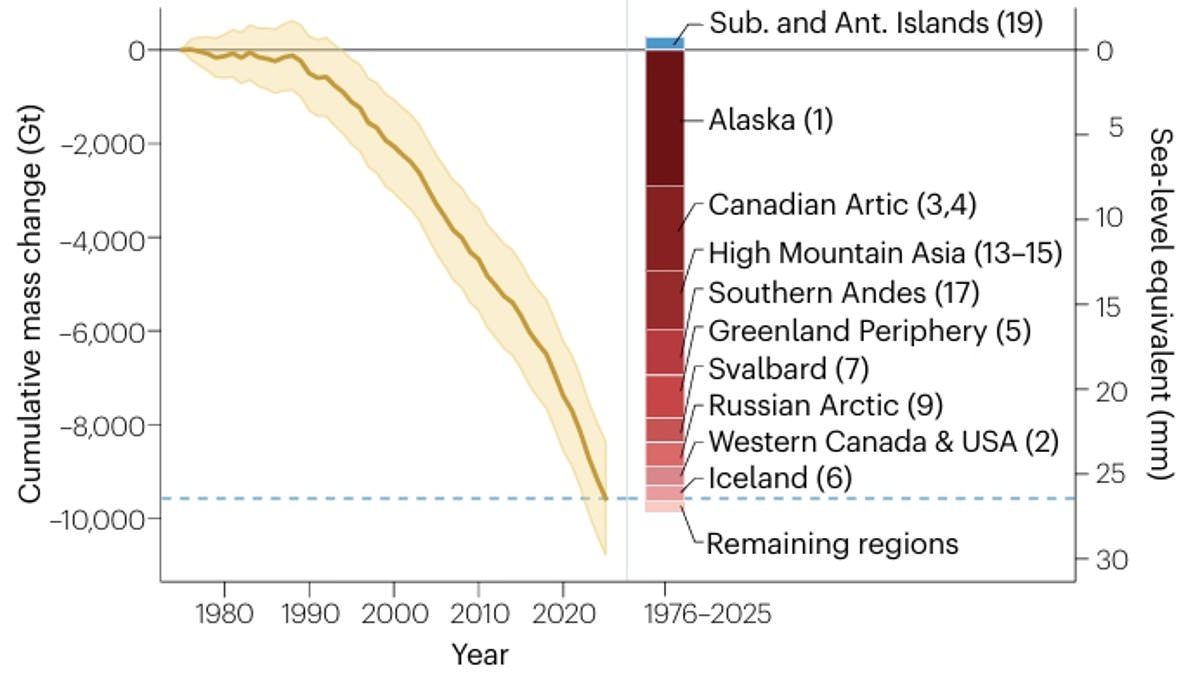
This graph shows cumulative global glacier mass change since records began in 1975, as well as the regions most affected
The research, conducted by the World Glacier Monitoring Service (WGMS) network, combined field observations and satellite data from around the world.
Last year was the fourth year in a row that all 19 major glacier regions across the globe experienced ice loss, it reveals.
The largest losses were recorded in areas including British Columbia in Canada and the Alps in Central Europe.
Other glaciers such as those in Iceland, Chile and High Mountain Asia – a region encompassing the Tibetan Plateau – also experienced significant loss.
The team warned increasing ice melt can have cascading impacts on sea level, ecosystems and the availability of fresh water.
Over the longer term, glaciers have lost nearly 10,000 gigatonnes of ice since 1975, with nearly 80 per cent of that melt occurring since the turn of the millennium.
This is the equivalent of 2.64cm (0.4 inches) of sea–level rise.
Dr Tielidze warned the findings, published in Nature Reviews Earth & Environment, highlight the importance of limiting future warming.

Global glacier mass change for 1976−2025. The blue bars represent an increase in ice while the red show years with ice loss. A total of 408 gigatonnes of ice were lost in 2025

The largest losses were recorded in areas including the Alps in Central Europe. Pictured: The Monteratsch Glacier in Switzerland
‘Even if global temperatures stabilise today, a substantial proportion of glacier mass is already committed to melting,’ he said.
‘However, every fraction of a degree matters, reducing warming will directly reduce future glacier loss and its impacts.’
The paper concludes: ‘The exceptionally high mass–loss rates of the past decade, relative to the remaining mass, suggest that many individual glaciers will soon vanish and that entire regions will lose their glacier cover within a few decades.’
The study focused on glaciers and did not include data from the continental ice sheets in Greenland and Antarctica.
The largest mass gain of glacial ice was in 1983, with the addition of 115 gigatonnes. This coincided with much colder weather across parts of the world.
Meanwhile the largest mass loss was recorded in 2023 – one of the warmest years on record – when 555 gigatonnes of ice melted.
Last month, a separate study warned that Antarctica’s Doomsday Glacier – which was not included in this study – could ‘snowball’ towards collapse as the ice is melting faster than expected.
Scientists from the University of Edinburgh predict that the glacier – whose official name is Thwaites – could shed 200 gigatonnes of ice every single year by 2067.
That is more than the current ice loss of the entire Antarctic Ice Sheet, which has been losing 150 gigatonnes of ice per year for the last two decades.
Worryingly, the ice loss would add an extra 0.5mm of sea level rise per year, outpacing the contribution of all the world’s mountain glaciers.
The Doomsday Glacier is a slow–moving river of ice about the size of the UK that contains enough fresh water to raise sea levels by a whopping 65 centimetres .
While the researchers don’t believe that total collapse is imminent, lead author Dr Daniel Goldberg says that the glacier is now accelerating towards disaster.
He told the Daily Mail: ‘That rate of 200 gigatonnes per year could then increase quite quickly, and that instability could lead to collapse.
‘That would be catastrophic for hundreds of millions, if not billions, of people in coastal cities around the world.’