Share this @internewscast.com
An NHS official’s recent remarks suggesting that individuals exhibiting flu symptoms should “wear” a face mask in public have sparked concerns among health experts, who fear these comments may create “confusion” regarding official health guidelines on combating the virus.
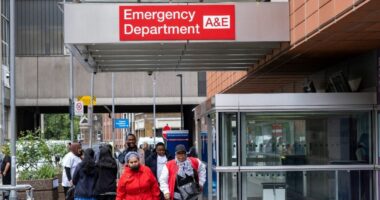
Currently, the number of flu-related hospitalizations in England has reached an unprecedented level for this period of the year. In response to a significant uptick in flu cases sweeping across the UK, at least six hospitals have advised patients to avoid visiting unless necessary.
On Tuesday, Daniel Elkeles, CEO of NHS Providers, stated that individuals who are coughing and sneezing, yet not too ill to refrain from work, “must wear a mask” in public spaces, including on public transport. These comments garnered significant media attention.
However, health experts have expressed concerns to the Guardian, suggesting Elkeles’ statement might lead to a loss of trust in the guidance provided by official entities like the UK Health Security Agency (UKHSA), which advises people to “consider” wearing masks under similar circumstances.
“One critical lesson from the Covid pandemic is the necessity for health authorities and governments to deliver messages that are clear and consistent,” said Simon Williams, a public health researcher and behavioral scientist at Swansea University.
“When the public is presented with conflicting, ambiguous, or mixed health advice, such as the circumstances under which masks should be worn, it can lead to confusion and potentially weaken the intended messages,” Williams added.
Williams added this could also prompt “alert fatigue”, where the public “ultimately get confused by, or switched off from health advisories”. Another risk is that the difference in language could be used by those spreading misinformation online “to make false statements”.
Ultimately, wearing a mask in indoor crowded spaces was “a good idea” when cases of flu were high and rising – “particularly if you yourself have symptoms of the flu”, Williams said. But detail in health advice from officials still mattered, he added.
“There is a big difference between saying that people ‘must’ wear masks and [that] they are ‘recommended’ to wear them.”
Paul Hunter, a professor of medicine at the University of East Anglia, voiced similar concerns. “In public health … one of the biggest problems with miscommunication is if experts disagree. So if you’ve got people arguing different things, that undermines the message, whatever it is.”
He added: “If people who are allegedly representing the consensus view, or are perceived by others to be part of that official view, then giving advice which conflicts actually undermines the advice full stop.
“It always causes confusion. It’s not just me saying that – there’s research to support that going back decades.”
Hunter said mixed messaging on masks also risked creating confusion over vaccines.
“It undermines not only that advice [on flu and masks] but more general advice. You know … ‘If the experts can’t agree about whether or not we have to wear masks, what about their advice on vaccines?’”
NHS Providers is a trade body that represents the 204 health trusts in England and speaks for the senior managers who run them, but is not part of the health service itself.
Last week Dr Jamie Lopez Bernal, a consultant epidemiologist at UKHSA, said if someone had flu-like symptoms and needed to go out while unwell, they could “consider wearing a face mask”.
Asked about Elkeles’s remarks yesterday, No 10 said there were different measures people “can consider taking to help limit the spread of winter bugs if they have flu-like symptoms.” That was “neither new nor an instruction, but simply something people can consider when trying to limit the spread of winter respiratory illnesses”.
When asked if they endorsed Elkeles’s view that those with flu symptoms “must wear” a face mask, other NHS and health organisations distanced themselves.
Rory Deighton, the director of acute care at the NHS Confederation, which also represents trusts, and with which NHS Providers is merging next year, pointed to the UKHSA’s advice, saying: “There are a range of sensible measures that people can take to help to reduce the spread of flu, including getting vaccinated I they are eligible and either staying at home if they feel unwell or wearing a mask if they have to go outdoors.”
Prof Mumtaz Patel, the president of the Royal College of Physicians, did not offer a view on masks and instead urged people, including NHS staff, to get vaccinated against flu.
More and more hospitals are asking staff, patients and visitors to wear a mask in at least some wards to combat flu.
“Some hospitals have introduced mask wearing on certain wards, such as A&E, intensive care units, oncology and renal dialysis services where the risk is higher,” Deighton said. “As rates of flu continue to rise, we expect this to continue.”