
Share this @internewscast.com
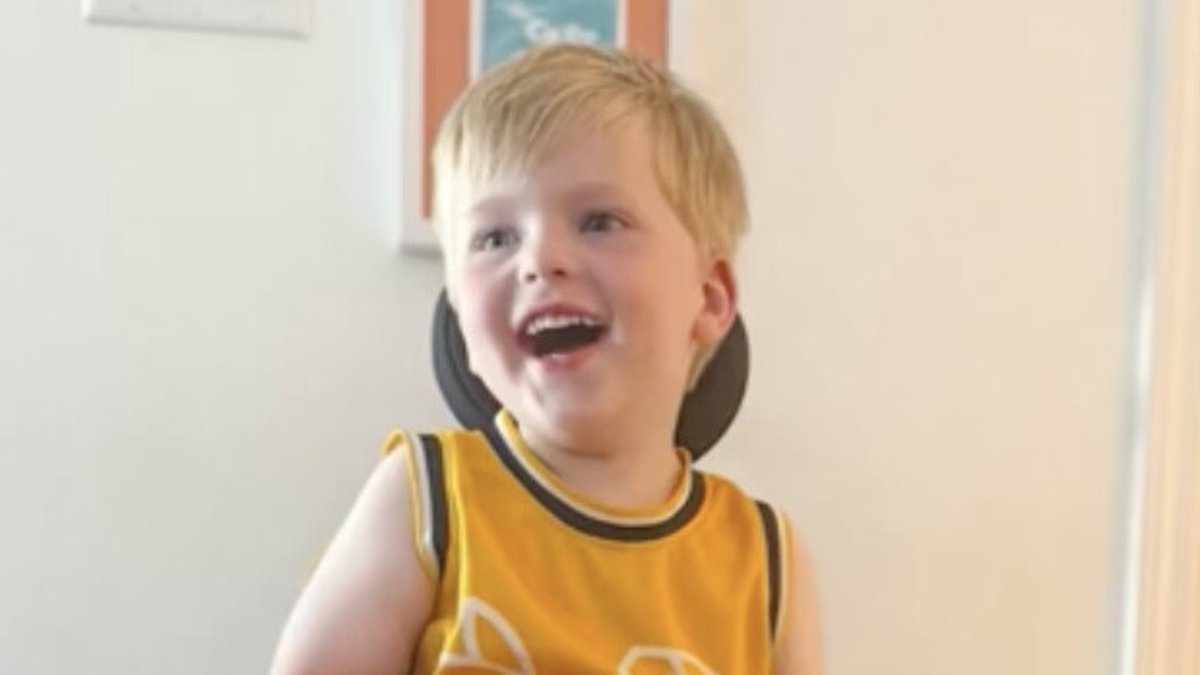
A young boy’s life took a dramatic turn when he lost his ability to walk and speak after contracting the flu, which triggered a rare and severe brain disorder.
At just four years old, Beckett Wear from Chicago faced a challenging battle with acute necrotizing encephalopathy (ANE) in February 2025. This condition causes brain inflammation due to the body’s intense inflammatory response to viral infections.
This was not Beckett’s first encounter with such a rare complication; it was his second episode.
Christine Wear, Beckett’s mother and a former educator, expressed her anguish, stating, “Nothing can prepare you for the sight of your child so ill and the uncertainty of the situation.”
Beckett first experienced ANE at the age of two in 2022, shortly after contracting an unknown virus near his birthday.
Medical professionals later discovered that Beckett carries a genetic mutation, heightening his susceptibility to ANE. This condition can lead to a range of serious issues, including loss of consciousness, seizures, brain damage, swelling, impaired movement, respiratory difficulties, and liver complications.
After a long recovery, he began to hit his neurological milestones on schedule again. Then, in early 2025, Beckett came down with the flu, which has hit the country earlier than usual this season and led to one of the worst flu outbreaks in two decades.
His case of ANE last year was worse than the first bout he battled at two. The influenza virus itself does not get into the brain and cause dangerous swelling. ANE is is caused by the inflammatory storm triggered by the body’s immune response to the invading pathogen.
‘It was utterly heartbreaking to see him in the hospital,’ his mother said. ‘Beckett was surrounded by machines, tubes, and monitors. He couldn’t communicate, move or eat normally.’

Four-year-old Beckett Ware developed acute necrotizing encephalopathy (ANE), a severe brain inflammation triggered by the flu

Beckett was hospitalized for nine weeks. As the brain swelling subsided, he began in-patient rehabilitation. At the start of this therapy, he was unable to move most of his body or feed himself
There were 109 deaths due to flu-caused ANE in the 2024-2025 flu season. The CDC has not published ANE data for the 2025-2026 season yet.
At least 10,000 Americans have died from the flu since the start of the season last October, including 44 children.
ANE is a generally rare complication, but it kills up to 41 percent of people who get it.
Influenza-associated encephalopathy (IAE), a broad term for serious neurological complications from the flu, was present in nine percent of American children hospitalized with the flu.
This means nearly 1 in 10 children with severe flu faced a significant brain-related issue.
Within this group of IAE cases, approximately 20 percent were diagnosed with ANE.
Treatment for ANE is aggressive and focuses on two main goals: fighting the brain inflammation and supporting the body’s vital functions.
Patients are treated in intensive care, where they often receive high-dose steroids and other immune-modulating drugs to calm the immune system’s overreaction. Antiviral medication such as Tamiflu targets the initial flu infection.

Beckett also had speech therapy to regain the ability to eat and speak. This involved exercises to strengthen his mouth and throat for safe swallowing, and to improve his breath control and articulation for forming words

As part of his therapy, Beckett received a treatment called electrical stimulation. This technique uses a device to send gentle electrical pulses through his skin to stimulate the nerves and muscles in his arms and reactivate the damaged communication pathways between his brain and limbs
Doctors also work to control dangerous brain swelling and support organs like the liver and heart.
There is no guaranteed cure, so this critical care is essential to help patients survive.
Wear said: ‘Shortly after we learned he had the flu, we brought him to the hospital and consulted his neurologists right away.
‘When Beckett gets sick, he often struggles to stay hydrated, so the plan was to admit him and monitor him closely.
‘As the night went on, he began yelling that his head hurt. By morning, it was clear he wasn’t himself. He was confused, less responsive, and we could tell the inflammation was starting again.’
Beckett was intubated, unable to breathe for himself, and ‘fighting for his life.’
He remained in the hospital for nine weeks, during which time the swelling went down and he began doing rehabilitation sessions in the hospital. When he first started rehab, he could not move most of his body or eat by himself.
Wear said: ‘The first few weeks were really hard on him, and he cried through most sessions.’

Since last October, influenza has claimed at least 10,000 lives in the United States, 44 of whom were children
He underwent electrical stimulation in his brain to re-engage nerve signals. This involves using a device to send mild electrical pulses through the skin to Beckett’s muscles and nerves in his arms.
The purpose is to wake up the neural pathways between his brain and his damaged arms.
The electricity causes his muscles to contract, which helps maintain muscle tone, prevents atrophy, and, most importantly, retrains his brain to re-establish control over movement.
He also underwent speech therapy to help him re-learn to eat and speak. This includes exercises to strengthen and coordinate the muscles of his mouth, tongue and throat, allowing Beckett to safely chew and swallow food without choking.
And he did exercises to improve his breath control, helping him form clear sounds and vocal strength, allowing him to eventually say a few words.
Nearly a year later, Beckett is able to walk and run without a mobility aid. He is still in rehab and is set to ‘graduate’ in March.
Wear said: ‘It has been heartbreaking and humbling to watch. Things you never think twice about – holding a spoon, taking a step, saying a word – became monumental victories, and this boy has done it three times.’
‘We’ve seen Beckett recover, work unbelievably hard in therapy, and reclaim his life more than once – that resilience gives us courage.’

Recent CDC data reveals a divergence in flu activity: while hospital admissions for adults have decreased, children and adolescents aged 5 to 17 are visiting emergency departments more frequently
Now, the family is always on high alert for potentially fatal pathogens, including the flu, which is tearing across the US.
This year’s severe flu season is driven by a strain that the human body has never seen before, H3N2 subclade K.
Hospitalizations due to the flu have reached levels that threaten to overwhelm hospitals, with more than 250,000 patients admitted since the fall.
The latest CDC data points to a decline in hospitalizations in adults, but children five to 17 are still going to the emergency department at a rising rate, accounting for about seven percent of hospitalizations the week ending January 10 to 8.2 percent the week ending January 17.
Wear said: ‘Things like the flu or common viral infections are frightening now in a way they never were before.
‘For most families, they’re inconveniences. For us, they carry real risk.’
There is significant focus on how well the current flu vaccine works against the new, highly virulent strain.
While the 2025–26 vaccine is designed for the older J.2 lineage and differs from the emerging K subclade, real-world data show it still provides meaningful protection.
Early reports from the UK indicate that vaccination prevented emergency room visits or hospitalization in 70 to 75 percent of infected children and 30 to 40 percent of infected adults. Even without a perfect match, the vaccine remains effective at reducing severe illness.