
Share this @internewscast.com
James Fairview cherished his lush, shoulder-length curls, which he meticulously styled and believed gave him a certain charm with the ladies.
So, when a hairdresser predicted that he would lose all his hair within five years at the young age of 24, James couldn’t help but laugh it off.
However, just a year later, he began noticing coin-sized bald spots appearing around his crown, and his hairline had receded by two inches. After another couple of years, only a few wispy strands remained on his head.
Determined to reverse his hair loss, the 6-foot-tall film director from New York tried everything. He slathered castor oil on his scalp, despite its motor oil-like smell, and consumed handfuls of vitamins. He even made tiny incisions in his bald patches, hoping to stimulate growth. He experimented with black hair fibers that would streak down his neck when he perspired and resorted to wearing baseball caps with suits.
Fairview, however, stayed away from finasteride and minoxidil—medications known to potentially slow hair loss—because he had seen a friend lose almost all his hair after discontinuing their use.
By his late 20s, he resorted to gathering loose wig pieces from film sets and secretly gluing them to his own scalp, carefully avoiding taller individuals who might notice. At 30, he decided to shave his head, but felt it gave him the appearance of a “convict.”
‘Certain guys can pull it off, this look,’ Fairview, now 48, told the Daily Mail. ‘But, for me, it just never quite worked. I always need a little wisp of something to feel myself.’
He said most people agreed, and told him that he ‘looked better with hair.’


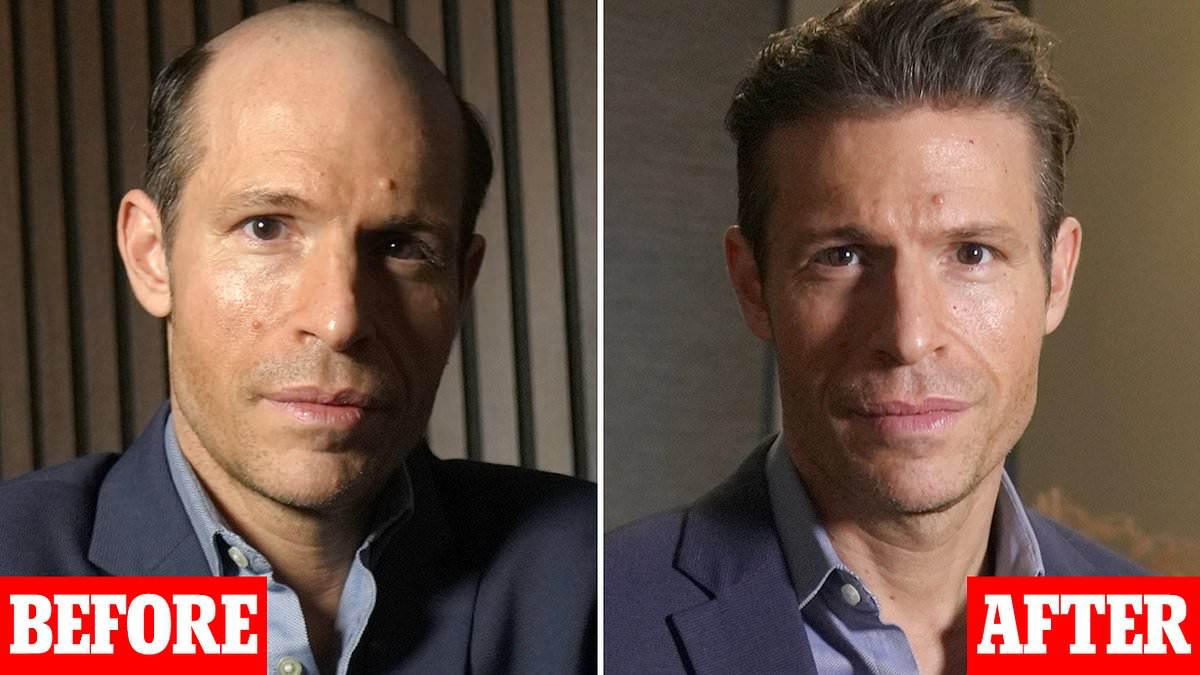
James Fairview, 48, is pictured above with and without the hair prosthesis he developed that blends seamlessly with his natural hair
Fairview was reluctant to opt for a hair transplant – which he said could leave scars or was pointless because the hair would fall out later anyway
Instead he decided to try a ‘hair system,’ where human hair that aims to mimic the lost locks is attached to the scalp using glue.
His first attempt was a disaster.
He said it didn’t match his natural hair and, at Thanksgiving dinner with his then-girlfriend’s family, clumps started to come away in his hands.
It was this embarrassing moment that sparked the idea of making his own, better version.
Fairview founded his own company, Sly Hair, that designs hair prostheses for clients that aim to blend with the clients’ natural hair and be less noticeable.
Fairview’s hair systems cost $1,000 upfront and then $600 to $700 a month thereafter for maintenance.
Each is individually made to match the color, texture, density, thickness and even parting of his client’s original hair.
He told the Daily Mail: ‘It blends perfectly 100 percent of the time. That’s always what we aim to do, make sure no one knows it’s there.’
Fairview called his system a prosthesis because it replaces a lost part of the body, as opposed to a wig that covers the whole head or a toupee that rests on top.
The prosthesis, he said, is glued onto the scalp and cut to ‘fully integrate’, or blend perfectly, with the surrounding hair.
After his lightbulb moment in 2012, Fairview – who also has a background in makeup and film – got to work ordering dozens of hair systems which he chopped up as he started preparing his own.
His mother was his sharpest critic throughout the design process, saying no to some and wincing at others. After two years of trying, he came in wearing one that caused her to gasp and say, ‘Wow, you’re really onto something there.’


Erik Flores, 35, is shown above before and after having his hair prosthesis applied
Others began noticing too, and in 2016 Fairview designed his first hair prosthesis for a friend. Next, he put an advertisement on Facebook, and was inundated with inquiries from men – and some women – seeking solutions to their hair loss.
About two-thirds of men have noticeable hair loss by 35 years old, and 85 percent have significant hair thinning by age 50, according to the American Hair Loss Association. For women, more than half experience noticeable hair loss during their lifetimes.
The loss is caused by fluctuations in hormones, genetics or lifestyle factors such as stress that cause hair follicles to become ‘dormant’ or ‘switch off.’
There is a whole industry built around fighting this.
Americans spend an estimated $3.5billion every year on supplements, surgeries and drugs that doctors say can slow hair loss.
Options include finasteride and minoxidil, which work by blocking hormones that cause hair loss or boosting blood flow to hair follicles to stimulate growth – but these have side effects including low libido, erectile dysfunction and triggering unwanted hair growth in other places.
People suffering from hair loss may also have a follicular unit extraction (FUE). This is where hair follicles are removed from the back of the head and placed into the front. But doctors warn this can cause scarring and the follicles may fall out later. In some cases, the hair behind the transplanted follicles falls out, requiring more surgeries.
But Fairview said he found a method that is cheaper, does not require a surgeon and, crucially, works in many cases.
The prosthesis uses hair donated from living humans that is then mounted into a plastic similar to cling film, with holes to help the underlying skin breathe.


Fairview also shared these pictures. He works to ensure the prosthesis matches the texture and density of someone’s hair


Zach Bruns, 57, from New York City, is shown above before and after the hair prosthesis was applied
It is attached to the head using glue that sticks to the skin, and the newer hair is then cut to blend seamlessly with what’s still there naturally.
Fairview works hard to ensure the third-party hair is matched to the natural hair on the clients’ head. He sources it from someone of the same ethnicity and takes care to make sure it even falls in the same way as his client’s.
He said he has not seen any allergic reactions to the glue so far, adding that clients tell him the result feels lightweight compared to other products such as a toupee.
The hair prosthesis can be worn anywhere, including in the shower, on a run or in any warm or cold climate.
But clients need to visit Fairview every two to three weeks to have it removed, cleaned and replaced. At each cleaning, Fairview removes the glue and shaves down any hairs that may have grown under the prosthetic. He warned that leaving it on too long could result in red, irritated patches on the skin or in-grown hairs.
Among his clients is New York City-based Erik Flores, 35, who started using the prosthesis about three to four years ago.
Flores began to lose the hair in the crown of his head in graduate school and, in a few years, had lost most of the hair on his scalp. Before opting for a prosthesis, he tried shampoos, vitamins and even rubbed coconut oil into his head to prevent hair loss all without success.

Shown above is a hair prosthesis before it is applied to a client’s scalp
‘I am very, very happy with the prosthesis,’ he told the Daily Mail. ‘It boosts my appearance and has made me feel more confident.
‘I have gotten friends who have complimented me on my hair [and] people have complimented me on my appearance, which has helped me feel much better about myself.’
It cost Flores $1,000 to have it fitted, and he has continued to pay for monthly upkeep, seeing Fairview about once every two to three weeks.