
Share this @internewscast.com
Allison Dashow says people often tell her to play the lottery, and after being diagnosed with a six in 1 million cancer, she agrees.
A native of New York City, the woman didn’t think much of the occasional pain she experienced in her left eye starting in April 2022, as she was accustomed to the sensation of dry eyes.
‘I just thought, probably nothing serious. It’ll probably go away,’ Dashow, 29, told the Daily Mail.
By the time two months had passed, the 26-year-old had completed her doctorate in psychology. In conversation with her therapist, she casually brought up the eye pain, prompting her therapist to advise a medical consultation.
‘My therapist said, “It’s your eye. You should take that seriously.” It was almost ironic because I’ve always been diligent about my health. I attend appointments and prioritize my well-being.
I do what I can, but this was the one time I wasn’t giving it the attention it deserved. Probably because the discomfort was so sporadic and mild.’
When she contacted her optometrist for the next available appointment, they urged her to visit immediately after she described her symptoms. Though her doctor remarked that everything appeared normal, he noticed fluid accumulation behind the retina and referred her to a specialist.
Dashow told the Daily Mail that the retina doctor performed several scans of her eye, including an ultrasound.

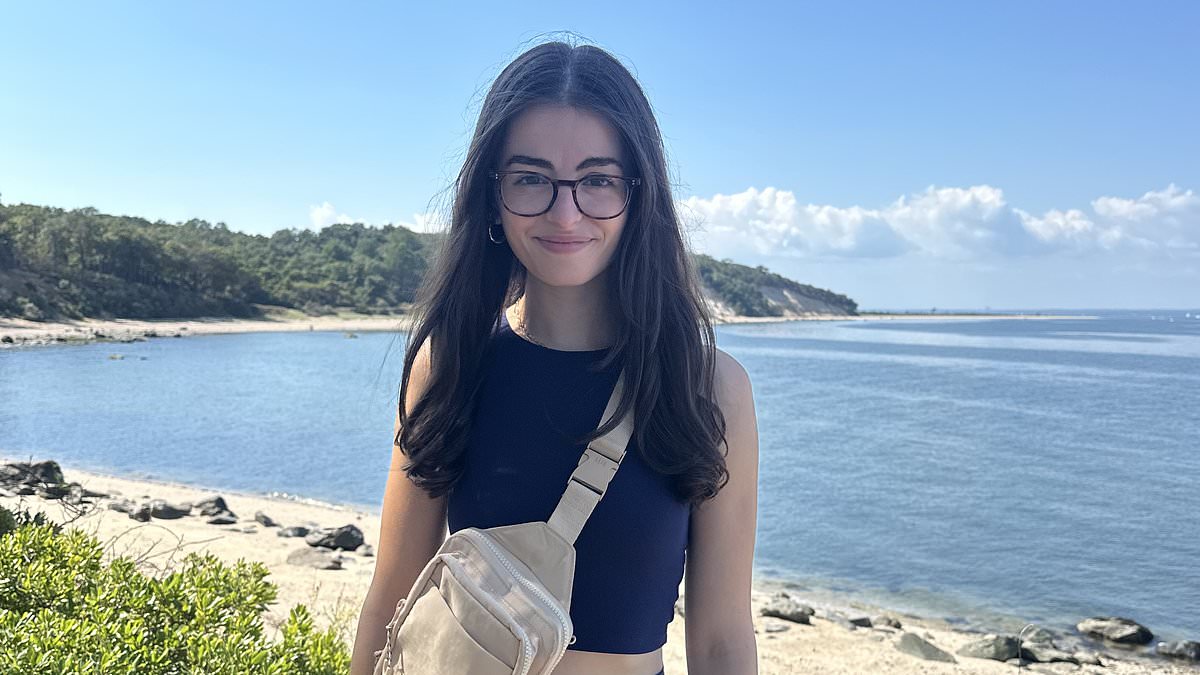
Allison Dashow, pictured above in 2025, was diagnosed with a rare eye cancer three years ago at 26 years old

Pictured: Dashow prior to her treatment for ocular melanoma, which involved a surgical procedure to place a radioactive plaque at the back of her affected eye.
‘The doctor came in, he took a couple looks at my scans, and he said, “This is very interesting. I want to bring in my colleague.”
‘So at that point, I thought: “Oh gosh, I don’t want to be an interesting patient.” So the colleague came in, and they were just grilling me with a bunch of questions about family history and symptoms.
‘And they ended up saying, “The good news is it’s not eye cancer.” And I was like, “Great; I didn’t even know that was something we were considering, but I’m glad to know it isn’t.”‘
Dashow was initially diagnosed with choroidal neovascularization (CNV), a condition in which abnormal blood vessels grow in the choroid – the layer of tissue underneath the retina. This can damage the retina and lead to vision loss.
CNV is typically caused by old age, degeneration of the eye, nearsightedness, complications from diabetes or other retinal diseases – none of which Dashow had.
The doctors recommended injectable treatments be started right away, but Dashow sought a second opinion.
A week later, she underwent more scans with a new doctor.

Pictured: Dashow, now 29, after her surgery with a covering over the affected eye – she wore it for seven days
Ocular melanoma, a type of eye cancer, is one of the only cancers that can be diagnosed without a traditional biopsy. Based on the scans, her new doctor diagnosed her with the disease – specifically, choroidal melanoma.
‘That was obviously a huge shock because I didn’t go into that appointment expecting to hear that,’ Dashow said.
There are about 2,000 new cases of ocular melanoma every year, according to the Melanoma Research Foundation (MRF).
It is an extremely rare cancer, affecting six in one million Americans annually, but the second-most diagnosed form of melanoma. Melanoma of the skin is the most common, with about one case in every 50 Americans annually.
Like skin cancer, the eye variety begins in the melanocytes – cells that produce the pigment that colors the skin, hair and eyes, and also form moles.

Dr Tate Kirk (pictured) is being honored at this year’s MRF gala, receiving the Cure OM Vision of Hope Award
Dashow’s specific type of ocular melanoma, choroidal melanoma, begins in the layer of blood vessels – the choroid – beneath the retina.
It is the most common type of ocular melanoma, according to the Melanoma Research Foundation (MRF).
Still, Dr Tate Kirk, an interventional radiologist who works with ocular melanoma patients, told the Daily Mail that many people have never heard of it.
‘Everybody has heard of skin cancer melanoma, but ocular melanoma is very, very rare… and the cause is not very well known or understood,’ Kirk said.
He explained that the disease is known to more likely be diagnosed in fair-skinned, blue-eyed people. Dashow has a fair complexion but does not have blue eyes.
While sun exposure is a commonly known cause of melanoma of the skin, the role it plays in ocular melanoma is unknown.
After her diagnosis, Dashow’s doctor recommended a laser treatment plan. But again, she sought a second opinion.
‘I did some research,’ Dashow said. ‘I saw just how fatal this cancer can be if it spreads.’
Kirk told the Daily Mail that the cancer spreads in about half of ocular melanoma patients. A 2009 study found the spread typically happens within 10 to 15 years of diagnosis.
Most often, the cancer travels to the liver where it becomes difficult to treat.
‘That’s the worst thing that happens and the thing that leads eventually to demise,’ he said. ‘You get metastatic disease in your liver and it grows – it’s difficult to treat.’
While there are no definitive cures for ocular melanoma, patients can be treated with a specialized laser therapy or plaque brachytherapy. These treatments kill the tumor and while doctors don’t declare patients ‘cured,’ they are considered to be what is called NED, no evidence of disease.
Dashow decided to look into treatment options herself.
‘This is a very serious cancer, and when I was diagnosed, I really didn’t understand the severity of it and what this meant for my life moving forward,’ she said.
‘And so then I listened to Dr Paul Finger’s podcast. He’s an ocular oncologist in New York City, and he does not recommend that laser treatment because it doesn’t get all the margins of the cells, and there’s a higher rate of recurrence.’
She went to Finger for a second opinion regarding treatment, and ended up getting plaque brachytherapy instead on June 30, 2022.

Dashow (right) with her medical oncologist Dr Richard Carvajal (left) at the 2023 MRF gala
Plaque brachytherapy has been used since 1915 and became the standard treatment for ocular melanoma in the ’90s. The treatment consists of sewing a radioactive plaque into the back of the cancerous eye for seven days to kill the disease. Patients are considered radioactive and must social distance, but the treatment yields a lower rate of spread and recurrence.
At the end of the week, the plaque is removed and the tumor is considered dead.
About six months after Dashow’s plaque was removed, her oncologist declared her tumor was dead. She continues to be considered NED, and sees Dr Richard Carvajal for checkups.
However, in 2023, she developed radiation retinopathy, which occurs in 50 percent of patients who receive plaque brachytherapy. It is a slow progressive eye disease in which blood vessels in the retina become damaged from radiation therapy. It can eventually lead to other diseases of the eye like glaucoma, cataracts and blindness.
There is no cure for radiation retinopathy, but Dashow undergoes injections every five weeks in her left eye to slow the progression and preserve her vision.
Now, three years after her diagnosis, Dashow is working to raise awareness for the rare cancer. She is this year’s recipient of the Melanoma Research Foundation’s Courage Award, which she will receive at the foundation’s annual gala later this month.
Dashow first became involved with MRF when she began working to raise awareness of ocular melanoma, and credits the organization with helping her find a ‘community’ of other patients.
‘It’s such an incredible organization… and without them, I don’t know if I ever would have met anyone with this cancer because it is so rare, and it’s really helped me sort of find a community,’ she said.
‘There’s just something really special about it. and I feel so much gratitude for the MRF.’
Kirk is also being honored at this year’s gala, receiving the CURE OM Vision of Hope Award for his groundbreaking work with ocular melanoma patients who have had their disease spread to the liver.
Dashow told Daily Mail about how her diagnosis has impacted her: ‘I try and remind myself that I have this awful thing that I was diagnosed with, and there’s a lot of uncertainty and fear as to what will happen.
‘And at the same time, I have an incredible life and family and friends and job.
‘So I think I really just try to not ignore the bad. Unfortunately, these were the cards I’ve been dealt, and I can suffer and be mad at the world and be bitter, or I can accept sort of what’s happened, and try to just live my life day to day.
‘So I do think it’s helped me be more present in the moment in my life… and a little bit more level-headed. That’s the silver lining.’