
Share this @internewscast.com
As my husband, Martin, locked the house, I settled into the car, bracing myself for the 200-mile drive ahead.
We were using his newly purchased BMW iX40 for our journey from Manchester to London. You’d expect him to be the one driving, given his excitement over his latest acquisition.
However, Martin reluctantly took the passenger seat, knowing all too well that the only way I’d agree to travel in his car was if I was the one at the wheel.
Martin is among the 473,000 drivers who embraced the electric vehicle (EV) movement last year.
On the other hand, I am part of the 30 percent of individuals who experience severe motion sickness when traveling in such vehicles.
“There’s a growing body of anecdotal evidence and emerging research indicating that EVs might provoke motion sickness more often than conventional cars,” explains Dr. Stefano Longo from the Advanced Vehicle Engineering Centre at Cranfield University.
‘The issue doesn’t appear limited to specific models, but rather relates to characteristics common across many EVs.’ More of which later.
But the irony is palpable. For it seems that the very factors which define these cars as cutting-edge engineering – cathedral-like silence and sophisticated automation – are the very things that make people like me feel sick.

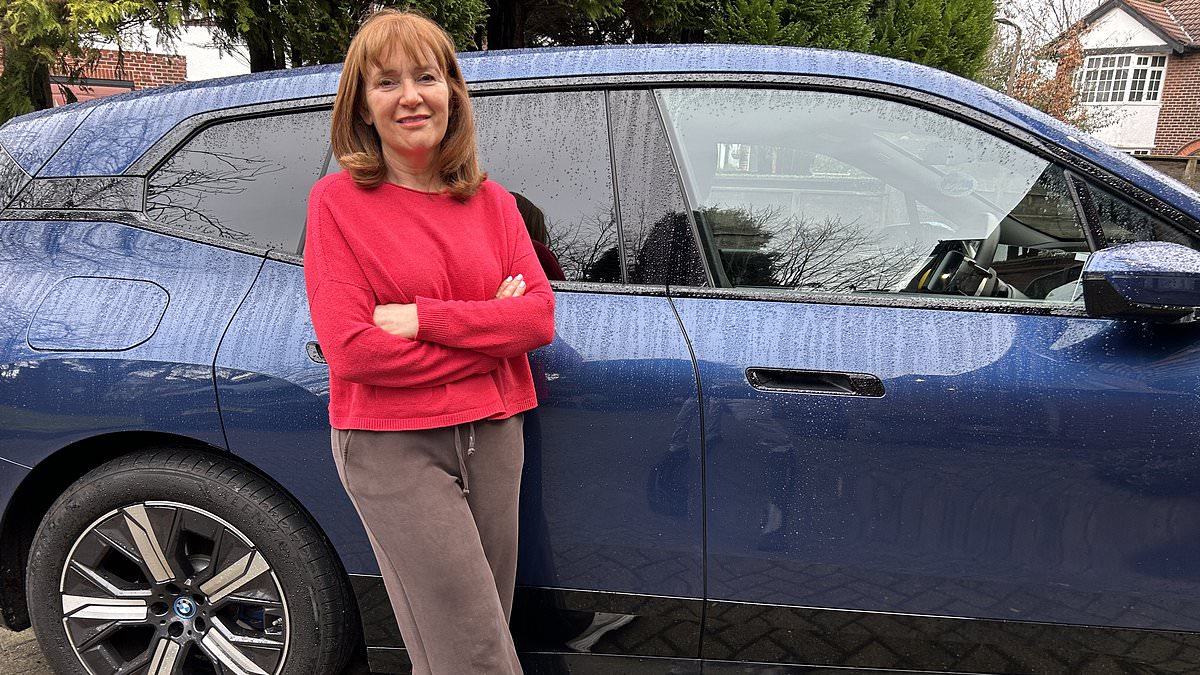
Angela Epstein with her husband’s electric BMW iX40, which makes her feel ill
Travel sickness generally is caused by a mismatch between signals received by the brain from our eyes and ears, as Dr Anil Joshi, an ear, nose and throat surgeon at Lewisham and Greenwich NHS Trust, explains.
‘There are little canals inside our ears which aid our balance [by detecting movement]. But when our brain receives movement information from these canals that contradicts what our eyes are seeing, for instance, it can trigger a reaction. The result for many is sickness and dizziness.’
This is worse in electric cars because these vehicles are so quiet, he adds. So, while our eyes may see movement, our ears may not hear the engine noise or feel the usual vibrations of accelerating or slowing down. And this mismatch of signals causes motion sickness.
Part of the problem may be psychological, according to William Emond, who is researching car sickness at the Universite de Technologie de Belfort-Montbeliard in France.
If you’ve been driving petrol or diesel cars for years, your brain is deeply rooted in how these vehicles work, look and what they sound like.
‘In combustion cars, you hear the engine revving and know someone is stepping on the accelerator – and the car moves forwards,’ he says.
But in an EV, the auditory and visual inputs don’t match the fact that you are actually moving.
Indeed, a 2020 study published in the journal Applied Ergonomics found that, through testing participants on a simulator, being able to anticipate upcoming motion through sounds such as acceleration could ease motion sickness (groups were divided into those who had audio ‘cues’ and those who didn’t).

‘There’s growing anecdotal evidence and emerging research suggesting that EVs may trigger motion sickness more frequently than traditional vehicles,’ says Dr Stefano Longo, of the Advanced Vehicle Engineering Centre at Cranfield University
Conversely, the absence of engine noise in EVs removes that cue, leaving the brain struggling to reconcile what it sees with what it hears – or doesn’t, in this case.
This link with auditory cues was supported by a study last year at Nagoya University in Japan, which found that exposure to short 100Hz sounds – such as the low-pitched grumble of an engine – before or during travel could reduce motion sickness.
Travel sickness doesn’t usually affect the driver because we’re in control and involved in the car’s movements. When we turn the steering wheel, for example, our body and head move in anticipation, fully aware of what’s coming.
This ability to predict movements seems to be key in avoiding motion sickness.
Other aspects of an EV contribute to the problem, too. A 2024 study by the University of Wisconsin found there were strong links between motion sickness and the seat vibrations of EVs linked to a number of factors.
These include the way the cars slow down, as another 2024 study, in the International Journal of Human-Computer Interaction, showed. EVs use regenerative braking systems, where the vehicle converts what’s known as kinetic energy as it slows into electricity – which is then stored in the battery.
Crucially, regenerative braking often begins as soon as the driver lifts their foot off the accelerator.
‘EVs can slow down quite aggressively, without the driver pressing the brake pedal – and this creates an unexpected sensory mismatch for passengers who don’t anticipate the slow-down,’ says Dr Stefano Longo.
He says that EVs also deliver ‘immediate, linear torque’ – an instant, steady pulling power – whereas petrol and diesel engines build it more gradually.
‘This can make acceleration feel more abrupt, especially in stop-and-go traffic,’ he explains.

Electric cars are so quiet, so while our eyes may see movement, our ears may not hear the engine noise or feel the usual vibrations of accelerating or slowing down, and this mismatch of signals causes motion sickness
Without the usual vibrations to feel, passengers may find it harder to sense what the car is about to do.
Indeed, in a 2024 study by Hong Kong University of Science and Technology, 16 participants ‘susceptible to motion sickness’ were tested under different degrees of regenerative braking. The researchers concluded that higher levels of regenerative braking trigger motion sickness.
Partly because of its ‘eco’ credentials, but also because he assumed it would be more cost-effective, my husband – a chartered accountant – chose to lease an EV.
But within one or two trips it was clear the misery of each journey for me didn’t match his enthusiasm for this fancy car.
And given that approximately 7.3million UK adults suffer from regular car sickness, according to RAC research, the impact of travelling by EV for large numbers of people shouldn’t be understated – not least as the problem is likely to increase. In 2024, 22 per cent of new car sales worldwide were electric vehicles, compared with 18 per cent in 2023.
If you must be a passenger, there are things that can help alleviate motion sickness.
For a start, get plenty of rest before travelling. A 2017 study by Brandeis University in the US found that lack of sleep can hinder a person’s ability to ‘adapt’ to the sensation of motion in a car, making them more likely to feel sick.
Certain foods and drinks can exacerbate feelings of nausea, too, says Dr Elise Dallas, a GP at the London General Practice. ‘This includes spicy or greasy foods, so avoid before travelling. Once in the car, opening a window for fresh air, and good ventilation can also help.’
Over-the-counter motion sickness medications may be of use. These work by either reducing stimulation of the inner ear or reducing nerve signals to the brain which cause vomiting.
It’s possible the EV industry is becoming aware of this issue: the Xiaomi YU7 SUV has a motion sickness relief mode – a collection of controls which include adjusting how the car accelerates and slows down (including regenerative braking) so that changes in speed feel gentler and more predictable.
And to compensate for the lack of engine noise – causing that nausea-inducing mismatch of signals – some models, such as the Hyundai Ioniq 5 N, use artificial sounds.
But for this queasy passenger, taking over the driving is the only answer. Though at least there’s some relief – tomorrow is one day nearer to giving up the lease on the car outside our house that literally makes me sick.