Share this @internewscast.com

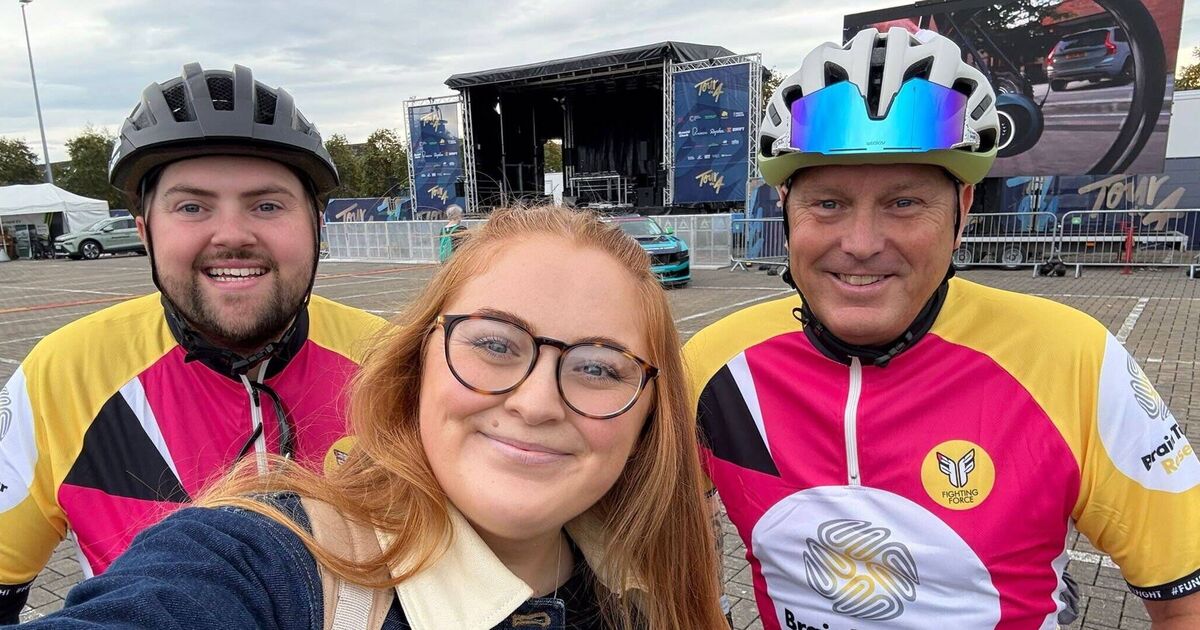
Sean Sweeney with wife Lucy and father-in-law Carl at Sir Chris Hoy’s 60KM Tour de 4 cycling challenge (Image: Brain Tumour Research/SWNS)
A man’s ‘running injury’ proved to be a devastating indicator of lethal cancer. Sean Ryan Sweeney, 31, started suffering from persistent headaches, muscle aches in his neck and pins and needles sensation down his right side.
What initially seemed like a minor running injury turned out to be a harrowing sign of a severe health crisis for Sean Ryan Sweeney. At 31, Sean began experiencing relentless headaches, neck muscle pain, and a tingling sensation on his right side.
As an avid runner and fitness enthusiast, Sean suspected he had strained a neck ligament during his workouts. Seeking relief, he visited a physiotherapist, but despite multiple sessions, his symptoms persisted without improvement.
The situation took a dramatic turn when Sean’s wife, Lucy, 28, found him having a seizure at their home. He was immediately taken to Doncaster Royal Infirmary, where doctors delivered the devastating news: Sean had a grade 3 astrocytoma, a highly aggressive brain tumor.
Medical experts informed Sean that the tumor was terminal, estimating a life expectancy of just 10 more years. After undergoing five weeks of radiotherapy and 12 cycles of chemotherapy, reports indicate that Sean’s condition is currently stable.
Reflecting on his ordeal, Sean, a senior accounts director from Doncaster, shared, “I truly believed I had just sustained an injury and that physiotherapy would resolve it. Despite attending several sessions, there was no improvement.”

He continued, “Eventually, the physiotherapist admitted they couldn’t determine the source of my pain and discharged me. That was concerning. I felt frustrated and uneasy, knowing something wasn’t right but unable to pinpoint the issue. Concentrating became difficult, and the symptoms lingered.”
Read more: ‘Super flu’ warning as 1.5m Brits ‘should stop taking meds’
Sean’s warning signs began in January 2022, before he suffered the seizure on July 19 of the same year.
He said: “Then, everything escalated suddenly. I was woken in the early hours by my partner, Lucy (now my wife), after I had a seizure. She called 999 straight away and within 20 minutes I was blue-lighted to Doncaster Royal Infirmary.”
Medical staff performed a CT scan and a junior doctor informed him there was something worrying visible on his scan. Sean was then referred to the neurospecialist team at Sheffield Royal Hallamshire Hospital, where additional CT and MRI scans were conducted. At first, surgeons thought the tumour could be low-grade, but this was subsequently proven incorrect.
He explained: “When I was told they’d found a lesion on my brain, I felt completely numb. I didn’t cry or panic. My mind went straight to Lucy and my family.”
He underwent a nine-and-a-half-hour awake craniotomy to debulk the tumour in November that year. Sean suffered an acute stroke during his surgery, which left him struggling to walk and a droop on the left side of his face.
He recalled: “Before the operation, I had sessions with a clinical psychologist, who talked me through everything from the moment I arrived at hospital to discharge. When the team explained the awake craniotomy, they said I seemed calm and unfazed, but it was still a huge thing to face.
“Because I was awake, I remember the exact moment things changed. I could hear the psychologist telling the surgeon my speech was becoming slurred. The next day I had problems walking and one side of my face had dropped.
“Later, I was told I’d had a stroke during surgery. It was frightening, but thankfully, with rehabilitation I recovered and today you wouldn’t know I’d had a stroke at all.”
Following the operation, Sean was diagnosed with a grade 3 astrocytoma. He began his chemotherapy and radiotherapy at Weston Park Hospital in early 2023, concluding in February 2024.
Sean is now sharing his journey and raising funds for Brain Tumour Research, the only national charity dedicated to finding a cure for all types of brain tumours. Together with his father-in-law Carl Hathaway, 59, Sean raised more than £2,500 by completing Sir Chris Hoy’s 60KM Tour de 4 cycling challenge. They plan to tackle the 100km route next year.
Sean said: “Carl drove me to so many of my radiotherapy sessions and, in those journeys, our bond really strengthened. Even in the darkest moments, we somehow found a way to have a laugh.”
He added: “He’s become the father figure I never had. We both love cycling, so when the Tour de 4 was announced, we were keen to take part.
“Completing it together was a massive milestone for me – it was the first endurance event I’d ever finished – and I couldn’t quite believe I was capable of doing it after everything my body had been through. It’s shocking how little funding brain tumours receive compared to other cancers.
“Finishing treatment doesn’t mean everything goes back to normal – you’re still living with the impact and for high-grade tumours like mine there still isn’t a cure.”
Ashley McWilliams, community development manager at Brain Tumour Research, said: “It is only with increased funding and more research that we can find a cure for patients like Sean. His experience also highlights the reality that treatment can be gruelling and recovery can be long, with life-changing consequences even when someone looks well on the outside. We are incredibly grateful to Sean for sharing his story and for supporting our work through fundraising to help change the story for brain tumour patients.”
To support Brain Tumour Research visit <a href=” target=”_blank” rel=”noopener noreferrer”>