
Share this @internewscast.com
On October 20, 2008, Mohammad Bagher Ghalibaf, who was serving as the Mayor of Tehran, embarked on a notable international journey, making his way to the Peace Memorial Museum in Hiroshima, Japan.
During his visit, he was shown a poignant artifact: a pocket watch that had frozen at 8:15 a.m. on August 6, 1945, the exact moment an American nuclear bomb devastated the city, claiming the lives of 140,000 people.
Moved by the experience, Ghalibaf recorded his thoughts in the museum’s visitor book, pledging, “I will spare no effort in helping to create a world without nuclear weapons. Promoting dialogue is an essential step.”
Following his visit, U.S. officials discreetly reached out to their Japanese counterparts who had engaged in private discussions with Ghalibaf. They sought insights into the Iranian politician’s stance and demeanor during these interactions.
The findings from these conversations were subsequently communicated to the State Department in Washington through two classified memos marked as ‘secret’ and ‘confidential.’
In these exchanges, it emerged that Ghalibaf had subtly distanced himself from the Iranian regime’s hardline stance on nuclear issues. In discussions with Japanese officials, he hinted at a willingness to compromise, suggesting a nuanced shift in tone, albeit a slight one.
In the presence of another Iranian official he parroted the regime line, although seemingly without conviction, according to those present. Then, when the other Iranian official was gone, he indicated a desire for dialogue.
The two memos, later published by WikiLeaks, confirm that US intelligence has been watching Ghalibaf for many years.
Now, as the speaker of Iran’s parliament and a major power player, he has emerged as the person in Iran that President Trump reportedly seems most keen to talk to.
As President Trump searches for a pragmatic new leader of the country, one who would agree to abandon ambitions to build a nuclear bomb, the focus is turning to Ghalibaf.

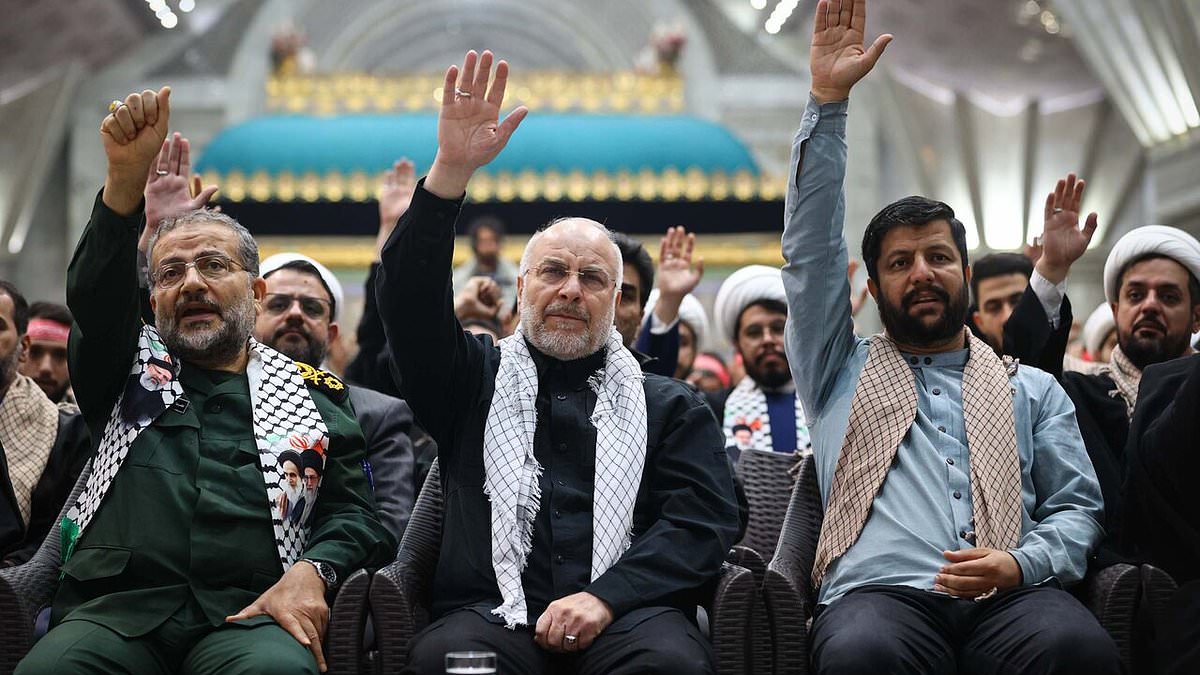
Iranian parliament speaker Mohammad Bagher Ghalibaf in Tehran on November 21, 2025
The plot thickened on Thursday as it emerged Israel had removed Ghalibaf from its list of assassination targets after the US told it to ‘back off.’
Intriguingly, also removed from the Israeli target list, by US request, was Iran’s foreign minister Abbas Araghchi.
In an extraordinary coincidence, according to the intelligence documents, Araghchi was with Ghalibaf on his earlier visit to Japan. Araghchi was Iran’s ambassador to that country at the time.
Of course, Ghalibaf’s nods to moderation could all be a charade. After all, he is a former Revolutionary Guard commander, and former police chief, with a reputation for extreme brutality.
He is reviled by many Iranians who regard him as a butcher for his role in suppressing student protests in 1999, 2003 and 2009.
In a leaked audio tape, he was once heard bragging: ‘Photographs of me are available showing me on the back of a motorbike beating them (protestors) with wooden sticks. I was among those carrying out beatings on the street level and I am proud of that.’
He was also heard boasting that he had secured government permission to have security forces enter a campus and shoot at students.
Protestors reportedly nicknamed him the ‘rooftop killer’ after students were thrown from the tops of buildings.
However, if he genuinely is prepared to abandon hopes of building nuclear weapons, Trump may be willing to deal with him.
In his conversations with the Japanese officials, according to the first memo, Ghalibaf was said to have suggested that he may support a ‘marginally less confrontational approach to the nuclear issue’ than the Iranian regime.
‘On nuclear issues…Ghalibaf reportedly at first went through his Islamic Republic of Iran (IRI) boilerplate points dutifully, but with little apparent conviction,’ one memo stated.
It continued: ‘Ghalibaf…appeared to suggest (without spelling anything out) slight divergences, at least in tone, from IRI nuclear boilerplate.’
He was said to have told the Japanese that Iran had no intention of relinquishing its ‘civil’ nuclear program, as the regime had ‘paid too high a price to get to this point.’
But he also said that Iran was capable of pursuing its nuclear goals ‘without confrontation’ and that he believed Iran should make ‘further efforts’ to earn the trust of the international community.
He was described in the memo as a ‘refined, affable, highly polished guest and interlocutor.’
The second intelligence memo reported that Japanese officials had found Ghalibaf to be a ‘calm, decent, and pleasant’ man, who was ‘very smart and well-informed.’
In discussions about Iran’s nuclear program, he maintained that Iran had a right to produce nuclear energy and that its efforts were peaceful.
He also argued that the West had a ‘double standard,’ accommodating nuclear programs in India and North Korea, but not Iran.
However, the Japanese officials reported that Ghalibaf ‘did not use any charged or emotional language when making his points.’
Ghalibaf appeared to see Iran’s path as ‘engaging in dialogue with the world in a better way,’ one of the memos said.

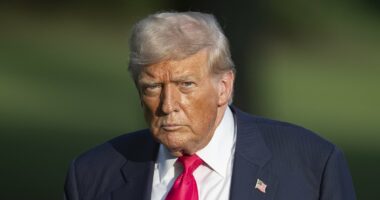
President Donald Trump is looking for a pragmatic leader in Iran

On a visit to Hiroshima, Ghalibaf said he wanted to rid the world of nuclear weapons
At the time of the Japan visit Ghalibaf was casting himself as an alternative to Iran’s hard line President Mahmoud Ahmadinejad.
Fast forward nearly two decades and it is not known whether the intelligence memos are still an accurate representation of his views.
Nor is it known what the exact effect visiting Hiroshima had on his thinking about Iran developing a nuclear weapon.
But some at the White House are said to see him as a possible US-backed leader.
‘He’s a hot option,’ one US official told Politico. ‘He’s one of the highest…But we got to test them, and we can’t rush into it.’
On Monday, President Trump said: ‘We are dealing with a man that I believe is the most respected – not the supreme leader. We have not heard from him.’
The President added that he was not naming the man, ‘because I don’t want them to be killed, OK? I don’t want them to be killed.’

Frozen in time: In Hiroshima, Ghalibaf saw a melted wristwatch that stopped at 8.15 am when the nuclear bomb hit

Visitors walking past the Atomic Bomb Dome on the eve of the 80th anniversary of the world’s first atomic bomb attack, in the city of Hiroshima on August 5, 2025
The following day, he said there were ‘negotiations right now’ involving Vice President JD Vance, Secretary of State Marco Rubio, special envoy Steve Witkoff, and the president’s son-in-law Jared Kushner.
‘We have a number of people doing it. And the other side, I can tell you, they’d like to make a deal,’ Trump said.
However, as speculation swirled that Ghalibaf, 64, was the person negotiating on the Iranian side, he flatly denied it.
‘Our people demand the complete and humiliating punishment of the aggressors,’ he wrote on social media. ‘All officials stand firmly behind their Leader and people until this goal is achieved.
‘No negotiations with America have taken place. Fake news is intended to manipulate financial and oil, and to escape the quagmire in which America and Israel are trapped.’

Smoke and flames rise at the site of airstrikes on an oil depot in Tehran

Members of the Islamic Revolution Guard Corps hold RPG weapons during an annual rally to mark Quds Day in Tehran on April 5, 2024
Iran’s Fars news agency claimed the negotiation reports were a US ‘psychological operation’ and a ‘character assassination of Ghalibaf.’
President Trump is looking for an Iranian version of Venezuela’s acting President Delcy Rodríguez, who took over after the US military captured then Venezuelan leader Nicolás Maduro in January.
There is no doubt that Ghalibaf’s power has increased since February 28, when Israeli and US strikes killed Supreme Leader Ali Khamenei, 86, and a host of other senior regime figures.
Mojtaba Khamenei, his son, who has been declared the new Supreme Leader, has for years backed Ghalibaf in a series of failed presidential campaigns in 2005, 2013, 2017 and 2024.
US diplomats have long been aware of their link, according to cables published by WikiLeaks.
‘Mojtaba reportedly has long maintained a very close relationship with Tehran Mayor and presidential hopeful Mohammad Bagher Ghalibaf; Mojtaba was reportedly the “backbone” of Ghalibaf’s past and continuing election campaigns,’ a cable in 2008 said.
‘Mojtaba is said to help Ghalibaf as an advisor, financier, and provider of senior-level political support. His support for and closeness to Ghalibaf reportedly remains undiminished.’
However, questions still remain over the extent of Ghalibaf’s current control with Mojtaba reportedly injured and various elements within Iran’s theocracy likely to be competing against each other.
‘Many Iranians despise Ghalibaf, diplomats see him as pragmatic,’ according to analyst Michael Rubin. ‘Those diplomats confuse pragmatism with opportunism.
‘Ghalibaf is a survivor. He sees in Trump someone who can help him achieve what late Supreme Leader Ali Khamenei denied him: the presidency or some equivalent interim leadership role.’

Iran’s Parliament Speaker Mohammad Bagher Ghalibaf speaks during an election campaign rally ahead of the presidential vote in Tehran on June 15, 2024

President Trump’s Operation Epic Fury against Iran was launched on February 28

An explosion erupts from a building following an Israeli strike in central Beirut, Lebanon, on Wednesday, March 18
Iran’s semi-official Tasnim news agency claimed reports he was talking to the US were a ‘political bomb’ meant to put the regime’s leaders in disarray.
‘The mention of Ghalibaf’s name was clearly intended to create internal divisions within Iran and to provoke conflict among political forces,’ it claimed.
Ghalibaf is the son of a shopkeeper from Torqabeh in northeastern Iran.
He fought in the Iran-Iraq War in the 1980s, went on to train as a pilot, and became head of the Revolutionary Guard’s air force, and later led Iran’s police.
A leaked recording of a meeting between Ghalibaf and members of the Revolutionary Guard’s volunteer Basij force had him claiming that he ordered gunfire be used against demonstrators in 2003.
It also had him praising the violence used against demonstrators in Iran’s 2009 Green Movement protests.
As Tehran’s mayor from 2005 to 2017 Ghalibaf faced corruption allegations, including over $3.5 million being donated to a foundation run by his wife.
He has engaged with the West in the past, including traveling to the World Economic Forum in Davos.
He also revealed in a newspaper interview in 2008 that, as Mayor of Tehran, he was closely studying New York for tips on urban management.
However, later, as Iran’s parliament speaker he praised the Hamas terrorist atrocity on October 7, 2023, claiming that the ‘Zionist regime will never have peace until the day it is annihilated.’