
Share this @internewscast.com
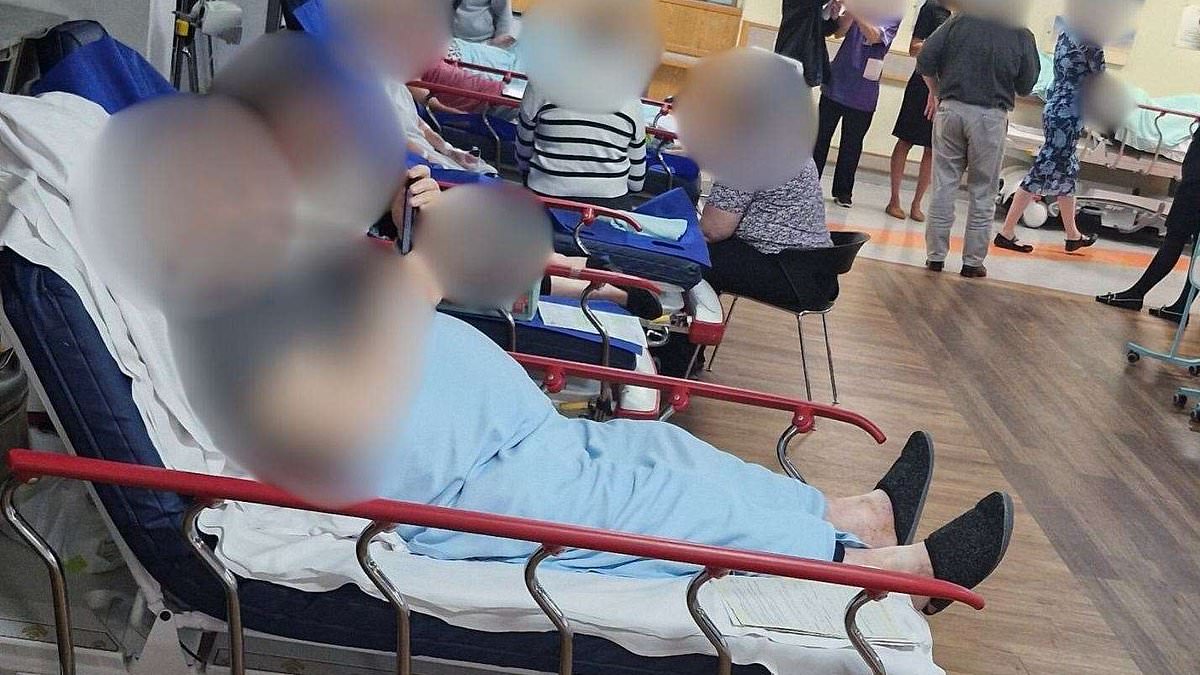
This winter, a staggering number of patients are enduring ‘degrading’ 12-hour waits on trolleys in A&E departments, highlighting a crisis that the Labour party seems to be ignoring, according to a revealing investigation.
Between January and October, more than 452,000 individuals waited over 12 hours for a hospital bed after being deemed in need of urgent admission by medical professionals. This figure marks a record-breaking increase from just 1,590 in the same period back in 2016, and it surpasses last year’s numbers by 34,000.
On Monday night, the country’s leading A&E doctor expressed grave concerns that these patients are being severely let down at their most vulnerable times, with some tragically losing their lives as a result. Dr. Ian Higginson, president of the Royal College of Emergency Medicine, urged politicians to acknowledge the dire situation unfolding in A&E departments, which are reaching a breaking point as we head into what is anticipated to be an especially challenging season.
Dr. Higginson emphasized the need for hospital trusts to receive support in discharging patients who are medically cleared to leave, thus freeing up much-needed space for the influx of patients requiring admission. This action, he suggests, is crucial to alleviating the strain on the healthcare system.
Dr Ian Higginson, president of the Royal College of Emergency Medicine, said politicians need to ‘open their eyes’ to what is happening in A&Es, which are at ‘breaking point’ going into what is expected to be a particularly difficult season.
He added: ‘Hospital trusts must be supported to focus on getting people out of hospital when they are medically fit to do so to free up capacity for the large number of people in need of admission.
‘For this to happen, hospitals need to work more effectively, we need more staffed beds, and social care and other supporting services must be improved.
‘We need politicians from across the political spectrum to open their eyes to what’s happening in Emergency Care.
‘I fear what’s to come in the new year, when the worst of winter is expected to hit emergency departments, which will in turn mean even more long waits for my patients, more of whom will die as a result of this systematic failure.’
The stark message comes as the British Medical Association prepares to march its resident doctors out on strike again for five days from December 17 to 22, causing mayhem in the run-up to Christmas.
The medics, who have seen their pay increase by 28.9 per cent over the past three years, are demanding a further 26 per cent pay rise.
An early flu season and new variant has also left health leaders braced for an influx of infected patients, which will pile additional pressure on beds.
Analysis of NHS England figures, by the Liberal Democrats, shows long A&E waits are higher than ever so far this year, with a record 452,595 so-called 12-hour ‘trolley waits’ reported in the first ten months alone.
Following the Budget, they are now calling for an emergency package of extra hospital and care home beds to protect patients as winter bites and to arrest the rise in delays.
Twenty-three trusts have seen increases in excess of 100,000 per cent since 2016, with five trusts seeing increases in excess of 500,000 per cent.
Lincolnshire Teaching Hospitals saw an increase in excess of 1000,000 per cent.

In September, pictures shared online of William Harvey Hospital in Ashford, Kent showed how it was forced to turn its café into a makeshift ward for patients
Meanwhile, 35 A&Es have already seen more than 5,000 patients wait more than 12 hours from decision to admit, with eight trusts seeing more than 10,000 waits of this length.
A report by the Royal College of Nursing earlier this year revealed the problem is now so bad that many patients do not even get to lie on a trolley while waiting for a bed on a ward — with some forced to sit for hours on a chair of lie on the floor.
Dr Vicky Price, president of the Society for Acute Medicine, said: ‘The number of people now waiting 12 hours or more in emergency departments — almost half a million in 10 months — is completely unacceptable.
‘It is causing serious and avoidable harm yet, more worryingly, it is only the tip of the iceberg.
‘Many more patients are enduring long delays before a decision to admit is made, waiting hours in triage or in waiting rooms, or being placed in temporary escalation areas, corridors or bays because hospitals are full.
‘These waits are not captured in ‘trolley-wait’ statistics which is masking the full scale of delay, overcrowding and unsafe corridor care that is now normalised across the system.
‘We and many others have been highlighting the dangers of this situation every month for a number of years.
‘Yet 2025 is the worst year on record and the question is when the rise will stop.’

Pictured, patients sleep in beds lining a hospital corridor in overrun A&E department at William Harvey Hospital in Ashford
Liberal Democrat MP Helen Morgan, the party’s health spokesperson, said: ‘The appalling delays at A&E are needlessly costing lives as patients are left waiting hours on end for the treatment they need.
‘The Government should have used the budget to save the NHS. Instead they are in total denial, as patients brace themselves for a historic crisis this winter.
‘We need a proper plan right now to free up hospital beds, reduce A&E delays and bring the NHS back from the brink.
‘That must start with extra staffed beds, and helping people to leave hospital and into social care.
‘Our proposed package would also rebuild GP services so that people can get an appointment within a week, or 24 hours if urgent, and don’t end up in A&E in the first place.’
Rory Deighton, acute and community care director at the NHS Confederation, said: ‘This data is extremely worrying, particularly during another very challenging winter for the NHS.
‘We know that rising demand and delays in discharge have created bottlenecks in A&Es.
‘With the flu season starting earlier than usual and levels of flu expected to rise sharply over the next week, health service leaders are working incredibly hard and making difficult decisions about how best to manage this, with corridor care only ever used as a last resort.
‘Car park care, where patients are waiting in ambulances outside A&E, is also not a solution to this problem.
‘Healthcare leaders continue to work on the root causes to ensure improvements by improving patient discharge, working with local authorities to increase social care support, and prioritising vulnerable older patients at the front door through increased frailty screening.
‘At the same time, patients should be encouraged to use urgent treatment centres, visit their local community pharmacy, use NHS 111, or see their GP, where appropriate, to free up A&E capacity for those with the most urgent needs.’
A Department of Health and Social Care spokesperson said: ‘These figures lay bare the shocking inheritance we’re working to turn around.
‘That’s why we’ve begun winter preparations earlier than ever before – pressure-testing hospital plans, coordinating closely with care homes and local leaders, and accelerating vaccinations to keep patients moving safely through the system.
‘And with a £450 million Urgent and Emergency Care Plan, we’re taking decisive action to cut A&E overcrowding, free up beds, and ensure people who don’t need to be in hospital get timely care in their community.’