Share this @internewscast.com
In a significant scientific breakthrough, a novel blood test has shown the ability to identify nearly two-thirds of lethal cancer cases with precision.
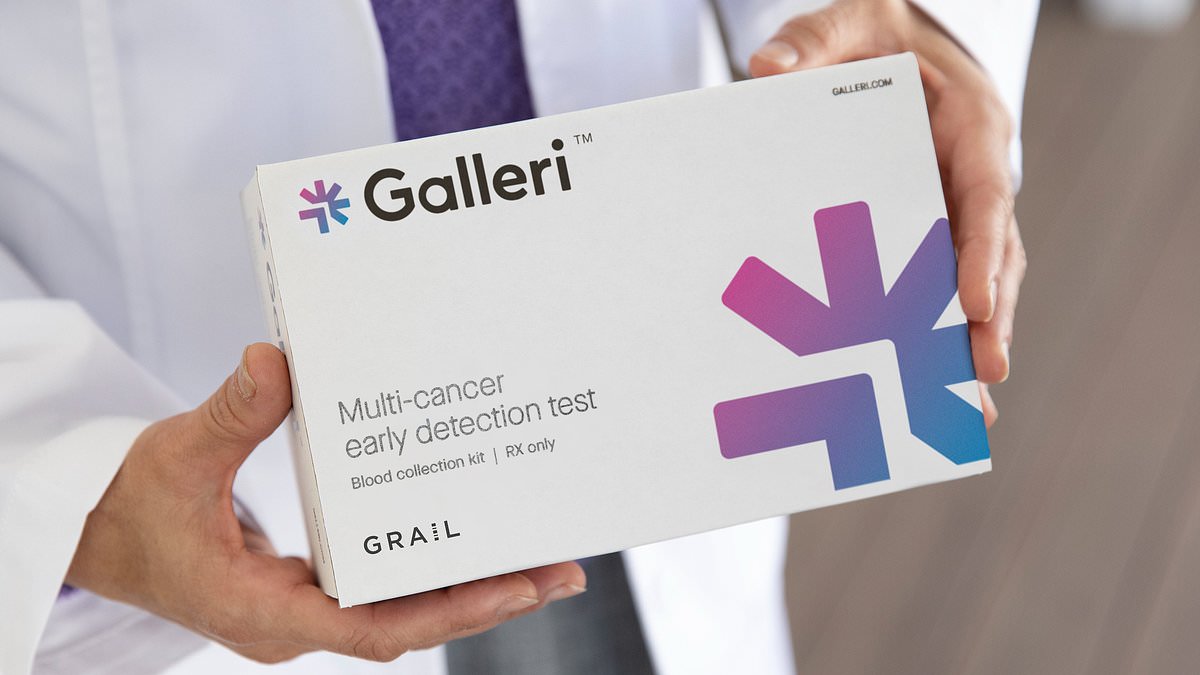
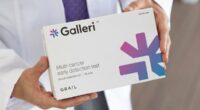
Known as the Galleri test, this innovative diagnostic tool is hailed as the ‘holy grail’ of cancer detection. It screens for over 50 types of cancer and can often detect them before any symptoms arise.
Recent data from a pivotal trial conducted in the United States, which included over 23,000 participants, revealed that the test successfully identified 62% of cancer cases.
The study also found that the test accurately detected 74% of cases for the 12 deadliest cancers, such as bowel, lung, and pancreatic cancer.
Specialists have expressed confidence in these findings, which will be unveiled at a prestigious cancer conference today, suggesting that the test could soon be implemented on a larger scale.
Created by the American company Grail, the test functions by searching for minute traces of tumor DNA present in the bloodstream.
The NHS is also currently conducting a major trial of the test involving more than 140,000 people and has previously hailed it a potential ‘gamechanger’.
Sir Harpal Kumar, president of International Business and BioPharma at Grail, which pioneered Galleri, and former head of Cancer Research UK, said: ‘We’re really very excited and we think this is a further step along the way in really transforming cancer outcomes.’

The Galleri test — dubbed the ‘holy grail’ for cancer — screens for more than 50 cancers, often picking up signs before symptoms even appear
‘What we wanted to assess was, what added value does the test provide over and above existing screening?
‘And one of the most important and exciting results is the fact that it detected seven times as many cancers as the other screening programmes put together.’
He added: ‘Assuming we do get positive results from NHS Galleri, the opportunity to find substantially greater numbers of cancers before they present clinically, means we should be able to find a lot more of them at an earlier stage.
‘This is also particularly effective in those types of cancer where we have no other screening at the moment – and in those types that are typically diagnosed very late, like pancreas, head and neck, liver and ovary, and so on.
‘Once we get those results next year, we would hope the NHS would move very quickly to an implementation evaluation in the NHS.’
In the US trial, researchers recruited 23,161 patients who took the blood test and were followed-up over at least 12 months.
The test detected a cancer signal in 216 people, and cancer was diagnosed in 133 of these.
This equated to correctly identifying 61.6 per cent of people with cancer, a measure known as sensitivity.
In 92 per cent of cases, the test could pinpoint in which organ or tissue the cancer arose, meaning time and money could be saved on other scans and other tests.
It also correctly ruled out cancer in 99.6 per cent of people who did not have the disease, a measure known as specificity.
But the test performed better for 12 cancers whose tumours tend to release higher amounts of abnormal DNA into the blood and which tend to have lower survival rates, including bladder, bowel, stomach, liver, lung, gullet and pancreatic.
The accuracy for this group was 73.7 per cent at stages one to three, with the test better at finding cancers at a later stage.
There are four stages of cancer, with stage four the latest, at which most cancers are terminal.
The results of the trial will be presented in full at the European Society of Medical Oncology annual congress in Berlin.
Responding to the findings, Professor Nitzan Rosenfeld, director of the Barts Cancer Institute at Queen Mary University of London, who was not involved in the trial, said they were ‘impressive’.
The 62 per cent accuracy figure was also ‘very encouraging and provides strong evidence that this test could be safe and informative’, he added.

The NHS is also currently conducting a major trial of the test involving more than 140,000 people and has previously hailed it a potential ‘gamechanger’
But he noted that further data was vital before the test was rolled out.
Professor Anna Schuh, an expert in molecular diagnostics at the University of Oxford, meanwhile, who was also not involved in the trial said the 62 per cent result was ‘disappointing as it is only fractionally better compared to tossing a coin’.
She added: ‘Although it is better compared to current screening tests where still most positive results turn out to be nothing.’
Grail says its Galleri test would not replace routine cancer screenings, and should instead be paired with them.
NHS screening programmes currently include those for breast, cervical and bowel.
Around 385,000 people are diagnosed with cancer in the UK every year, which is the equivalent of more than 1,000 cases being spotted every day.
Research published in the journal BMJ Open in May found that an annual blood test for cancer could lead to 49 per cent fewer late-stage diagnoses and 21 per cent fewer deaths within five years compared to patients receiving usual care.