
Share this @internewscast.com
Recent analysis reveals that prostate cancer has now surpassed breast cancer as the UK’s most prevalent form of cancer.
Significantly, the number of men diagnosed with prostate cancer has surged dramatically within a single year.
In 2022, prostate cancer was identified in 64,425 men, outpacing the 61,640 breast cancer cases, according to findings from the charity Prostate Cancer UK.
Compared to the previous year, where 51,823 men were diagnosed, this represents a substantial 24% increase in prostate cancer cases, the charity noted.
While prostate cancer became the most diagnosed cancer in England as of last January, comprehensive data from Scotland, Wales, and Northern Ireland now provide a complete UK picture.
Prostate Cancer UK attributes a 42% rise in diagnoses over the past decade to heightened awareness efforts by charities, the NHS, and influential public figures.
The Daily Mail has been campaigning for earlier diagnosis of the disease and a full screening programme.

Health Secretary Wes Streeting said he was surprised by UKNSC’s recommendation that prostate cancer screenings should not be made routinely available for all men
The charity is calling on the NHS to adopt wider screening using the prostate specific antigen (PSA) test.
It is also running a major clinical trial, expected to report within two years, into whether combining PSA with other tests, such as rapid MRI scans, could lead to a recommendation for population-wide screening for all men.
In December, a draft recommendation from the UK National Screening Committee (UKNSC), which advises the Government, said prostate cancer screening should not be made routinely available for the vast majority of men in the UK.
It did not recommend population screening using the PSA test, saying this was because it ‘is likely to cause more harm than good’.

The Daily Mail has been campaigning for earlier diagnosis of the disease and a full UK-wide screening programme
The committee instead put forward only a recommendation to screen men with BRCA1 and BRCA2 genetic mutations, which puts them at far higher risk of prostate cancer, every two years, between the ages of 45 and 61.
Health Secretary Wes Streeting said he was surprised by that decision and is reviewing the findings.
Among those speaking out against the UKNSC recommendation were Olympic gold medallist Sir Chris Hoy, former prime minister Lord David Cameron, broadcaster Sir Stephen Fry and Blackadder actor Sir Tony Robinson, who have all been diagnosed with the disease.
Prostate Cancer Research is in favour of more screenings, while Cancer Research UK agrees with the screening committee decision. Prostate Cancer UK said it was disappointed by the decision but determined to change it through more research and evidence.
Chiara De Biase, director of health services, equity and improvement at Prostate Cancer UK, said of the latest data: ‘We’re hugely proud to have played our part in the growing awareness of prostate cancer, which has led to more men than ever being diagnosed and treated.
‘But it’s unacceptable that the full weight of responsibility still falls on men to understand their risk and talk to their GP about the pros and cons of a PSA test.
‘Prostate cancer is now the most common cancer in the UK, but despite this, men are facing deeply unfair inequities across the country, and their experiences vary hugely based on where they live.
‘We urgently need an early detection programme that will address these regional inequities.
‘My message to men today is, find 30 seconds to do Prostate Cancer UK’s online risk checker. It’s free, anonymous and in a few quick questions you will understand your risk and your rights like the four million men who have already taken it. Knowing your risk could save your life.’
Sir Chris Hoy said: ‘Prostate cancer is curable if found early. That’s why it’s vital we get the message out to men to think about their risk and to talk to their GP about a simple blood test to check.

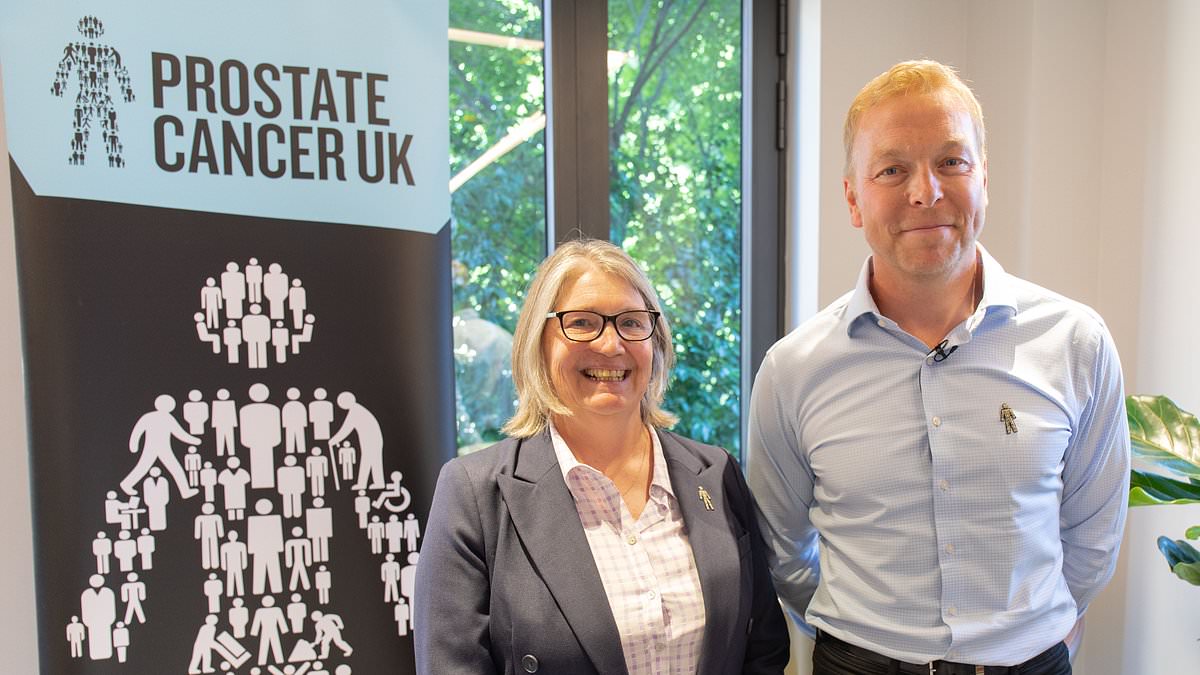
Sir Chris Hoy (pictured at a Prostate Cancer UK event last June) who has been diagnosed with the disease, says that GPs should be discussing the PSA blood test with more high-risk men
‘That way we’ll get more men with prostate cancer diagnosed earlier, and we’ll save thousands more lives.
‘What we need now is action to change the system, to enable more men to be diagnosed earlier and stop them getting the news I got.
‘We need GPs to be able to proactively speak to men at highest risk, for example men with a family history like me, or black men, and discuss the PSA blood test to check for signs of cancer at an earlier stage.
‘It shouldn’t be only men’s responsibility to make these potentially lifesaving conversations happen.’
Men living in areas of higher deprivation are 29 per cent more likely to be diagnosed with disease that has already spread, than men living in more affluent areas, analysis by Prostate Cancer UK shows.
And although more men are being diagnosed in Scotland, these men are more likely to be diagnosed with prostate cancer at a later stage (31 per cent) than those in England (21 per cent).
The charity said GPs are currently prevented by ‘outdated’ NHS guidelines from proactively speaking to men who have the highest risk of getting prostate cancer about their risk and offering a PSA.
Some experts say the PSA test is not reliable because men with a high PSA level may not have cancer and some men with cancer have a normal PSA result.
A positive test result may lead to unnecessary treatment for slow-growing or harmless tumours, leaving men at risk of serious side-effects such as incontinence and erectile dysfunction.
But others say current evidence supports much wider testing.