
Share this @internewscast.com
One evening a little over two years ago, Philip ‘Pip’ Harding was enjoying dinner with his wife, Claire, when he noticed something unusual. Out of the corner of his eye, he saw unfamiliar figures in the room.
Claire’s perplexed expression made it clear that these figures were not real. Feeling a bit strange himself, Pip decided to take a rest.
He recounts the experience: “It was quite bizarre. As I lay in bed, I suddenly found myself unable to speak. I eventually drifted off to sleep. Claire was concerned and checked on me a few times. However, by the next day, I felt fine, and we both thought it might have been an odd reaction to the Covid vaccine I had received earlier that day.”
At the time, Pip was a distinguished RAF helicopter pilot with missions in Iraq, Afghanistan, and Northern Ireland under his belt. He had been stationed in Hawaii, collaborating with the US military, and at 52, he was thriving.
Yet, just weeks later, after a meeting at the Pentagon in Washington, D.C., he was struck by sudden, intense nausea. “I quickly had to find a secluded wooded area,” says Pip, now 54, residing in Wallingford, Oxfordshire.
Back in Hawaii, Pip consulted a doctor, which led to a series of tests and scans. Shortly thereafter, he and Claire sat before a consultant in Honolulu, who delivered the devastating news: Pip had late-stage glioblastoma, the most prevalent and aggressive form of brain cancer, and without treatment, his prognosis was just four to five months.
Brain tumours are the biggest cancer killer of those under 40 in the UK; in the vast majority of cases the cause is unknown.
The average survival time for glioblastoma (with more than 3,000 cases diagnosed every year) is 12 to 18 months, and only around 5 per cent of patients are still alive after five years.

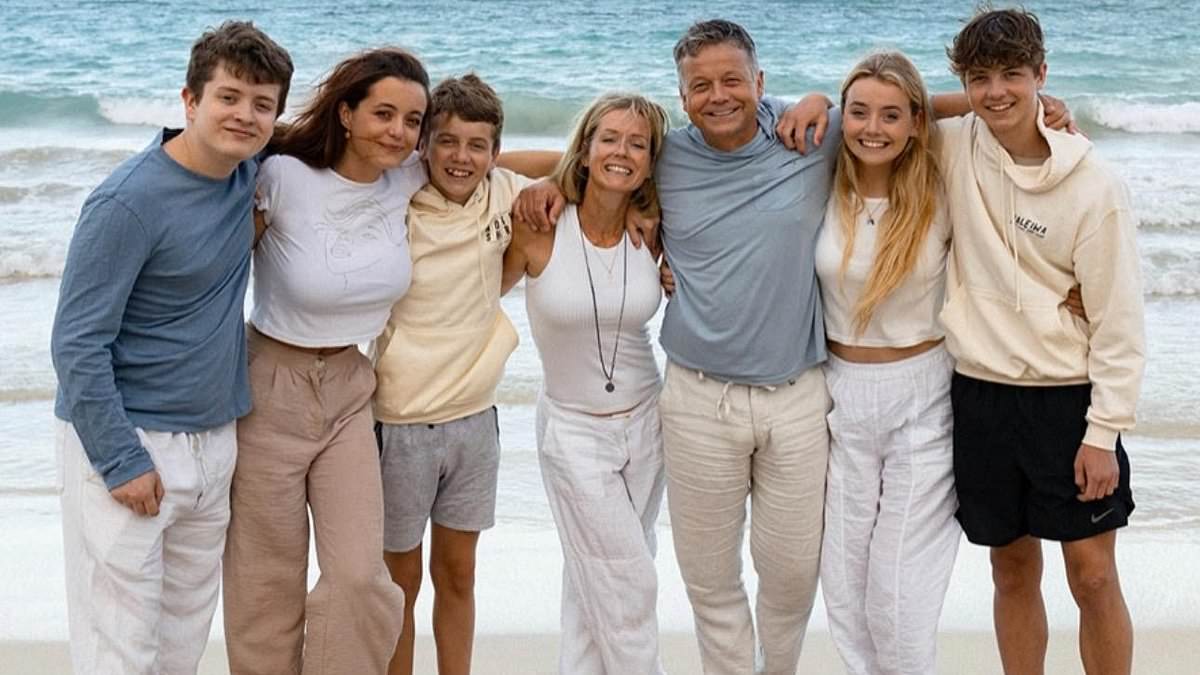
Philip ‘Pip’ Harding (centre), with his wife Claire and their five children, has glioblastoma
Pip recalls: ‘I didn’t know what to say. Claire had tears in her eyes. Suddenly everything changed. I went from living this incredible life with my family and doing an exciting, fulfilling job, to being told I could be on the way out…’ His voice falters at the memory.
Pip and Claire met as students at the University of Exeter and have five children: Ellie, 26; Johnny, 24; Bobbie, 21; Harry, 19; and William, 16. After joining the RAF in 1993, Pip had risen to Group Captain and been awarded an OBE.
Practical and optimistic by nature, he was nonetheless floored by his diagnosis in March 2024. ‘I wasn’t ready to give in – I was determined to fight,’ he says.
Pip was told his best chance was a ten-hour operation, followed by chemotherapy and radiotherapy.
After six weeks, a scan showed the tumour had shrunk, and he embarked on a rolling course of five days of chemotherapy every month, which he still receives, following his return to the UK in September 2024. But he was warned that he might still expect to live only another year.
Then in October that year, Claire, 55, a yoga teacher, came across an experimental treatment – oncothermia – where focused heat and an electric field is passed through cancer tissue, raising the temperature of the tumour to around 45c.
It’s not been proven by clinical trials and is available only in some centres in Europe and one clinic in London, at a cost of £1,000 a session.
Pip’s GP thought it was worth pursuing, and RAF colleagues and family rallied, raising £36,000 to fund 36 sessions (which he had alongside his chemotherapy). After six sessions, an MRI scan showed the tumour had reduced from 7cm to 1.7cm, says Pip.
His story is in some ways extraordinary – yet the situation he found himself in is not.
There has been no significant improvement in treatments or survival rates for those diagnosed with brain cancer in decades.
This dire state of affairs contrasts with a new report published earlier this month that showed overall cancer deaths in the UK are at a historic low, dropping by 11 per cent in the past decade.

Anna Jewell chairs the Less Survivable Cancers Taskforce – a campaign group representing the six cancers with the lowest five-year survival rates
The analysis, by Cancer Research UK, found that ovarian cancer death rates fell by 19 per cent and stomach cancer by 34 per cent. Meanwhile, breast cancer deaths are down 14 per cent; bowel cancer 6 per cent; and leukaemia by 9 per cent.
However, some rates increased over the same period – including gallbladder cancer (up by 29 per cent), eye cancer (26 per cent) and liver cancer (14 per cent).
The improvements are the result of ‘decades of scientific breakthroughs, from vaccines that prevent cancer to kinder, more targeted treatments,’ says Dr Sam Godfrey, science engagement lead at Cancer Research UK.
For instance, a drop in prostate cancer deaths (by 11 per cent in a decade) is partly due to the new drug abiraterone, which stops testosterone fuelling the disease.
Cervical cancer has seen one of the biggest improvements across all cancer types – with a 75 per cent reduction in deaths over the past 50 years, thanks to screening and innovations such as the HPV vaccine given to teenagers, introduced in 2008.
But late diagnosis, lack of treatment options and poor survival rates are still a disturbing fact of life for many of the more than 95,000 Britons diagnosed every year with so-called less survivable cancers – a group that includes brain, stomach, liver, oesophageal, pancreatic and lung cancers.
In the UK, 47 per cent of all cancer diagnoses are of rare and less common cancers – yet they account for 55 per cent of cancer deaths (nearly 167,000 people died from all types of cancer in 2022/3), according to Cancer52, which represents more than 100 specialist cancer charities.
And the difference in survival between cancer types in the UK is wider than ever, as reported in The Lancet Regional Health – Europe last year.
A study of data from adults diagnosed in England and Wales between 1971 and 2018 found a significant difference in ten-year survival rates between the most and least deadly cancers: 97 per cent of those diagnosed with testicular cancer survive ten years or more, compared with just 4.3 per cent for pancreatic cancer.
At the root of this disparity lies systematic neglect of some cancers – in terms of research funding, clinical trial access, diagnostic pathways and drug development.
Money is clearly a problem. There are more than 200 types of cancer, yet the four most common – prostate, breast, bowel and lung – attract the lion’s share of research funding.
Data published in January by the Less Survivable Cancers Taskforce – a campaign group representing the six cancers with the lowest five-year survival rates (brain, stomach, oesophageal, lung, liver and pancreatic) – found that these cancers are the focus of less than one fifth of UK government-funded cancer research, despite accounting for nearly 40 per cent of all cancer deaths.
‘These figures are a wake-up call,’ says Anna Jewell, who chairs the taskforce. ‘It’s unacceptable.’ Another problem is clinical trials, which are often funded by large pharmaceutical companies.
‘They will have more customers for a drug that treats a common cancer than a rare one,’ says Karol Sikora, an oncology specialist and professor at the University of Buckingham.
Also, because such cancers are individually quite rare and complex, collecting good trial data for new treatments is a longer, more difficult process than for cancers that affect larger numbers. There are simply fewer patients, so trials often need to be conducted across multiple centres in many countries to collect adequate data.

Pip (pictured on holiday with his family) is taking each day as it comes, serving in the RAF and giving regular talks to raise awareness for the campaign group Brain Cancer Justice
Dr Matt Williams, a consultant oncologist specialising in brain tumours at Charing Cross Hospital in London, says there is also a painful circularity: because survival rates for brain and other rarer cancers are so low, there are fewer survivors around to lobby for better research and treatments.
‘There can also be a certain nihilism involved,’ adds Anna Jewell. ‘Historically, there has been a tendency for those evaluating research funding applications – such as the National Institute for Health and Care Research – to be ‘cancer agnostic’ about which research they back.
‘This means the focus is often on funding the highest-quality research where there is a good track record – which may count against a rarer cancer where previously little progress has been made.’
Lack of funding and research also underlies the absence of national screening tests for certain cancers. Currently the NHS screens for breast, bowel and cervical cancers, although a targeted lung cancer screening programme is being introduced for those at higher risk, such as smokers.
The consequences are lives lost on a great scale.
The last significant new treatment for brain cancer was an improved chemotherapy drug, temozolomide, in 2003. It provided hope for those with glioblastomas, partly because of its ability to penetrate the blood-brain barrier.
Dr Williams is frank about the frustrations faced by patients and doctors alike. ‘One of my patients said to me: ‘When they talk about gold-standard treatments for brain cancer, it’s really more like bronze, isn’t it?’ It’s hard to disagree,’ he says.
An additional complicating factor is that there are around 120 types of brain tumour, which makes research into how the tumours develop, and new treatments, difficult.
There are further challenges in the way such cancers spread within the brain’s complex structure, explains Paul Brennan, a professor of clinical and experimental neurosurgery at the University of Edinburgh.
‘While surgery is a key treatment for many cancers, such as breast, it’s less effective for brain cancers because the tumour cells spread through the brain to areas where it’s not safe to operate.’

Dr Matt Williams, a consultant oncologist specialising in brain tumours, says because survival rates for brain and other rarer cancers are so low there are fewer survivors around to lobby for better research and treatments
Symptoms of most brain cancers – including headaches, mood changes and memory problems – are also vague enough to have many potential causes, making it difficult for patients to know when to seek help and for doctors to determine when further investigation is warranted.
Patients with rare cancers often attend multiple GP appointments before receiving a specialist referral.
Other cancers also have vague, non-specific symptoms which are easily attributable to other causes. Oesophageal cancer can present with heartburn, for instance.
For ovarian and pancreatic cancers, late diagnosis is particularly acute. Early signs of ovarian cancer can include bloating – and more than 75 per cent of cases are diagnosed at an advanced stage.
Up to 80 per cent of patients with pancreatic cancer are also diagnosed at this late stage.
Claire Machin Lloyd says her 76-year-old mother Pauline died in agony in November 2022, just five weeks after her diagnosis of advanced pancreatic cancer.
‘Mum was diagnosed at the end of September, and her target was getting to Christmas – it wasn’t even a big target, yet she still didn’t make it,’ says Claire, 45. ‘We were completely devastated.’
‘We didn’t get the letter confirming her oncology appointment until after Mum had died,’ says Claire, who works in marketing and lives near Exeter with her husband Mike, 51, a surveyor, and their children Caitlin, 15, Joseph, 13, and Meredith, nine.
She adds: ‘My mum was active, fit and very hands-on as a grandmother to my children.’

Claire Machin Lloyd with her mother Pauline, who died in November 2022, just five weeks after her diagnosis of advanced pancreatic cancer

Claire says: ‘My mum (pictured) was active, fit and very hands-on as a grandmother to my children’
A year or so before her death, Pauline developed indigestion and back pain. She saw her GP several times. Blood tests didn’t initially reveal anything and the GP put it down to IBS.
‘Around a year after her first GP appointment, a further blood test showed low blood sodium levels – which can indicate serious underlying illness – and she was referred for a scan,’ says Claire. ‘This revealed stage 4 pancreatic cancer that had spread to her liver. There were only palliative treatment options available; her cancer was incurable.
‘We couldn’t even get her a place in a hospice – she died in pain, hidden behind curtains on a stroke ward, which was the only place they had a bed,’ says Claire. ‘She was my best friend and I felt she’d been written off – like her life didn’t matter.’
Like Pauline, half of pancreatic cancer patients die within three months of diagnosis, says Michelle Garrett, a professor of cancer therapeutics and chair of the Scientific Advisory Board for Pancreatic Cancer UK.
‘They’re also often simply too ill to take part in any clinical trials by the time they are diagnosed.’
This cuts them off from what is often the only route to a new treatment.
Specialist centres for many rare cancers are also concentrated in a handful of cities – principally London, Manchester and Birmingham, with additional hubs in Oxford, Cambridge, Glasgow, Leeds and Cardiff – making access a potential postcode lottery for some.
However, there are signs that the tide has finally begun to turn.
The Rare Cancers Act, which became law earlier this month, places a duty on the Health Secretary to promote and facilitate research into rare cancers. It also aims to improve patient recruitment into clinical trials through greater data sharing.
In addition, the National Cancer Plan for England promises a specific focus on less common cancers, prioritising research funding and clinical trials.
‘These are major steps forward and offer real promise for progress in treating rarer cancers,’ says Anna Jewell. Other grounds for optimism include more approaches to tackling cancer, ranging from vaccines to gene therapies.
‘The latest research increasingly suggests that the unique biology of cancer cells may be more relevant to how it responds to treatment than where it is located,’ says Dr Sarah Halford, a consultant oncologist at St Bartholomew’s Hospital in London.
This opens the door to treatments that might otherwise not have been considered – with targeted drugs already approved for common cancers now being tested for rarer ones.
Professor Karol Sikora says repurposing existing drugs is a promising avenue. He cites imatinib, originally developed for chronic myeloid leukaemia, which has shown efficacy against gastrointestinal stromal tumours – a rare cancer of the digestive tract.
Professor Sikora is also optimistic about the role of artificial intelligence in analysing a patient’s history and symptoms, spotting patterns and drawing on a wider database of comparisons than is currently possible.
As for Pip Harding, he is taking each day as it comes, serving in the RAF and giving regular talks to raise awareness for the campaign group Brain Cancer Justice.
He is hopeful his treatment – a regimen of monthly oncothermia sessions alongside chemotherapy – will continue to help.
‘I know it doesn’t work for everyone, but my tumour has stayed shrunken – for me, this has been tremendous,’ he says.
‘But my experience highlights the importance of groups raising awareness of the inequalities of brain cancer treatment and funding.’