
Share this @internewscast.com
A deadly fungus dating back to ancient tombs could help treat blood cancer, researchers have revealed.
Aspergillus flavus is a fungus that grows on dead plant tissue in soil, spreading to cereal grains, legumes and tree nuts.
It’s also been nicknamed the ‘pharaohs’ curse’ after researchers studying the tombs of ancient kings over the past several decades have suddenly been struck by deadly respiratory issues.
Killing up to 50 percent of those it strikes, the fungus is thought to ‘eat people from the inside out,’ and experts fear climate change may lead it to spread.
But researchers in Pennsylvania and Texas have found polar opposite effects. In a newly released study, they found Aspergillus flavus produces interlocking ringed molecules they named asperigimycins.
When tested against human leukemia cells, two of the four asperigimycins showed potent cancer-killing effects
But when the researchers enhanced the asperigimycins by adding a lipid to it – a fatty molecule – the asperigimycins treated leukemia cells just as well as cytarabine and daunorubicin, two FDA-approved drugs that have been used to treat the cancer for decades.
They believe asperigimycins may attack structures responsible for cell division, which normally causes healthy cells to mutate into cancerous ones.
The team compared the surprising benefit of the deadly fungus to crucial advancements in treating diseases, such as the invention of penicillin.

Aspergillus fungus is a toxic fungus that kills up to 50 percent of patients. But researchers have found some forms of it may help treat leukemia

Aspergillus flavus has been nicknamed the ‘pharaohs’ curse’ after researchers studying the tombs of ancient kings over the past several decades have suddenly been struck by deadly respiratory issues
Dr Sherry Gao, senior study author and associate professor in chemical and biomolecular engineering and in bioengineering at the University of Pennsylvania, said: ‘Fungi gave us penicillin.
‘These results show that many more medicines derived from natural products remain to be found.’
The findings come as 60,000 Americans are struck by leukemia every year and about 23,000 die.
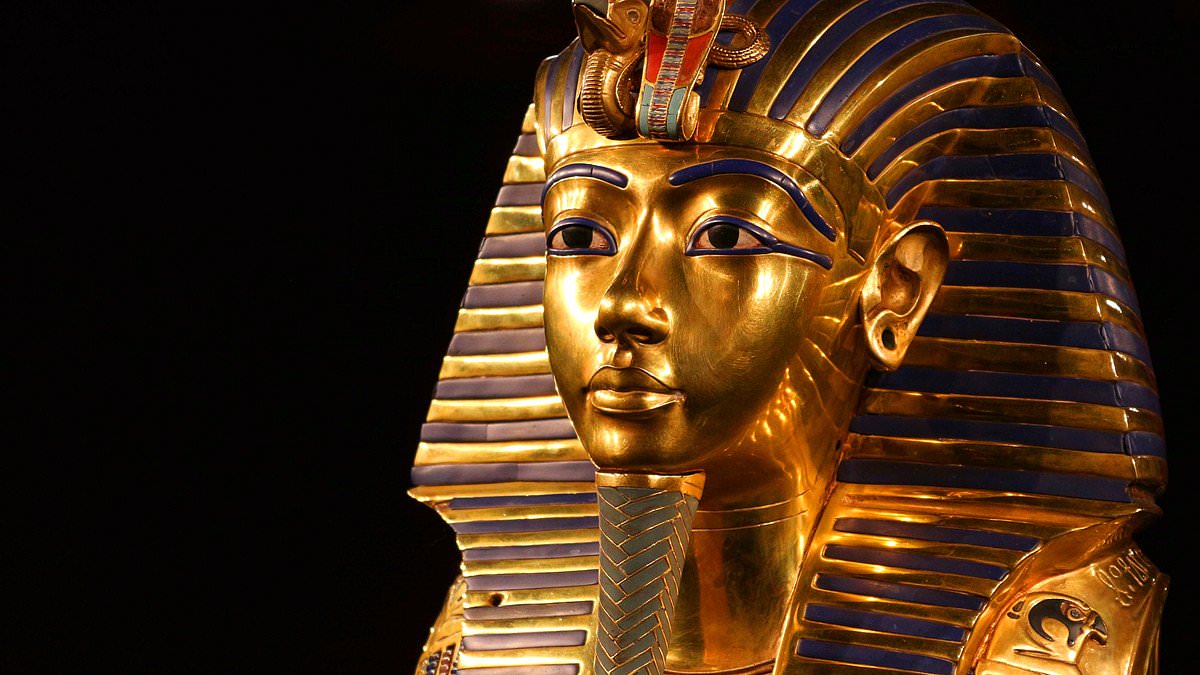
Aspergillus flavus was first thrust in the spotlight in the 1920s after a team of archeologists opened the tomb of King Tutankhamun in Egypt and suddenly become ill. After their deaths, rumors circulated of a curse.
About 50 years later, in the 1970s, a dozen scientists opened the tomb of Casimir IV, who ruled Poland in latter half of the 15th century. A few weeks later, 10 of the researchers died.
Later investigations revealed the presence of Aspergillus flavus.
It’s unclear how many people worldwide are affected by Aspergillus flavus, but it’s believed to kill up to 50 percent of patients it infects by producing spores that attack the liver and lungs, especially in people who are immunocompromised.
In the new study, published Monday in the journal Nature Chemical Biology, researchers looking at Aspergillus flavus samples found they had molecules with interlocking rings, which had never been previously described. They dubbed them asperigimycins.
Even with no modification, they found two of the four variants of asperigimycins they looked at had potent effects against leukemia cells.
They then added a lipid that’s also found in royal honey to another variant of asperigimycins and found the method killed just as many cancer cells as the drugs cytarabine and daunorubicin.
Both drugs have been linked to a roughly 50 to 80 percent remission rate.
The team also found the gene SLC46A3 helps molecules like asperigimycins exit lysosomes, tiny sacs that collect materials that enter cells.
Qiuyue Nie, lead study author and a postdoctoral fellow at the University of Pennsylvania, said: ‘This gene acts like a gateway. It doesn’t just help asperigimycins get into cells, it may also enable other “cyclic peptides” to do the same.’
Roughly 2,000 of these cyclic peptides have been shown to treat diseases like cancer and lupus, an autoimmune condition, but most need to be modified in some way.
‘Knowing that lipids can affect how this gene transports chemicals into cells gives us another tool for drug development,’ Nie said.
However, the asperigimycins had no effect on breast, liver or lung cancer cells, siggesting they only disrupt cell division for certain types of cancer cells.
Nie cautioned findings are still early but mark the beginning of an ‘unexplored region with tremendous potential.’ The team will next test asperigimycins in animals with the hope of moving on to human clinical trials.
Dr Gao said: ‘Nature has given us this incredible pharmacy.
‘It’s up to us to uncover its secrets. As engineers, we’re excited to keep exploring, learning from nature and using that knowledge to design better solutions.’