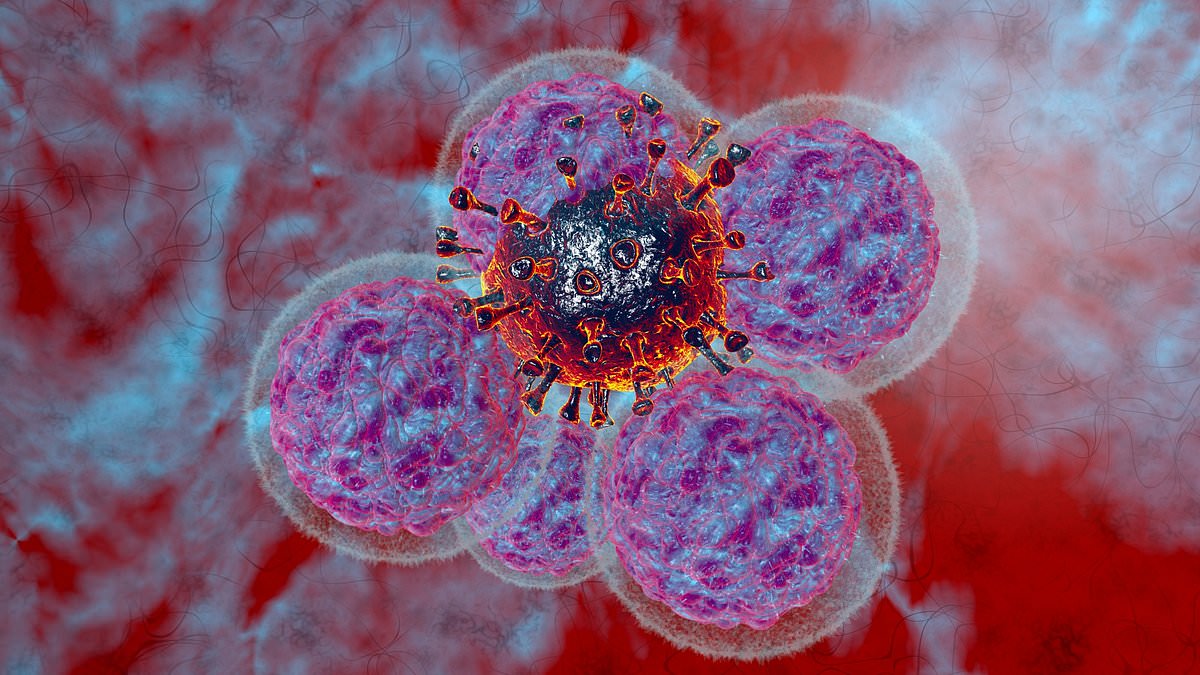

Top experts have developed new ‘natural killer’ cells to fight off cancer and lower the risk of disastrous immune effects.
Researchers from Harvard Medical School and the Massachusetts Institute of Technology (MIT) conducted an experiment where they implanted mice with cancerous tumors and treated them with CAR-NK cells, a type of natural killer cell.
Natural killer cells are found in the immune system and kill invaders without needing to be ‘trained’ to recognize specific dangers.
CAR-NK cells are similar to CAR-T cells in that they are both genetically modified to specifically target cancer cells, and CAR-T cells have been prevalent in cancer therapy.
Yet, a challenge with CAR-NK cells is that they might be rejected by the patient’s immune system, prompting Boston scientists to create a new series of these cells to avoid this issue.
According to the research team, by altering NK cells to ‘silence’ certain properties, they could dodge detection by T cells, which are part of the immune system tasked with attacking foreign threats.
When they gave the mice these modified CAR-NK cells, they stayed in their bodies for three weeks and were able to nearly eliminate the cancer.
In contrast, mice that received either natural NK cells or the typical CAR-NK cells showed these cells vanished within a fortnight, allowing the cancer to persist unchecked.

A stock image shows natural killer (NK) cells, which naturally form part of the immune system. Researchers at Harvard and MIT have developed a revised version with potential to treat lymphoma.
The team also noted these new CAR-NK cells were less likely than standard CAR-T cell therapy to cause cytokine release syndrome (CRS), a side effect of chemotherapy that can cause multi-organ failure.
The genetic modification used took just one additional step, which the researchers believe could make it easier to develop ‘off-the-shelf’ CAR-NK cells that could be given to patients as soon as they are diagnosed.
Traditional CAR-NK and CAR-T cells often take several weeks to develop due to needing multiple steps.
Jianzhu Chen, senior study author and professor of biology at MIT, said: ‘This enables us to do one-step engineering of CAR-NK cells that can avoid rejection by host T cells and other immune cells.
‘And, they kill cancer cells better and they’re safer.’
In the new study, published Wednesday in the journal Nature Communications, researchers modified mice with human-like immune systems and injected them with cells that cause lymphoma, a type of blood cancer that affects the lymphatic system.
Lymphoma affects about 90,000 Americans every year and kills 20,000.
To create CAR-NK cells, doctors take a blood sample from a patient, isolate NK cells and engineer them to express the protein chimeric antigen receptor (CAR), which targets proteins found on cancer cells.
The cells then spend several weeks replicating until there are enough to transfuse into the patient.

The above graph shows the estimated cancer diagnoses for 2025 by cancer type. Breast, prostate, and lung cancers are expected to be the most common cancers this year
Researchers in the study found that NK cells may be able to evade detection by T cells if the T cells did not carry the surface proteins HLA class 1, which are usually expressed on NK cells and trigger T cells to attack if the immune system cannot recognize them.
The team engineered the CAR-NK cells used in the study to express short interfering RNA that stops the genes of HLA 1 from being expressed.
By being modified with CAR, the cells were able to produce the genes for proteins that make NK cells more effective.
Mice who received the modified CAR-NK cells still had them in their bodies for three weeks and had nearly all of their lymphoma cured, while mice receiving normal NK cells or CAR-T cells did not have a response because the cells filtered out of their bodies after two weeks.
In those mice, the cancer continued to spread.
Chen suggested modified CAR-NK cells could eventually replace CAR-T cell therapy. CAR-NK cells are being developed in clinical trials to treat lymphoma and some other forms of cancer, and the Boston researchers believe their findings could be adapted in those studies.
The team is planning to run a clinical trial using their approach and is working with a biotech company to test CAR-NK cells to treat lupus, an autoimmune disorder suffered by 1.5million Americans that causes the immune system to attack healthy tissues and organs