
Share this @internewscast.com

Experts are raising concerns that certain multivitamin brands might be misleading consumers about their Vitamin D intake, creating a deceptive sense of security.
According to an investigation by the Daily Mail, numerous supplements available in Britain fall short of the recommended Vitamin D levels for adults. Despite labeling claims of fulfilling ‘100 percent’ of daily needs, these supplements often fall below the advised amount.
The NHS recommends adults and children over the age of four consider taking a daily supplement of 10 micrograms (mcg) of Vitamin D during the autumn and winter months, due to limited sunlight exposure during these seasons.
Vitamin D, commonly referred to as the ‘sunshine vitamin,’ is synthesized in the skin through exposure to sunlight. It can also be sourced from foods such as oily fish, eggs, and fortified cereals. This essential nutrient is crucial for regulating calcium and phosphate in the body, ensuring the maintenance of healthy bones, teeth, and muscles.
However, the labeling on many supplements is still based on an outdated European nutrient reference value (NRV) of 5 mcg, a standard established decades ago. This figure is now only half of the UK’s current recommended daily intake.
Consequently, products containing 5 mcg of Vitamin D can legally claim to provide ‘100 percent’ of the daily requirement, despite only delivering half of the current governmental recommendations.
Dietitian Dr Carrie Ruxton, from the Health & Food Supplements Information Service (HSIS), said the mismatch risks confusing consumers.
‘We’ve got this really strange anomaly in labelling law where the NRV comes from older European regulations and doesn’t match current UK recommendations,’ she said.
‘People may discover they are low in vitamin D, buy a supplement and see that it contains 100 per cent of their intake and assume that’s enough.
‘In reality, 5mcg is only half of what the UK government recommends. The NRV for Vitamin D is out of date and needs to double.’
Most labels on popular brands of multivitamins available from high street pharmacies reviewed by the Daily Mail continue to use the older NRV system.
Many of the lowest–dose products are gummy supplements, while the number of capsules or gummies recommended per serving also varies, adding further confusion for shoppers.
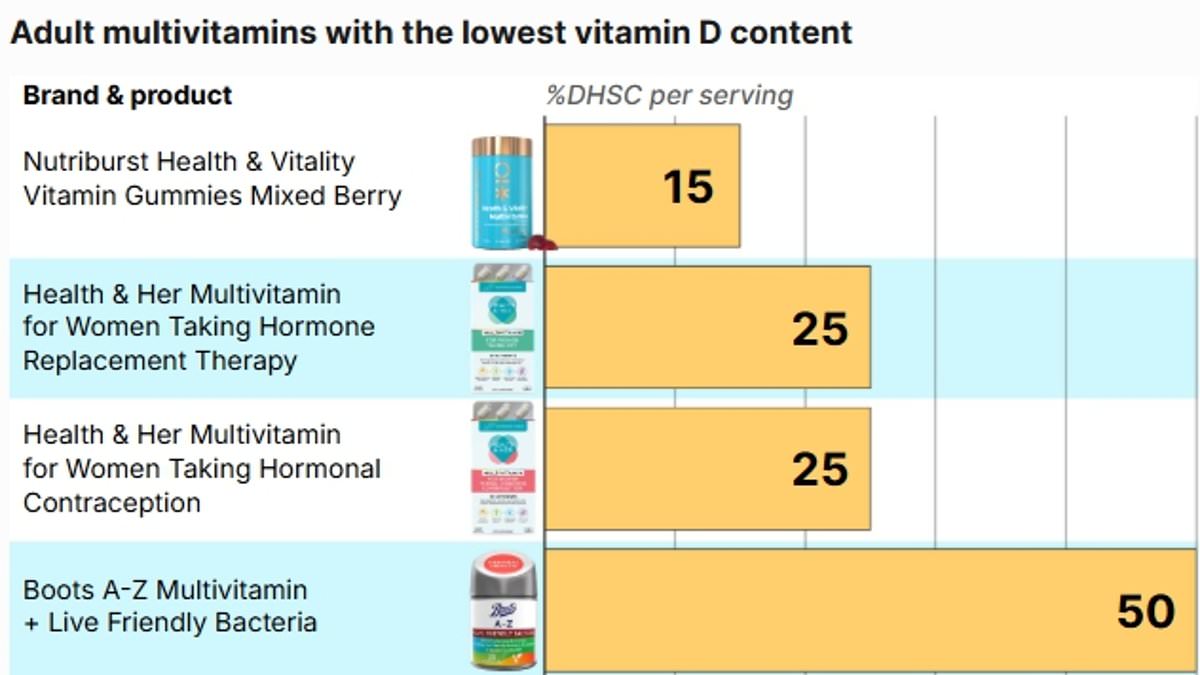
One product, Nutriburst Health and Vitality Vitamin Gummies, contains just 1.5mcg Vitamin D per serving of two gummies, equivalent to 15 per cent of the UK recommendation.
The nutritional information for this product on the Boots website states that the supplements contain 30 per cent of the NRV.
Boots Multivitamin Gummies provide 5mcg per serving, while two products by Health & Her contain 2.5mcg per serving.
On the packaging of the Boots Multivitamin Gummies, it states that per gummy, there is 5mcg of Vitamin D3 and ‘100 per cent’ of the NRV.
For both Health & Her products, the nutritional label says that two tablets ‘typically provide’ 2.5mcg of Vitamin D3, 50 per cent of the NRV.
Even where products do contain higher amounts, serving sizes differ.
Some brands require multiple gummies or capsules to reach their stated dose, meaning consumers must check instructions carefully to understand how much they are actually getting.
| Brand & Product | Vitamin D per serving | % EU guidance (NRV) | % NHS guidance |
|---|---|---|---|
| Nutriburst Health & Vitality Vitamin Gummies Mixed Berry | 1.5 µg | 30 | 15 |
| Health & Her Multivitamin for Women Taking Hormone Replacement Therapy | 2.5 µg | 50 | 25 |
| Health & Her Multivitamin for Women Taking Hormonal Contraception | 2.5 µg | 50 | 25 |
| Boots A–Z Multivitamin + Live Friendly Bacteria | 5 µg | 100 | 50 |
| Boots A–Z + Ginseng | 5 µg | 100 | 50 |
| Boots Multivitamins with Iron | 5 µg | 100 | 50 |
| Boots Everyday Multivitamins | 5 µg | 100 | 50 |
| Boots Multivitamin Gummies | 5 µg | 100 | 50 |
| Boots Multivitamins Orange Flavour | 5 µg | 100 | 50 |
| Centrum Women Multivitamins & Minerals | 5 µg | 100 | 50 |
| Centrum Men Multivitamins & Minerals | 5 µg | 100 | 50 |
| Bassetts Multivitamins Raspberry & Pomegranate Flavour Soft & Chewies | 5 µg | 100 | 50 |
| Gold Collagen Forte | 5 µg | 100 | 50 |
| Chewy Vites Adults Multivitamin Complete | 5 µg | 100 | 50 |
| Seven Seas Cod Liver Oil Plus Multivitamins Omega–3 Fish Oil | 5 µg | 100 | 50 |
| Bettervits Multivitamin Capsules | 5 µg | 100 | 50 |
At the other end of the spectrum, the Daily Mail’s analysis identified one multivitamin containing 45mcg of vitamin D per serving, well above daily guidance but still below the UK’s safe upper limit.
Some supplements use Vitamin D2, also known as ergocalciferol, rather than Vitamin D3, cholecalciferol, which is generally considered more effective at raising Vitamin D levels in the blood.
Excessive Vitamin D intake can, in rare cases, lead to toxicity, causing high calcium levels, kidney problems, nausea, weakness and confusion. However, this is typically linked to high dose supplements rather than diet or sunlight exposure.
In practice, many popular multivitamins provide only half, or even less, of the Vitamin D adults are advised to take daily in the UK, despite claiming to provide up to 100 per cent of the daily requirement.
Food supplements sold in England are regulated but they are not treated as medicines.
Under the Food Supplements (England) Regulations 2003, products must be clearly labelled as ‘food supplements.’ Labels must include key information such as the ingredients, the recommended daily intake, and the name and address of the business responsible for the product.
There are also required safety warnings. Labels must state that the recommended daily dose should not be exceeded, that the product should be kept out of reach of young children, and that supplements should not be used as a substitute for a varied, balanced diet.
If a supplement contains vitamins, minerals, or other substances with a nutritional or physiological effect, the label must show the amount of each so consumers know what they are taking.
There are strict limits on what companies can claim. Supplements cannot be marketed as preventing, treating, or curing disease.
Any health claims must comply with the UK Nutrition and Health Claims Regulation and be authorised.
Unlike medicines, there is no single set of fixed legal maximum levels for all vitamins and minerals in supplements across the UK. Instead, safety is assessed using scientific guidance, and regulators can take action if a product poses a risk.
Following Brexit, the UK retained these rules in domestic law, with responsibility now sitting with UK authorities rather than EU institutions.