Share this @internewscast.com
In her role as the executive director of a non-profit organization and an active participant on various boards, as well as a museum docent, Terry Aretz was known for her ambitious spirit. However, by January 2020, at age 62, she noticed a significant decrease in her usual pace.
“I constantly felt overwhelming fatigue, and my muscles and joints began to ache,” Terry recounts. “One day, after returning from work, I collapsed onto the couch and couldn’t muster the energy to get up.”
A mother of two, Terry had been enduring severe sinus infections for several weeks. Suspecting a link between these infections and her fatigue, she decided to consult an ENT specialist at her local hospital in Montana.
Following a series of scans and a thorough examination, the specialist identified calcification in all the salivary glands on the left side of her face.
“He suggested I was a textbook case for Sjogren’s syndrome,” Terry recalls. “I had never come across the term before.”
Weeks later, Terry received a formal diagnosis of Sjogren’s syndrome, an incurable autoimmune disorder. In the UK alone, it is believed that around 500,000 individuals are affected. Notably, women between the ages of 40 and 60 are nearly ten times more susceptible to the condition than men.
In up to 40 per cent of patients, Sjogren’s causes the immune system to attack healthy joint tissue, leading to inflammation and pain. But it also affects moisture-producing glands, meaning the tell-tale symptoms can be more subtle – dryness of the mouth, eyes and skin.
The disease has also been shown to damage the kidneys, blood vessels, liver, pancreas, nerves and lungs. One in 20 patients may even go on to develop lymphoma, a type of blood cancer.
Treatments have focused on managing symptoms rather than curing the disease. Patients are typically prescribed lubricating eye drops, medications to stimulate saliva and tears, and immune-suppressing drugs such as hydroxychloroquine to help with joint pain and fatigue.
For many, these therapies are ineffective and can cause side effects including severe headaches and nausea.

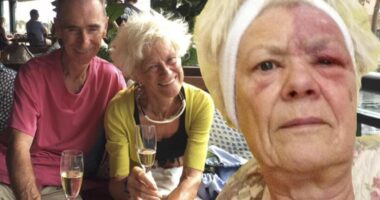
Terry Aretz, with husband Anthony, after the pioneering drug transformed her life
Within weeks of her diagnosis, Terry’s symptoms took a sudden, dramatic turn for the worse.
‘I was completely debilitated by the pain,’ she says. ‘I went from being busy sun-up to sun-down to curled in the foetal position in bed all day, with pain that felt like it ran from my fingertips to my toenails.’
Today, however, Terry’s life has been transformed. She is back spending time with her family, meeting friends for lunch and even exercising again.
The solution? A pioneering monthly injection experts hope will soon be rolled out on the NHS.
Called ianalumab, the drug blocks and then destroys immune cells that attack the body’s tear and saliva-producing glands. In ltrials, it rapidly and significantly reduced Sjogren’s symptoms.
The treatment has been granted breakthrough therapy status by the US Food and Drug Administration – a designation designed to fast-track drugs targeting serious or life-threatening conditions.
Experts say it could be available on the NHS in the next few years. ‘It could be revolutionary,’ says Prof Simon Bowman, consultant rheumatologist at University Hospitals Birmingham NHS Trust.
Ianalumab would be the first targeted treatment for Sjogren’s disease and could help prevent – and even repair – long-term damage caused by the condition.
By treating the underlying cause of the disease, Prof Bowman adds, the drug could reduce the risk of more serious complications.
For Terry, access to the treatment came in a clinical trial – at a hospital six hours drive away.
The journey was excruciating, Terry recalls – particularly as there was no guarantee she would receive the drug.
But within a few months she knew she was receiving the real thing. ‘A doctor would do an examination in each visit and they began to note changes, like my saliva production rising 60 per cent,’ she says.
‘My fingernails and hair started growing again, my eyes were less dry and, three months in, I could get out of bed.’
Symptoms she had dismissed for decades cleared up – dry eyes, skin irritation from perfume or make-up and even Raynaud’s phenomenon, in which poor blood flow causes the fingers and toes to turn cold and purple.
After a year, when the trial ended, Terry was offered the option of staying on the drug for five more years, ahead of its wider rollout. She accepted immediately.
Ianalumab is not entirely without side effects. For Terry, it causes occasional low moods.
Prof Bowman adds it will not work equally well for everyone. But there are similar medications in development that might.
Terry believes she is proof of the potential of these treatments.
‘I can participate in life again,’ she says. ‘I’m so excited for this drug to come out for everyone.’