
Share this @internewscast.com
Do you find yourself constantly applying lip balm or frequently reaching for eye drops and nasal decongestants?
While these readily available over-the-counter products might seem innocuous, experts caution that excessive use can inadvertently create a vicious cycle, where the supposed remedy exacerbates the initial issue.
In more concerning scenarios, this dependency might escalate to the point where professional medical intervention becomes necessary.
Victoria Tzortziou Brown, chair of the Royal College of GPs and a primary care and health policy professor at Queen Mary University of London, notes, ‘As general practitioners, we occasionally encounter patients who overuse over-the-counter (OTC) remedies, particularly when used more frequently or for extended periods than recommended.’
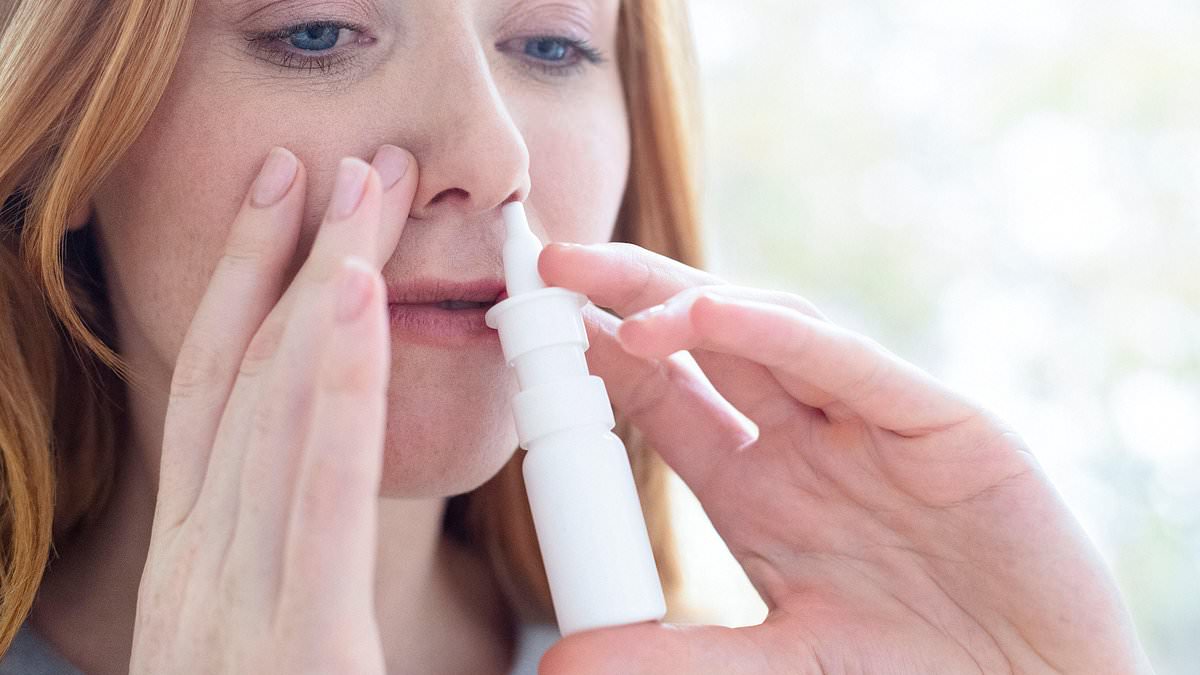
Nasal decongestants often illustrate this overuse.
Earlier this year, the Royal Pharmaceutical Society (RPS) highlighted the mounting issue of individuals excessively using nasal decongestant sprays.
These sprays – typically containing xylometazoline or oxymetazoline – work by shrinking swollen blood vessels inside the nose which can become inflamed and swollen when you have a cold, flu or a sinus infection – this in turn reduces the swelling, helping to clear congestion.
However, used for more than a week, they can damage the tiny hair-like structures in the nose that help clear mucus and protect against infection, potentially increasing the risk of sinus problems.

Used for more than a week, nasal decongestant sprays can damage the tiny hair-like structures in the nose that help clear mucus and protect against infection, potentially increasing the risk of sinus problems
Surveys by the RPS found that 60 per cent of pharmacists believe patients are unaware of this risk, while 63 per cent reported they have intervened in cases of suspected overuse – recommending alternatives free of chemicals that cause the problem, or refusing further sales of nasal sprays.
Even more concerning, research by Ipsos and ITV News suggests more than a fifth of adults use these sprays for longer than the recommended week – putting an estimated 5.5 million people in the UK at risk of dependency and ‘rebound congestion’, causing worse congestion, making it harder to breathe.
‘The medicines contained in decongestant sprays work on receptors in the blood vessels which cause them to constrict,’ explains Dr Helen Wall, a GP based in Bolton.
‘But with repeated use the medicines can become less effective – and when the drugs wear off you get rebound vasodilation: the vessels dilate quickly, you get a rush of blood which causes inflammation and swelling, and leads to congestion again.’
This creates a frustrating cycle – more spray, temporary relief, then worse congestion. ‘Usually, you’ll get congestion from day three to five of a cold, so use it for a limited number of days and stop as soon as it starts to improve,’ says Dr Wall.
If you’re struggling to limit use, she suggests over-the- counter decongestant tablets such as Sudafed instead – which take longer to relieve symptoms, but are less likely to trigger dependency.
And if you think you’re already dependent, talk to your pharmacist, who can recommend alternatives, says Professor Amira Guirguis, chief scientist at the RPS. These include saline sprays, menthol-based products and steam inhalation.
But nasal sprays aren’t the only over-the-counter, everyday products that we can become dependent on, with potentially negative consequences…
Eye drops
Eye drops to banish redness – caused by allergies, dry eyes or tiredness, for instance – can create a similar cycle to decongestants and ‘you can get rebound redness’, says Professor Guirguis.
‘They act by narrowing the blood vessels on the surface of the eye to reduce the redness. But when that effect wears off, the blood vessels widen again, causing the redness to return – and this leads to repeated use.’

Dr Helen Wall, a GP based in Bolton, says that repeated use of some medicines can make them less effective
These products, which often contain ingredients such as the decongestant naphazoline (which makes blood vessels constrict), only treat the appearance of redness rather than the underlying cause – and as they are less effective with repeated use, the rebound effect means the eyes can look even redder than before you started, adds Dr Wall.
‘Plus, more worryingly, long-term use of drops that restrict blood flow and oxygen supply to the eyes may cause chronic redness, irritation and inflammatory changes of the eye surface.’
Warning signs you’ve become overly reliant on the drops include needing to apply them several times a day, redness returning within hours, or symptoms such as blurred vision or watery eyes, says Professor Guirguis. The key is to treat the cause – not just the redness; for example, using eye drops containing antihistamines for an allergy.
Sleeping tablets
Any over-the-counter sleeping aid, including Nytol (which contains a sedating antihistamine), can cause an over-reliance, says Dr Wall.
‘Often these products work initially and then you become tolerant and they don’t work as well. But you feel even worse if you stop taking them, because you believe you won’t sleep without them, so it can be a psychological addiction.’
Another problem is that over-the-counter sleeping tablets – even lavender pills, some studies suggest – act on GABA receptors in the brain, producing a calming effect, but frequent use can disrupt the body’s natural sleep mechanisms. ‘You end up relying on external influence and your body stops being able to do this naturally, making sleep problems worse,’ says Dr Wall.
Lip balm
‘Some lip product formulas can create a cycle where irritation or dryness makes people feel the need to apply more,’ says Professor Guirguis.

Repeated use of lip balms containing peppermint, menthol, salicylic acid, camphor and alcohol all irritate the lips, or remove natural oils from them
A 2024 review found that repeated use of lip balms containing peppermint, menthol, salicylic acid, camphor and alcohol all irritate the lips, or remove natural oils from them, reported the journal Cutaneous and Ocular Toxicology.
These ingredients can make lips tingly and irritate already chapped skin, explains Dr Wall. This irritation can lead to more dryness and make you lick your lips – which dries them further.
‘If you’re using a lip balm every 30 to 60 minutes, it’s a sign you’re overusing it,’ says Professor Guirguis.
Stick to simple products such as petroleum jelly and lanolin, which create a barrier on the lips that lasts a few hours – keeping water under the skin to retain the moisture – and stay hydrated.
Painkillers
‘Taking [OTC] painkillers such as paracetamol or ibuprofen too often can result in a medication-overuse headache,’ explains Professor Guirguis.
‘Over time, the brain can become more sensitive to pain signals and when the medicine wears off, this sensitivity can trigger another headache, which often leads to people taking more painkillers – and thus creates a cycle of repeated headaches.’
This condition affects around 1 to 2 per cent of the population, particularly those prone to migraines or frequent headaches.
‘Painkillers shouldn’t be used more than twice a week and are not designed to be used long term,’ says Professor Guirguis.
‘The good news is that medication-overuse headaches are usually reversible once the medication is reduced or stopped.’ Talk to your pharmacist if you’re concerned.
Hand cream
Some moisturising hand creams can make dry hands worse. ‘This is most likely with fragranced hand creams, because the chemicals can make dry, cracked skin become inflamed and irritated,’ says Professor Guirguis.
Fast-absorbing creams may also leave little protective barrier, allowing moisture to escape quickly, so you reapply often.
Hand creams should keep your hands moisturised for two to four hours, so if you’re having to apply it every hour or less, it’s clearly not working as it should be, adds Dr Wall.
Professor Guirguis says: ‘Switching to thicker, fragrance-free creams containing ingredients such as glycerine, ceramides or shea butter can help repair and protect the skin barrier.’
Nicotine replacement therapy
Nicotine replacement products – such as patches, gum and lozenges – are designed to help people quit smoking, but while they avoid the other harmful chemicals found in cigarettes, nicotine itself is still a stimulant.
‘Nicotine is nicotine, whether it’s in a cigarette or a nicotine replacement product,’ says Dr Wall. ‘It can increase blood pressure, constrict blood vessels and potentially cause cardiovascular issues if used long term.’
Using these products for six to nine months is usually long enough – but if you’re still relying on them after a year, it can be a sign that you’re addicted to them, she adds.
‘You can swap an addiction to cigarettes for an addiction to nicotine products.’
In this case, ask for a review with a pharmacist or GP for a new plan to help you stop smoking.