
Share this @internewscast.com
Victoria Privett cherishes the significance behind each of her seven tattoos, yet she finds herself in the process of having one removed—not because she regrets it, but due to health concerns.
The trouble began a month after she adorned her hip with an intricate phoenix tattoo. Victoria, who frequently used the same hair dye, experienced an alarming reaction: “Within minutes of applying the dye, my scalp began tingling and then burning,” she recounts.
Victoria, a 33-year-old content creator known for her equestrian videos on social media, initially dismissed the incident. But when she dyed her hair again two months later, the reaction was even more severe.
“The burning was unbearable,” she recalls. “It was immediate and incredibly painful. I had to wash it off earlier than usual.”
Her scalp remained irritated and sore for several days after the episode. The situation escalated when she went to have her eyebrows tinted a few weeks later.
“I’d had my eyebrows tinted before without any issues,” she explains. “But this time, my brows swelled, itched intensely until they bled, and eventually scabbed over. My face was swollen for days. I couldn’t understand why I was suddenly having these reactions to products I had used without problems in the past.”
The answer lay with her tattoos.
In fact, tattoos commonly trigger allergies to hair dyes or to the tattoo itself, says Dr Jonathan Kentley, a consultant dermatologist based in London.
It happens ‘because the process of tattooing places chemical substances permanently into the dermis – a layer of skin that is closely monitored by the immune system, and your body recognises it as something foreign’, he explains.

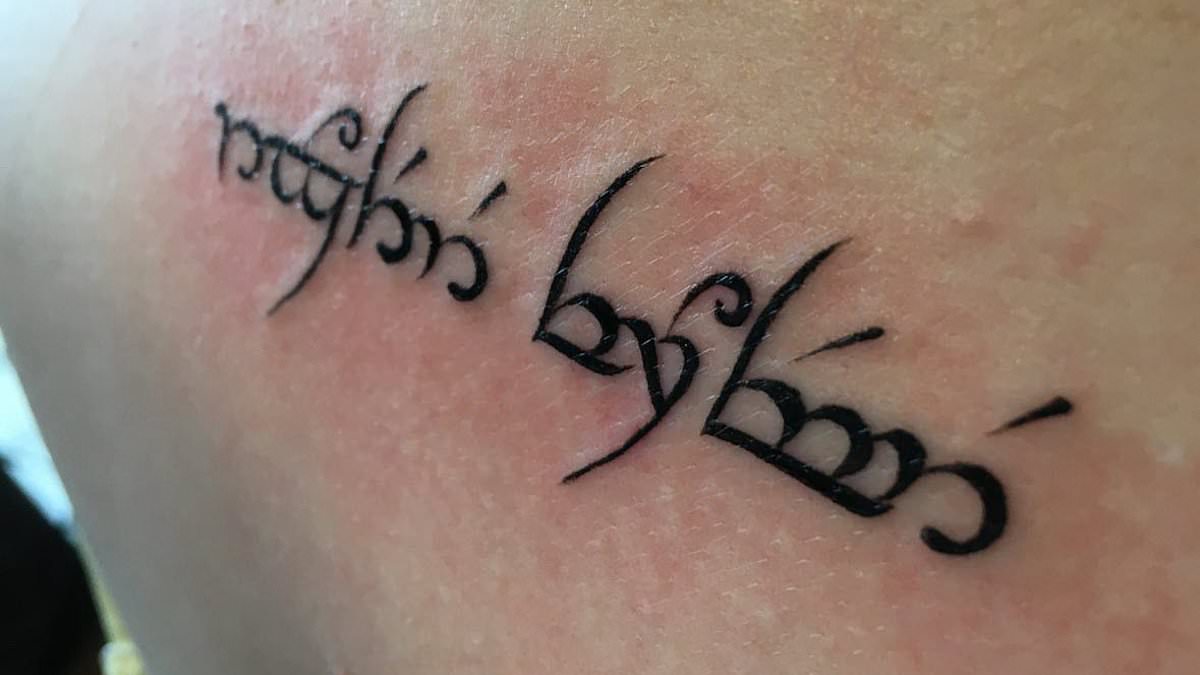
Victoria suffered an allergic reaction to a large phoenix tattoo on her hip and this tattoo on her back, which is in Elvish, a language invented by Lord of the Rings author JRR Tolkien

Victoria, 33, is a content creator who makes equestrian videos for social media platforms
‘In some people, the immune system recognises components of the ink as harmful and mounts an allergic response.’
This is usually a delayed type of allergy, he adds, ‘meaning it may not appear immediately – you won’t necessarily react when you have the tattoo.
‘Reactions can develop months – even years – after the tattoo was done, and is sometimes triggered by factors such as sun exposure, infection, trauma or changes in immune health.’
This might then not only cause a reaction to the tattoo, but the fact it will be there permanently on the skin means that the body may then be sensitised and react when it comes into contact with components of the tattoo dye – also found in hair dyes and some other cosmetic products.
And the more tattoos you have, the likelier this is to happen.
As Dr Kentley, who is also a spokesman for the British Skin Foundation, explains: ‘If someone is already allergic to a tattoo pigment, any amount of ink could trigger a reaction.
‘However, the more of the pigment delivered into the skin – i.e. via large or multiple tattoos – the greater the risk of you becoming sensitised to the allergen, and in turn developing an allergy.’
The chance of developing an allergy varies according to the colour of the tattoo.

Dr Jonathan Kentley, a consultant dermatologist based in London
‘Red ink is the most notorious,’ says Dr Kentley. ‘Historically, red pigments often contained mercury sulphide, and although modern inks may no longer use mercury, many still rely on complex dyes or metal-based compounds that are able to stimulate an allergic response.
‘As a result, red tattoos are disproportionately associated with chronic itching, swelling, scaling and raised lumps that can persist for years.’
This is the explanation supported by a 2020 study published in the journal Contact Dermatitis which found that red ink tattoos ‘are prone to’ triggering allergic reactions. The findings came from analysis of more than 100 skin biopsies from people with tattoos.
However, Dr Kentley says black tattoos are also commonly implicated by delayed allergic reactions, because many contain para-phenylenediamine (PPD) – a chemical dye widely used in hair dyes and black henna tattoos.
‘Not all black tattoos will contain PPD, but it is a very common allergen – often found in hair dyes and temporary tattoos – which people can develop an allergy to even despite multiple exposures in the past,’ he says. ‘This is why patch tests are usually recommended.’
‘People sensitised to PPD – which can occur with repeat exposure to hair dye, too – appear to have a higher risk of reacting to certain tattoo pigments later on.’
Meanwhile, yellow and orange inks can also cause reactions, particularly photosensitive ones that worsen with sun exposure, says Dr Kentley.
‘This is usually related to the yellow pigment cadmium sulfide – when exposed to light, this can become phototoxic which means it produces compounds that can damage skin cells, causing inflammation.’
And some people may have an allergy to metals found in tattoo ink pigments, too, such as nickel, cobalt and chromium,’ adds Dr Kentley.
All of which may come as a surprise to the millions of tattooed Britons – a quarter of people in the UK have one, according to a YouGov poll in 2022.
Yet many are unaware of the risk when they start getting tattoos. Victoria, who lives in Hampshire with her husband, got her first tattoo aged 18.
‘I loved it and it had meaning to me – and within two years, by the time I was 20, I had seven,’ she says.

Victoria, who lives in Hampshire with her husband, got her first tattoo aged 18

It was months after her brow tint reaction that Victoria discovered from a friend that it could be linked to her tattoos
The last tattoo she had was particularly intricate – it took three days to complete – and was formed of lots of red ink.
It was months after her brow tint reaction that Victoria discovered from a friend that it could be linked to her tattoos.
‘I was wearing a hat because my head was still so puffy, itchy and painful,’ says Victoria. ‘My friend asked why I was wearing a hat, and I explained what had happened, to which she replied: “Did you know tattoos can cause hair dye allergies?” I’d had no idea.’
Victoria thinks the large amount of ink used in the design is what kickstarted the allergy. ‘This was the last tattoo I had and the most time-consuming, so it can only be that which brought on the allergies,’ she says.
Treatment for a tattoo-triggered allergy is ‘challenging’, says Dr Kentley, ‘because the allergen cannot easily be removed from the skin’.
Mild reactions may respond to topical steroid creams to reduce inflammation and itch.
In more persistent cases, steroid injections into the affected area or short courses of oral anti-inflammatory medication may be needed.
‘Unfortunately, some reactions are resistant to treatment and continue to flare intermittently,’ says Dr Kentley.
‘And laser tattoo removal is controversial with allergic tattoos because it can potentially worsen the reaction by breaking down the pigment into smaller fragments.’
In some cases the tattoo may need to surgically removed, but ‘this is a last resort and generally only feasible for smaller tattoos’, says Dr Kentley.
‘In the case of larger tattoos causing an allergy, there have been cases where a skin graft is needed to cover the area after surgery to remove it.’
Victoria is halfway through having her large tattoo removed by laser to limit further allergic reactions, but it is time-consuming.
‘I don’t regret my tattoos as they were meaningful,’ she says. ‘I just wish I could dye my hair and tidy my brows. I have long hair, which is my main feature, and I used to love putting colour in.’
Meanwhile, Dr Kentley adds that tattoos are not only a cause of allergies: ‘Tattoo ink can cause a range of other skin issues,’ he adds.
‘These include infections or specifically granulomatous reactions – where the immune system recognises pigment as foreign and tries to wall it off – which usually presents as hard lumps and bumps within the tattoo that can be red or skin-coloured.’
Tattoos can also cause flare-ups of medical conditions such as sarcoidosis – a rare condition that occurs when the body’s immune system is overactive, causing tiny clusters of inflammation in areas such as the skin, eyes and lung.
Another condition, lichen planus, occurs when the body’s immune system mistakenly attacks the skin, causing itchy bumps – or a phenomenon called Koebnerisation, where it flares up in areas following an injury to the skin, such as the site of a tattoo.
‘Tattoos can also obscure skin cancers, delaying their detection,’ says Dr Kentley.
And in June 2024, a study of almost 12,000 people in Sweden found that those with tattoos had a 20 per cent increased risk of some types of lymphoma, a type of blood cancer.
‘However, this was only one study and there is still much research to be done in this area,’ says Dr Kentley.
Victoria is hopeful the laser removal will end the allergic reactions that have now affected her for ten years.
‘It’s annoying not being able to dye my hair, but I can’t take the risk,’ she says. ‘I’m hopeful laser tattoo removal will mean these allergic reactions will stop.’