
Share this @internewscast.com
“Mom, do you think I need to do something about this slight line?” my 23-year-old daughter Grace asked, gesturing towards what I saw as her perfectly smooth, youthful forehead.
By “do something,” she was referring to Botox injections, and my heart sank. My immediate response was, “But you have such a naturally beautiful, young face; you really don’t need it.”
It puzzled me why Grace would even consider anti-aging injections at her age, where they’re clearly unnecessary. Was I surprised? Not really.
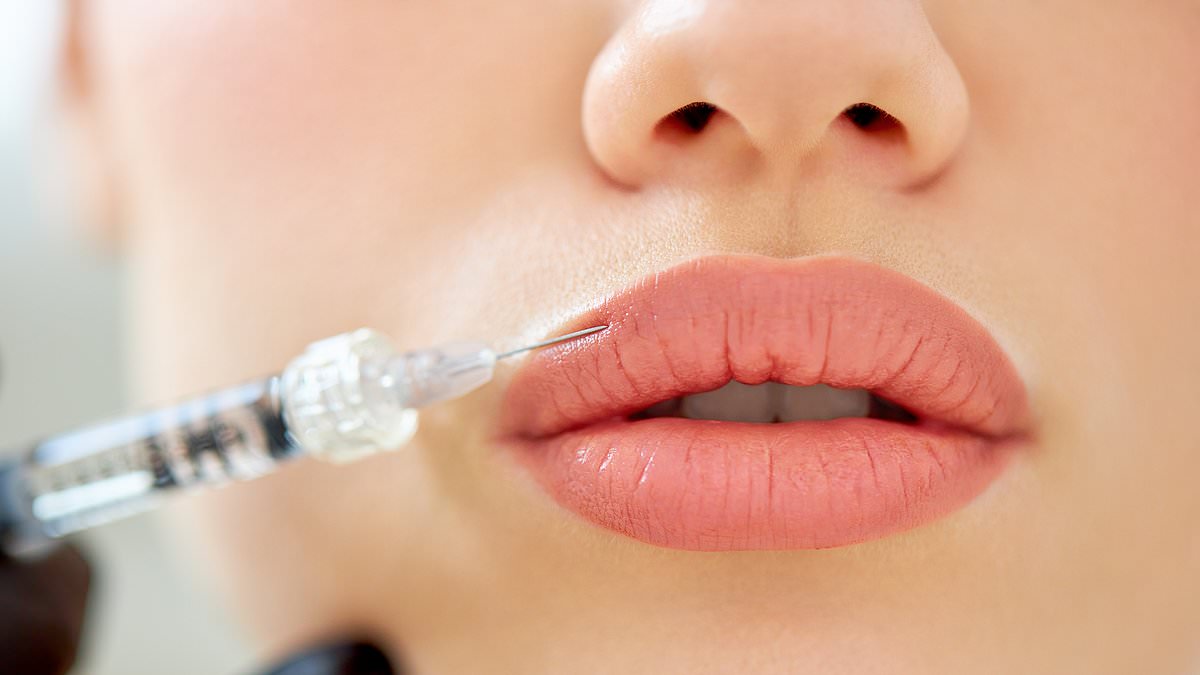
As a consultant dermatologist working both for the NHS and in private practice, I frequently encounter young women in their 20s—or even younger—inquiring about anti-aging procedures. These treatments, often called “tweakments,” include Botox to smooth fine lines and fillers, such as hyaluronic acid, to restore volume to the cheeks and fill in wrinkles.
This growing trend is fueled by the belief that starting cosmetic anti-aging treatments early can somehow “stop” skin aging in its tracks.
The concept took off in 2013 when an American dermatologist introduced the term “prejuvenation,” a catchy but scientifically unsupported blend of prevention and rejuvenation. Despite lacking a solid scientific foundation, this idea has rapidly gone viral over the past five years, spreading across social media and influencing millions of young people.
And judging by the number of requests I get – and posts I see online – it’s caused a cultural shift so intense that numerous young people (mainly girls) feel compelled to adopt this approach.
It really concerns me because not only does it expose young girls to risks that just aren’t warranted, but it’s also potentially a complete waste of time and money.

Dr Justine Hextall’s daughter Grace, who is 23 years old, asked her mum if a slight line on her forehead needed treating
And as I shall explain, it may have the opposite of the desired effect – and make younger women appear older than their years.
When a facial muscle contracts, as it does when we squint or frown for example, it shortens – and the overlying skin folds, emphasising lines in the skin. Botox works by blocking the release of chemical messages that run from the nerves to make facial muscles contract – as a result, the muscles relax and this eases out fine lines.
But if you aren’t using a muscle because it’s been frozen in this way, there’s a risk of muscle atrophy – or weakening.
There have been worrying findings in animal studies suggesting that long-term use of botulinum toxin may lead to wasting or weakening of the muscles.
Studies in rabbits and rats found that muscle strength did not return to normal six months after the last injection.
Following such findings, the authors of a 2023 review published in Clinical Neurophysiology Practice said that ‘serial and repeated injections’ (as may occur if you start young) could cause muscle atrophy ‘that is impossible to reverse’, and called for longer term studies.
The point is, we know if you start Botox injections in middle age – ideally not before the mid to late 30s – the risk is minimal, but we can’t give the same reassurance to someone who starts at 20, because we just don’t know.
And, critically, at 20 they don’t need Botox, and without the need there is no point in exposing them to the risk.

Fillers, when accidentally injected into the wrong place, can cause blocked blood vessels which can lead to tissue death, ulcers, unsightly scars or even blindness
Fillers, too, are not without their dangers. If accidentally injected in the wrong place, filler may block a blood vessel – and if that feeds the eye area, that risks blindness. Elsewhere, this may lead to tissue death, ulcers and unsightly scars.
Another risk is infection. Again, as 20-something skin doesn’t need filler to plump it up, the risk is not worth the supposed benefit.
Plus, the cheaper places younger people may be drawn to might not have the safety checks you’d hope for. While Botox can be given only by someone medically trained who can write a prescription, with filler anyone can do it.
What’s more, MRI scans have revealed many fillers don’t dissipate quickly, they hang around for years – what that means for someone having this in their 20s in the long term, we just don’t know.
For people in middle age, the risk-benefit ratio is clear – I’ve had a little Botox in my forehead twice a year since my early-40s – but for younger people, it simply isn’t justified.
Sometimes in clinic I wonder how we got to this stage.
On top of fending off requests for Botox from 20-somethings (which we always politely turn down), increasingly I’m having to treat young people for skin complaints, brought on by using strong anti-ageing products never intended for younger skin – such as retinols, which speed up the turnover of skin cells, allowing plumper new skin to appear.
But in your 20s, skin is already plumped and cell turnover is already quick, so over-zealous application of retinol may simply strip the skin’s outer protective barrier and leave you vulnerable to inflammatory conditions.
Young women come to me for help with allergies, eczema and perioral dermatitis (small pustules and areas of scaly, inflamed skin, often around the mouth) – a condition we used to see much less in this age group than we do now.
I fear this generation of young girls is vulnerable like no other. Their lives are lived on social media and they’re so used to seeing filtered, enhanced images that they forget what a real working face looks like.
When young patients tell me they need Botox to iron out their wrinkles, I ask them to show me what they mean. They then frown and what I see is not a sign of ageing, it’s their face moving entirely naturally – movements that are in fact necessary.
For example, movement of the corrugator supercilii muscles above your eyebrows is, in time, the main cause of the glabellar lines running down your forehead, between your brows (sometimes nicknamed ‘11s’). But this muscle also makes you automatically squint in bright light to protect your sight – having Botox there means you can’t squint as easily.
Crucially, there’s no evidence that Botox in your 20s will stop that line appearing in your 50s. So if you don’t have a line in your 20s, what’s the point?
And the sad thing is that having Botox or fillers at a young age could actually make young girls appear older. Because the brain is no fool, it can spot when something is ‘off’ about the face.
There’s an area of the brain called the fusiform face area, which helps us to ‘read’ faces. Not only does it help you recognise people, but it assesses the proportions and space between features. Other brain areas assess facial movements and signs of emotion (such as frowning).
It’s all part of an evolutionary trick to help us identify healthy, fertile mates. When you meet someone, this complex system flicks into life to ‘judge’ the age of the face. It then predicts what that face should look like and if someone is young and healthy it expects to see supple, hydrated even-toned skin that reflects light well – and a face that moves and has lots of micro expressions.
But a face partially frozen by Botox or plumped with filler may not match the prediction. As a result, our brain sends an alerting message to run further checks – to watch more carefully for micro movements, for example.
The result is the brain registers that this isn’t the youthful face it may have first appeared to be. It’s why you experience that moment where you find yourself thinking ‘something doesn’t fit about that face’ or ‘what has that person done to their face?’
The frustration for me is there are ways young women can care for their skin without drastic measures. Around 80 per cent of visible ageing is to do with external aggressors such as UV light and pollution, which both kickstart an enzyme that breaks down collagen and elastin – which provide skin’s scaffolding and give that elastic, youthful quality.
Sometimes people compliment me on my skin and I think it has a lot to do with the fact I’ve worn sunscreen every day since I was 23.
I’m also a firm believer in using vitamin C serum (a form of antioxidant) every morning that can help protect against damage from UV and pollution.
That, together with plenty of water, a good diet, a gentle, effective moisturiser to keep skin hydrated (which in the end is what I managed to convince Grace was all she needed) and a gentle cleanser is all these girls require.
Remember: Our faces, like our bodies, evolve. Young people shouldn’t be worrying about what they might look like decades down the line. It’s a waste of their youth.
INTERVIEW: LUCY ELKINS