
Share this @internewscast.com
The United States has reached a troubling new threshold in its ongoing measles outbreak, exceeding 2,000 cases for the first time in over thirty years. This resurgence marks a significant setback for a disease that was once declared eliminated in the country back in 2000.
The relentless spread of measles, notorious as the world’s most contagious disease, has been exacerbated by a severe outbreak last year in Texas. This outbreak primarily affected an unvaccinated religious community, highlighting the critical role of immunization in disease prevention.
As of December 30, 2025, the measles virus has afflicted 2,065 individuals across the nation, resulting in three fatalities. This represents the most significant outbreak since 1992, when 2,126 cases were reported. Health experts express growing concern that this number may continue to rise.
In a span of less than two weeks, the Centers for Disease Control and Prevention (CDC) reported an increase of 107 new measles cases. Notably, Connecticut recorded its first case since 2021, signaling the disease’s alarming reach.
The outbreak’s impact is evident across several states. South Carolina saw its cases climb from 142 to 181, while Utah’s numbers rose from 122 to 156. Arizona reported 14 fresh cases, bringing its total to 196. Additionally, California and Nevada each reported a few new cases.
In South Carolina, cases grew from 142 to 181; Utah’s outbreak increased from 122 cases to 156 cases; Arizona saw 14 new cases, totaling 196; California recorded two new cases; and Nevada recorded an additional case.
In 2024, South Carolina had one measles case, Utah had zero, Arizona had five, California had 12 and Nevada also had zero.
In 2025, Texas recorded the most measles cases at 803. There was one case in 2024.
The measles had been declared eliminated in the US 25 years ago as there was no prolonged or local transmission of the disease – many cases were travel-related, with Americans contracting the virus abroad and returning home to the US.
However, as cases grow, public health experts fear the US will lose its measles elimination status in the near future.
Measles, mumps and rubella are prevented via the MMR vaccine. The nationwide MMR vaccination rate is 92.5 percent, but in Utah, just 89 percent of kindergartners were vaccinated for the 2023-2024 school year.
In South Carolina, that number is 92 percent, and it is 89 percent in Arizona.
The MMR is 97 percent effective in preventing infection for those who receive both doses, according to the CDC. One dose is 93 percent effective.
Dr Renee Dua, medical advisor to TenDollarTelehealth, previously told Daily Mail: ‘The current measles outbreaks in the US are a direct consequence of falling childhood vaccination rates.
‘Measles requires about 95 percent community immunity to prevent spread, and many regions are now below that threshold.’
Dr Dua continued: ‘We are seeing real consequences: preventable outbreaks, hospitalizations, and deaths from diseases that were previously well controlled. These are measurable public-health failures.
‘Vaccines remain among the safest and most effective tools in medicine. Rebuilding trust through clear, evidence-based communication is now as critical as vaccine access itself.’
Measles is considered the world’s most infectious disease because people who are not vaccinated have a 90 percent chance of getting sick if they are exposed, even from sharing the same air, briefly or hours later, with someone who has measles.
Three in 1,000 people who contract measles will die.

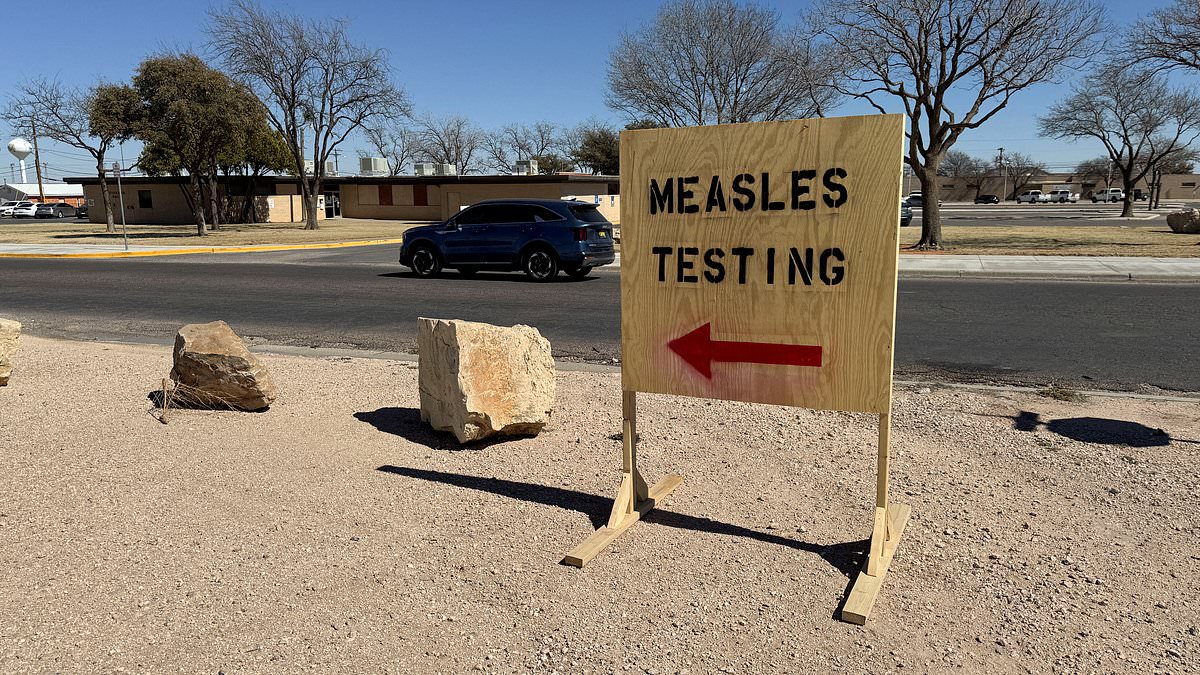
A sign reading ‘measles testing’ is seen as an outbreak in Gaines County, Texas, has raised concerns over the disease’s spread in February 2025

Measles is an infectious, but preventable, disease caused by a virus that leads to flu-like symptoms and a rash that starts on the face and spreads down the body (stock image)
Of the current cases, 537 are in Americans under 5 years old; 865 are in 5- to 19-year-olds; 650 are among Americans 20 and older; and 13 cases are in people of unknown age.
According to the CDC, 93 percent of cases are in people unvaccinated or have an unknown vaccine status. Three percent have received one dose of the MMR vaccine and four percent have received both doses.
Of those sickened in the US, 235, 11 percent, are hospitalized, with the majority of those, 20 percent, being children under 5.
Measles is caused by a virus that leads to flu-like symptoms, a rash that starts on the face and spreads down the body, and, in severe cases, pneumonia, seizures, brain inflammation, permanent brain damage, and death.
The virus is spread through direct contact with infectious droplets or through the air.
Patients with a measles infection are contagious from four days before the rash through four days after the rash appears.
Deaths typically occur from acute encephalitis, or brain swelling, when the virus travels to the central nervous system, or pneumonia if it migrates to the lungs.
Before the current two-dose childhood vaccine’s approval in 1968, there were up to 500 US deaths each year from measles, 48,000 hospitalizations and 1,000 cases of brain swelling.
Roughly three million to four million people were infected every year.