
Share this @internewscast.com

Kerry Brown with sister Leah, sister-in-law Kerri and friend Teresa (Image: Brain Tumour Research/SWNS)
A mother attributed her hot flushes and ‘tingling sensation’ to the menopause – until scans uncovered she had 10 brain tumours. Kerry Brown, 54, started experiencing hot flushes and ‘tingling sensations’ in 2017 that she presumed were hormonal and connected to the menopause.
Kerry Brown, a 54-year-old mother, initially dismissed her hot flashes and tingling sensations as typical symptoms of menopause. But routine assumptions took a dramatic turn when medical scans unveiled the presence of 10 brain tumors.
Her journey began in 2017 when she started experiencing what she believed were menopause-related symptoms. These symptoms gradually worsened over two years, leading to severe fatigue and slurred speech. It wasn’t until her vision began to decline that she sought further medical advice. A visit to the optician revealed swelling behind her eye, prompting a referral for an MRI scan.
The results were startling: the scan identified four brain tumors requiring surgical intervention in July 2019. However, once in surgery, doctors discovered a total of 10 tumors. They managed to remove five, while the others were monitored under active surveillance.
In the years following her surgery, Kerry has faced additional challenges. She has experienced intermittent seizures and has lost sight in one eye due to a tumor pressing on her optic nerve. A recent medical evaluation revealed that two of the tumors have started to grow again, prompting a course of radiotherapy.
Reflecting on her experience, Kerry, who works as a production manager in Hull, shared, “Initially, the hot flashes and tingling felt like menopause. I never imagined it was something serious. But then I started to go pale, slur my words, and feel overwhelmingly tired. I didn’t realize the gravity of the situation.”
Kerry Brown began experiencing strange sensations that she assumed were hormonal and related to the menopause (Image: Brain Tumour Research/SWNS)
Read more: ‘Key nutrient’ boosts immunity and energy
Read more: Teen’s back pain and loss of appetite ‘dismissed’ before mum left in tears
Read more: Discover how a ‘Key nutrient’ can enhance immunity and boost energy.
It emerged that the ‘hot flushes’ Kerry had attributed to menopause were in fact seizures. A Specsavers optician referred Kerry to hospital after noticing swelling behind her eye. An MRI scan was conducted and a few days later, she received an urgent call to return to the hospital.
She recalled: “I remember walking in and seeing pictures of brains on the wall and thinking ‘this can’t be good’. The consultant asked whether I’d been having headaches and if I could walk upstairs, before explaining they had identified four brain tumours. I was completely stunned. My partner, Gary, was with me and thankfully he stayed calm.”

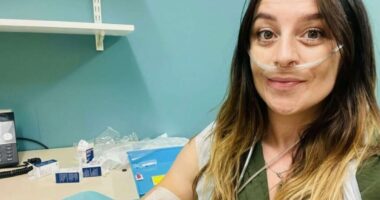
Kerry Brown in hospital (Image: Brain Tumour Research/SWNS)
Although the tumours were low-grade, two of them were larger than two centimetres and required surgical removal.
Kerry said: “When I woke up after the surgery, they told me they hadn’t found four tumours – they’d found 10. I remember joking ‘every time I speak to you, you find more’ – but inside, I was terrified.
“I spent about five days in hospital and the tumours were confirmed as meningiomas – the most common form of adult primary brain tumour. I continued to have seizures and was placed on steroids and anti-seizure medication.
“One of the biggest impacts was on my sight because the tumour at the front of my head had been pressing on my optic nerve. They hoped that removing it would release the pressure, but it didn’t. The nerve continued to die, and I’m now blind in my right eye. I had to go through the DVLA process again just to be allowed to drive with one eye.”
Kerry is currently raising funds for Brain Tumour Research to increase awareness of the disease and underscore the lack of funding for research.

Kerry Brown (Image: Brain Tumour Research/SWNS)
She said: “Knowing how underfunded research into brain tumours is, and having experienced this first-hand, really motivated me. I know what it’s like to go through this. I’ve lived it. If sharing my story helps raise awareness or helps someone else feel less alone, then it’s worth it.”
Ashley McWilliams, community development manager at Brain Tumour Research, said: “Kerry’s experience highlights how symptoms of a brain tumour can be mistaken for more common conditions, leading to delays in diagnosis. Stories like Kerry’s remind us why this work is so urgently needed.”