
Share this @internewscast.com
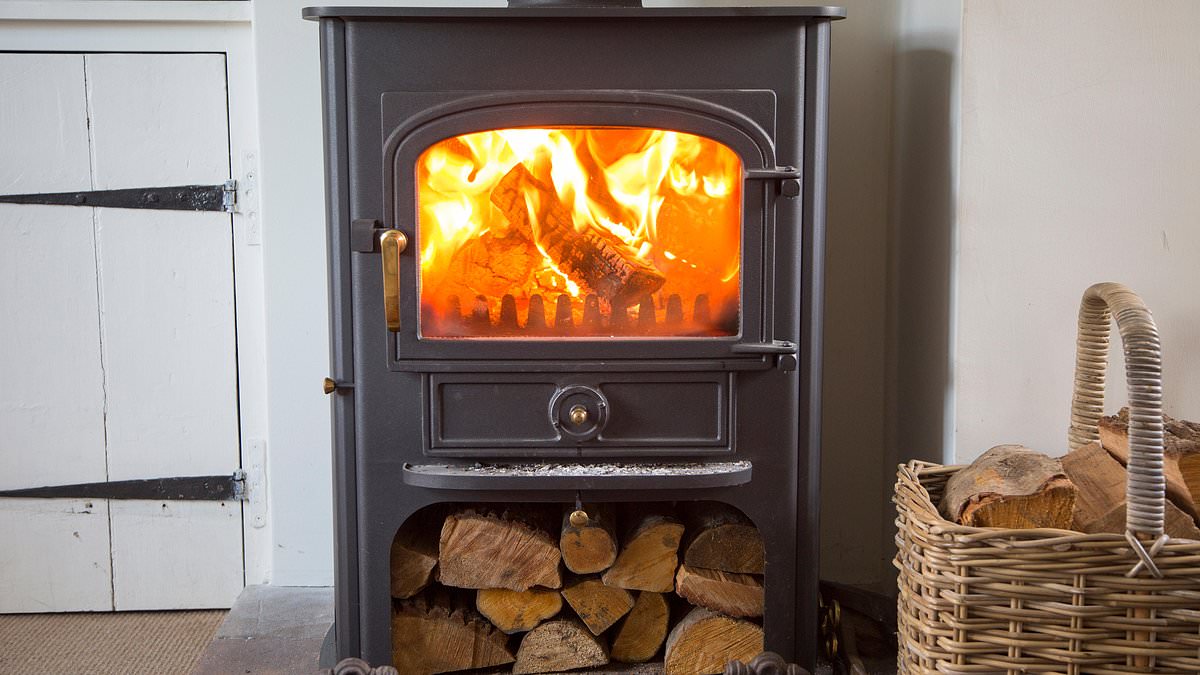
In a move to combat air pollution, the UK Government plans to introduce cigarette-style health warnings on new wood-burning stoves, highlighting their environmental impact.
According to the proposals, both stoves and firewood will soon be required to display labels detailing the potential health risks of pollution, such as asthma and lung cancer.
Officials are also considering reducing the permissible smoke emissions from wood burners by 80%, bringing it down to one gram per hour. However, this regulation would only affect new models, many of which are already compliant with these updated standards.
Emma Hardy, the air quality minister, stated, “Polluted air detracts from people’s health and places a financial strain on our NHS to address conditions like lung disease and asthma.”
She continued, “Our commitment to cleaner air involves setting emission limits and introducing informative labeling through our consultation, empowering families to make more informed and healthier home heating decisions.”
Despite these efforts, the new restrictions are expected to reduce toxic emissions from wood burning in the UK by only 10% over the next ten years, leading some campaigners to argue that the measures are insufficient.
A suggested warning reads: ‘Please be aware that this appliance emits air pluton into and around your home which can harm your health.
‘Burning in the home leads to air pollution which has a negative impact on the health of you and your family.’

Pollution from wood burning kills thousands but proposed emissions limit would cut toxic particles by 10%
Last year, ministers proposed tighter controls on certain areas, which limit the types of fuel that can be used to ‘smokeless fuels’ that don’t release smoke.
These measures could, it was suggested, effectively amount to a ban on older appliances in some areas and even a ban on wood-burning stoves altogether.
Currently, wood burners are thought to be used in around 12 per cent of households, but more than 90 of these rely on other sources of heating.
Pollution from wood burning in homes is one of the UK’s leading sources of air pollution, producing around the same amount of fine particles all all road traffic.
Fine particles are the most dangerous air pollutant for humans according to the World Health Organisation (WHO), with log-burning stoves and fires in homes linked to 2,500 premature deaths year in the UK.
According to a recent study, these pollutants are also responsible for 3,700 cases of diabetes and 1,500 cases of asthma.
Wood burning produces a complex chemical mixture of fine particulate matter PM2.5 and other gases which can be breathed deep into the lungs and enter the bloodstream, where they are linked to increased risk of heart and lung disease and even death.
Breathing in such particulates – invisible to the human eye – has even been linked to atherosclerosis which causes plaque to build up in the arteries.
These plaques cause arteries to narrow, restricting blood flow and increasing the risk of heart attack and stroke.
It comes as a new study found today that despite only 2 per cent of households in the US relying on wood for their heating, wood burning accounts for more than a fifth of Americans’ wintertime exposure to the particulate.
Among their findings, the scientists from Northwestern University, predicted that pollution from wood burning specifically is associated with around 8,600 premature deaths a year.
Kyan Shlipak, expert in mechanical engineering and study lead author, revealed: ‘Our results suggest that the impact of residential wood burning are primarily an urban and suburban phenomen.
‘This finding underscores the public health relevance of this pollution.
‘While a lot of emissions from residential wood burning comes from the suburbs, pollutants emitted into the air don’t typically stay put.
‘When this pollution is transported over densely populated cities, more people are exposed.’
The proposed restrictions in the UK for smoke emissions from new stoves is a marked improvement at 1g per hour, down from the current 6g per hour.
But testing shows around 70 per cent of wood burners already meet the new limit, the consultation found.
Since 2021, households in Smoke Control Areas covering most major cities have been legally required to us only approves fuels and low-emission stoves.
Breaches can result in £1,000 fines but only 24 were issued last year, up until August, despite more than 15,190 complaints.
Research found that no prosecutions for illegal wood burning was made in this period.
The new limit is not expected to come into for for at least three years from the the new law is passed.
But paediatric registrar and Royal College of Paediatrics and Child Health (RCPCH) clinical fellow,Dr Alice Wilson, told the Daily Mail this delay poses serious health risks.
She said: ‘Air pollution exposure at every stage of the human lifecycle, from gestation right through to adulthood, adversely impacts health.
‘RCPCH feels strongly that more must be done to phase out the use of wood-burners and raise public awareness of the health harms they cause.
‘Governments and local authorities must act to protect the most vulnerable, who have the least power and resources to control their environments.’