Share this @internewscast.com
On Sunday, many Australians will lose an hour of sleep as daylight saving time kicks in.
This marks the approach of summer and offers the prospect of longer daylight hours — ideal for basking in the sun after finishing work.

However, the clock change can also challenge your body’s routines and circadian rhythm as they adapt to a new schedule. Here’s what you need to know.

When does daylight saving start in 2025?

Daylight saving time will start on Sunday 5 October at 2am AEST.

At 2am, clocks will roll forward one hour to 3am, stealing an hour of sleep in the process.

Daylight saving time generally begins each year on the first Sunday of October, continuing until the first Sunday of April, when clocks are set back one hour.

Wait, are clocks rolling forward or backwards?

In doing so, you’ll gain an extra hour of sunlight in the afternoon, with the sun setting an hour later on your watch.
It means that in the evenings, you’ll have more daylight time to enjoy that summer sun.

But on the other hand, it will mean your mornings will have a lot less light than usual, which could make early morning wake-ups more difficult.

Which states and territories observe daylight saving?

Not every Australian state and territory adopts daylight saving time. Over the past 50 years, several Australian jurisdictions have voted for or against using it in their region.
NSW, Victoria, South Australia, ACT, and Tasmania all observe daylight saving.
But Queensland, Western Australia and the Northern Territory don’t.

Professor Tim Bedding from the School of Physics at The University of Sydney, an expert in stellar oscillationsemphasized that geography plays a crucial role in these decisions.
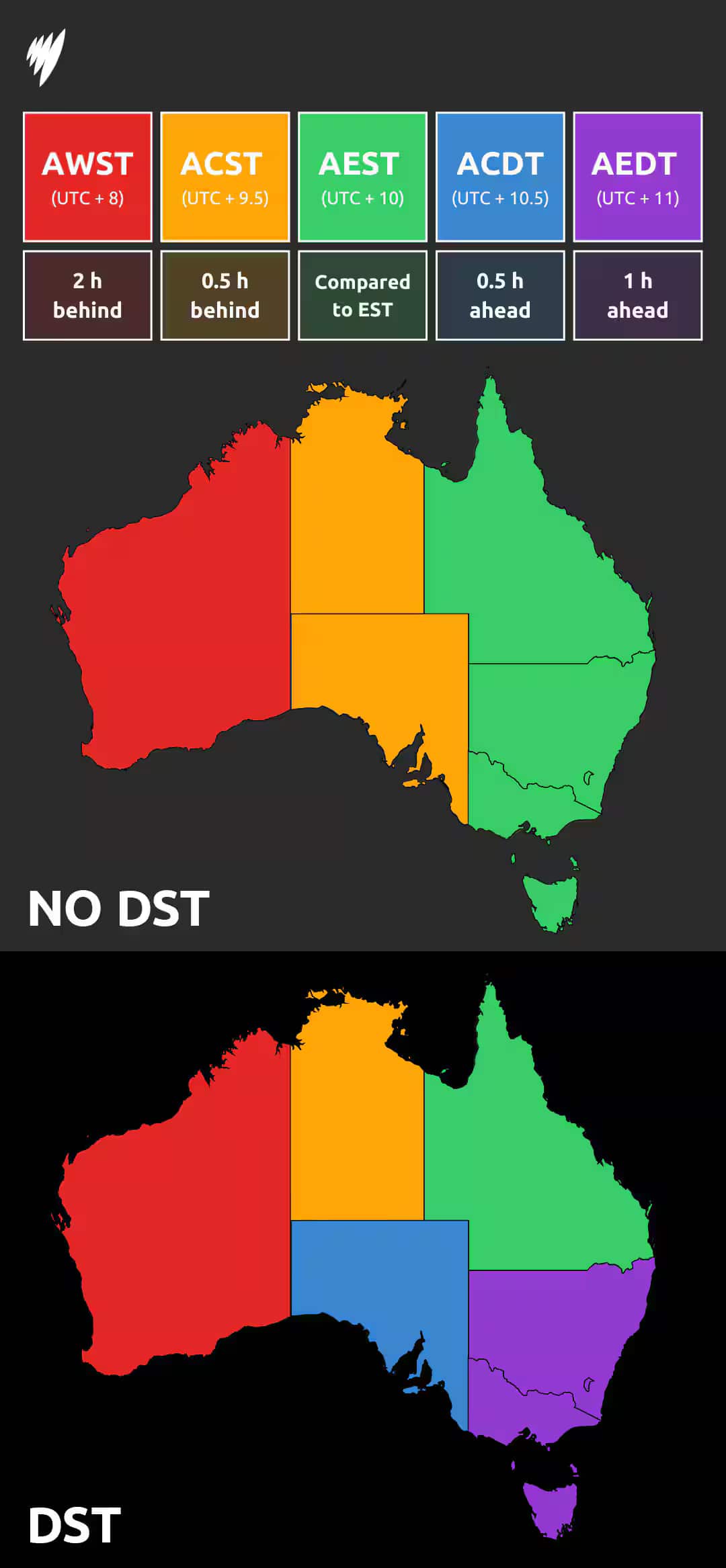
A map showing Australian time zones before and after daylight saving.

Daylight saving time is not observed in Queensland, Western Australia, or the Northern Territory. Source: SBS News

“The effect of DST becomes less as you move towards the equator, which is presumably why Queensland decided not to adopt daylight saving,” Bedding said.

“In a large geographically and climatically diverse country, one size does not necessarily fit all and should not be imposed upon all.”

Once daylight saving time kicks in, Australia goes from having three time zones across the nation to five.

Is daylight saving bad for your body?

When daylight saving time kicks in, we lose an hour of sleep. It might not sound like much, but the shift also risks putting stress on our bodies.
The Sleep Health Foundation says losing an hour of sleep in October can be more challenging to adjust to than gaining an hour in April. That’s because our circadian rhythm — or our internal body clock — is timed to match light and darkness and can be thrown out of sync when the clocks change.

“Our internal body clock or 24-hour circadian rhythm will need time to adjust to the shift,” according to its website. “While most people manage this adjustment without major issues, there is an increased risk of sleepiness as the body adapts to the new schedule.”
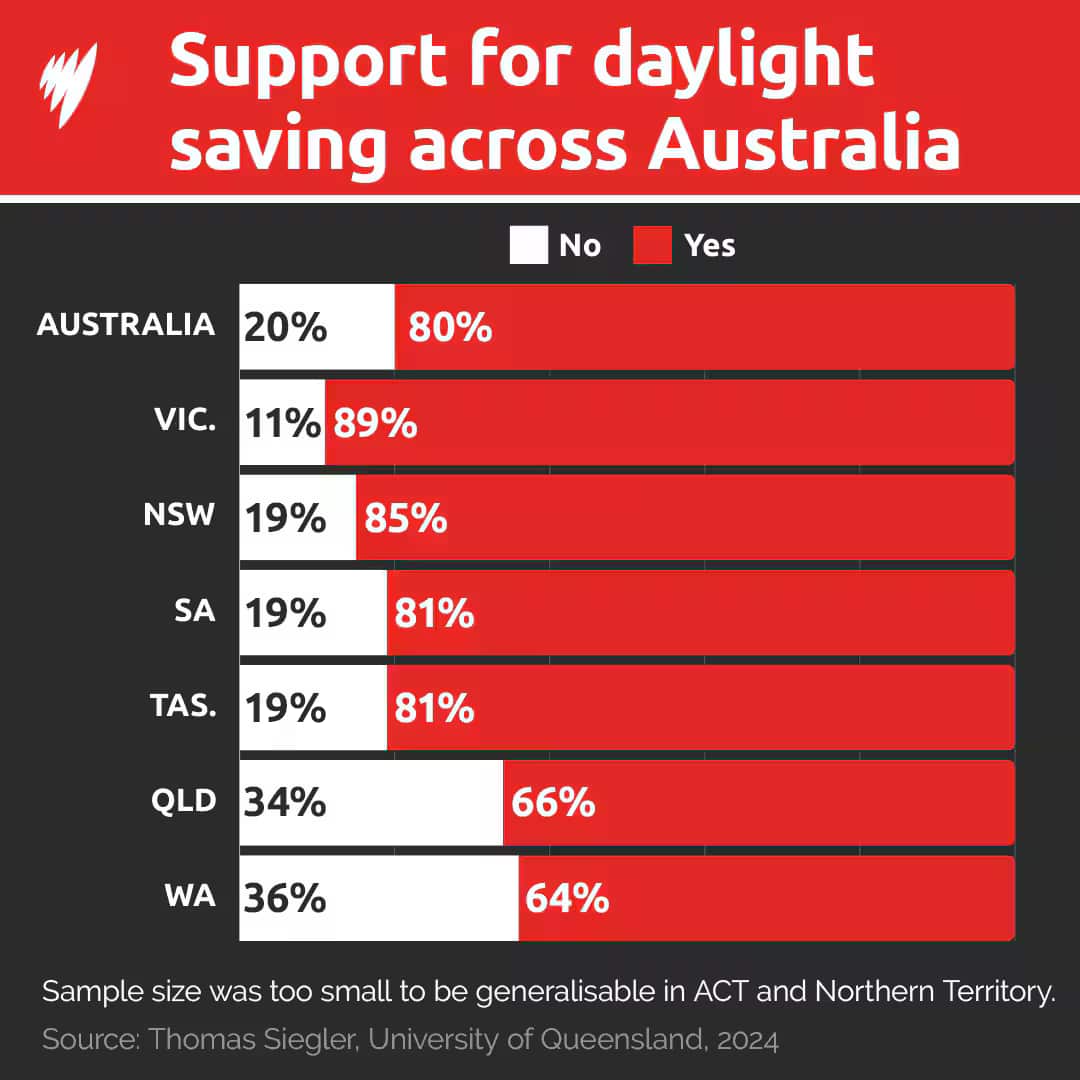
A graph showing support and opposition to daylight saving time.

A 2024 survey found overwhelming support for daylight saving time across Australia. Source: SBS News

The foundation recommends adjusting your bedtime earlier for three to four nights before the transition, which should help reduce the risk of sleep loss.

But other research suggests the change in times is a good compromise between early and late risers.
Research from Flinders University also found no significant evidence daylight saving time resulted in long-term sleep loss or impaired sleep health and daytime functioning.

Report author and sleep specialist emeritus professor Leon Lack noted: “Our studies indicate that although the initial transition into DST might be challenging, any adverse effects tend to diminish within one to three months at most.”

How can you adjust?

To help adjust to daylight saving time, there are a few easy changes you can make, according to Lack and his research partners.

– Start your day with sunlight. Especially in the mornings leading up to and after the clocks move forward.

– Limit afternoon caffeine. Try and avoid coffee or tea after midday so it doesn’t keep you up at night.

– Consume a nutritious breakfast and exercise consistently. A good breakfast can help stabilize your wake-up routine, while regular physical activity (not too late in the day) can enhance sleep quality.

– Reduce screen time before bed. Put the phone away and dim the lights about two to three hours before bed to support your circadian rhythm.

– Plan for post-daylight saving rest. Expect a slight disruption after the clock change, and if needed, take a 15-minute power nap to recharge.


When does daylight saving end?

On Sunday 5 April 2026, when clocks roll back to 2am AEST.

Share this @internewscast.com
You May Also Like
Two of the NSW's most dangerous criminals have been caught up in a violent brawl at Goulburn's Supermax Prison. Footage of the fight between the rival prisoners, which was in 2022, has been released to 9News. The encounter started as a friendly stroll between Talal Alameddine and another inmate before the pair started to circled in the holding yard and throw punches.

Explosive Brawl Erupts at Goulburn Supermax: Unraveling the Chaos Among NSW’s Most Infamous Inmates

Two infamous criminals from New South Wales were recently involved in a…
Former NRL sideline reporter Tiffany Salmond is pictured while she was caught up in the mass shooting at Bondi

Bondi Massacre Survivor Advocates for Nationwide Justice Reform Inspired by New Zealand’s Approach

Former NRL media figure Tiffany Salmond is urging Australians to adopt a…

Israel Greenlights 19 New West Bank Settlements in Strategic Move Against Palestinian Statehood

Israel has approved the establishment of 19 new settlements in the occupied…
Rapper Nicki Minaj has made a surprise appearance at a gathering of conservatives in Arizona.

Nicki Minaj Commends US President, Surprising Conservative Circles

Rapper Nicki Minaj made an unexpected visit to a conservative event in…
A serious seatbelt fault could cause a passenger in the rear seats to become unrestrained in a crash in the Suzuki Fronx.

Urgent Recall Alert: Dangerous Safety Flaw Discovered in Popular Car Model Currently in Use

Australia’s car safety rating agency has warned passengers not to travel in…
Sussan Ley's attack on Anthony Albanese after the Bondi terror attack. has not led to a bump in support for her or her party in the polls.

Opposition Pressures PM to Launch Royal Commission Following Bondi Attack: Critics Claim Government Response Insufficient

Opposition Leader Sussan Ley has called on Prime Minister Anthony Albanese to…
13 remain in hospital one week after Bondi Beach massacre

Latest Update: 13 Survivors Still Hospitalized After Shocking Bondi Beach Tragedy

Thirteen individuals remain hospitalized following the Bondi Beach terror incident, more than…

Shocking Assassination: High-Profile Russian General Killed in Moscow Car Bomb Attack

An explosion in Moscow claimed the life of Lieutenant General Fanil Sarvarov…

Tragic Mass Shooting in South Africa Claims Nine Lives, Leaves 10 Injured

Nine people were killed when gunmen opened fire at a bar outside…
What's inside the Epstein files released by the Justice Department

Unveiled: Key Insights from the Justice Department’s Release of Epstein Files

The Department of Justice has announced that more files will be released…

Australia Reinforces Gun Safety: Albanese Launches Buyback Program Amid NSW’s New Restrictions

Prime Minister Anthony Albanese has announced that the government will introduce legislation…
Multiple gunmen open fire at a South African pub, killing nine and wounding 10

Tragic Shooting at South African Pub: Nine Killed, Ten Injured by Multiple Assailants

Nine individuals lost their lives, and at least 10 others sustained injuries…