
Share this @internewscast.com

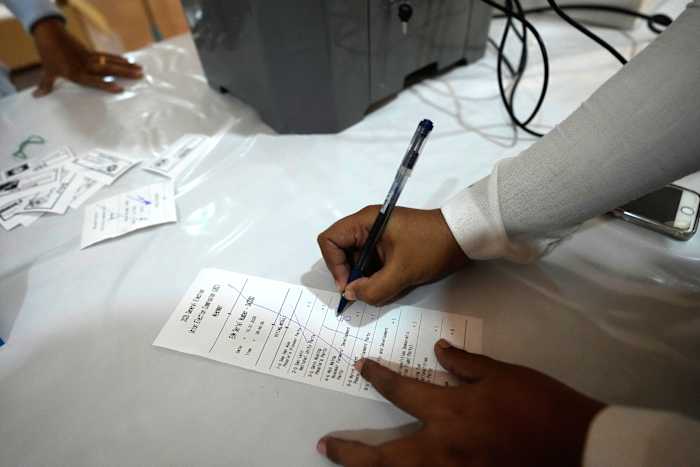
YANGON – On Sunday, Myanmar expanded its voting efforts in the second round of its first general election in five years, encompassing additional townships, including regions affected by ongoing conflicts between the military government and armed opposition groups.
Beginning at 6 a.m. local time, polling stations opened in 100 townships across Myanmar, covering areas such as Sagaing, Magway, Mandalay, Bago, and Tanintharyi regions, along with Mon, Shan, Kachin, Kayah, and Kayin states. Many of these regions have experienced recent clashes or remain under strict security measures, highlighting the precarious nature of the electoral process.
The election is divided into three phases due to ongoing conflicts. The initial phase occurred on December 28 in 102 of the nation’s 330 townships, followed by the second phase on Sunday. The final voting round is set for January 25, though 65 townships will be excluded due to ongoing hostilities.
Myanmar’s national legislature comprises two houses with a total of 664 seats. The party securing a majority across both houses gains the authority to appoint the new president, who will then form the government and appoint a Cabinet. According to the constitution, the military is guaranteed 25% of the seats in each house.
Critics argue that the elections orchestrated by the military government lack fairness and transparency, viewing them as a move to legitimize military rule following their takeover from Aung San Suu Kyi’s elected government in February 2021.
Throughout Sunday morning, citizens in Yangon, the largest city, and Mandalay, the second-largest, were seen casting their votes at various locations including high schools, government buildings, and places of worship.
While more than 4,800 candidates from 57 parties are competing for seats in national and regional legislatures, only six parties are competing nationwide with the possibility of gaining political clout in parliament.
The first phase left the military-backed Union Solidarity and Development Party, or USDP, in a dominant position, winning nearly 90% of those contested seats in that phase in Pyithu Hluttaw, the lower house of parliament. It also won a majority of seats in regional legislatures.
The military government claimed more than 6 million people — about 52% of the more than 11 million eligible voters in the first phase of elections — cast ballots, calling the turnout a decisive success.
Suu Kyi, Myanmar’s 80-year-old former leader, and her party aren’t participating in the polls. She is serving a 27-year prison term on charges widely viewed as spurious and politically motivated. Her party, the National League for Democracy, was dissolved in 2023 after refusing to register under new military rules.
Other parties also refused to register or declined to run under conditions they deem unfair, while opposition groups have called for a voter boycott.
Tom Andrews, a special rapporteur working with the U.N. human rights office, urged the international community Thursday to reject what he called a “sham election,” saying the first round exposed coercion, violence and political exclusion.
“You cannot have a free, fair or credible election when thousands of political prisoners are behind bars, credible opposition parties have been dissolved, journalists are muzzled, and fundamental freedoms are crushed,” Andrews said.
According to the Assistance Association for Political Prisoners, which keeps detailed tallies of arrests and casualties linked to the nation’s political conflicts, more than 22,000 people are detained for political offenses, and more than 7,600 civilians have been killed by security forces since 2021.
The army’s takeover triggered widespread peaceful protests that soon erupted into armed resistance, and the country slipped into a civil war.
A new Election Protection Law imposes harsh penalties and restrictions for virtually all public criticism of the polls. The authorities have charged more than 330 people under new electoral law for leafleting or online activity over the past few months.
There were no reports of major interference with the polls on Sunday morning, though opposition organizations and armed resistance groups had vowed to disrupt the electoral process. During the first phase, attacks were reported in 11 of the 102 townships holding polls, according to the military government.
Copyright 2026 The Associated Press. All rights reserved. This material may not be published, broadcast, rewritten or redistributed without permission.