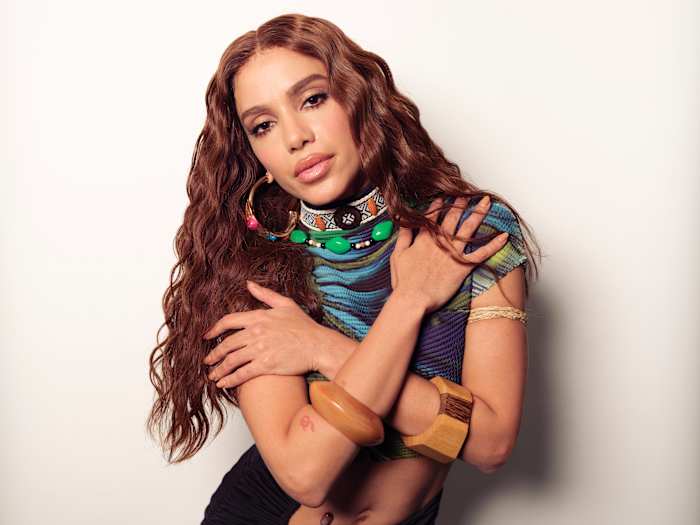


NEW YORK – The atmosphere inside Studio 8H is electric. In the dimly lit room, all attention is riveted on Anitta, the Brazilian sensation. Surrounded by a troupe of dancers and a compact band, she commands the stage. Silence reigns, only broken by the voice of a stand-in who announces, “Ladies and Gentlemen, Anitta.” Suddenly, the room is awash in red light, signaling the start of the performance.
This is the iconic setting of “Saturday Night Live” at 30 Rockefeller Plaza in New York City. Anitta is in the midst of rehearsing two fresh tracks — “Choka Choka” featuring Shakira, and “Varias Quejas,” a Spanish rendition of an Olodum classic from Bahia, Brazil, as she prepares for her upcoming appearance.
The songs are highlights of her anticipated album, “Equilibrium,” which blends Brazilian funk, samba, bossa nova, semba, reggae, and electronic pop, spanning Portuguese, Spanish, and English. It’s a unique fusion made possible by Brazil’s most internationally acclaimed artist since Astrud Gilberto charmed the world with “The Girl From Ipanema” over 60 years ago.
“I believe this is the most Brazilian thing I’ve ever showcased on American television,” Anitta shared with The Associated Press during a break in the NBC offices.
Regarding “Equilibrium,” she affirmed, “It’s unquestionably my most Brazilian album.” Born Larissa de Macedo Machado, Anitta emphasized her intent: “I truly wanted to create an album that honors my roots.”
An evolving sound
“Equilibrium” is a sonic jump from her last release, 2024’s “Funk Generation.” That was a full-on tribute to Brazilian funk — what is frequently referred to as funk carioca or baile funk and is heard in working-class neighborhoods known as favelas around Rio de Janeiro. It’s a combination of Brazilian rhythms, African and electronic music and rap that has been stigmatized like hip-hop and reggaetón before it. The genre still exists on “Equilibrium,” but so does a myriad sounds — and beliefs — from her homeland.
“Some of the songs are honoring some entities from Yoruba culture, from Orishas,” she says, referring to the religion that originated in West Africa and its divine spirits, like on the track “Nanã.” “One of the songs talks about God and how do I see God in life.”
It should come as no surprise to Anitta fans: In 2024, she released a music video for the song “Aceita,” which featured a video depicting rituals of the Afro-Brazilian faith Candomblé, sparking controversy in a country where religious intolerance is all too common. Elevating marginalized populations, religious groups and also women, residents of favelas, LGBTQ+ and Black people has always been a core feature of Anitta’s public persona.
Going global by going home
Naturally, “Equilibrium” is also a full-on embrace of community. The album is stacked with Brazilian collaborators, like the rising songwriter Melly, Liniker’s award-winning samba rock-and-then-some, the Brazilian reggae band Ponto de Equilíbrio and countless others. Even “Choka Choka,” the assertive single with Colombian superstar Shakira, is a love letter to Anitta’s culture: The “She Wolf” singer performs in Portuguese.
“Anitta wanted to create something for Brazil, but with an international touch,” said “Choka Choka” co-producer Daramola in a press statement. Its Brazilian funk percussion “has a lot of energy, a lot of intensity. And who better to represent that sound than Anitta and Shakira?”
The song, like the rest of “Equilibrium,” seeks to deliver a universal message with regional sounds. Where she could’ve leaned into conventional, commercial music trends, she doubled down on what makes Anitta, Anitta instead. Clearly the world — and “Saturday Night Live” — are paying attention.
In the past, “If I wanted to reach certain audience, I would do more English or Spanish or whatever,” she says. “And I just think … I don’t know if people are accepting better. I don’t care that much as I used to.”
She still sings in three languages, but Portuguese takes a front seat. That may be because this is the freest Anitta has sounded on record. Consider a song like the syrupy “Vai Dar Caô” featuring rapper Ebony and producer Papatinho, with its sample of DJ Mandrake and MC Tikão’s “A Pedido,” built over a late-night-at-the-club interpolation of Art of Noise’s 1984 New Age classic “Moments In Love.” Anitta’s raps are earned show boasts, something that doesn’t feel out of place next to the nylon-string classical guitars of a softer song, like “Ternura.”
On “Equilibrium,” specificity and storytelling is key. “The last song, we also bring a mantra from the God Tara, which is a female God, from another type of religion,” she says.
Anitta is referring to “Ouro,” a collaboration with the Brazilian duo Emanazul who describe their work as medicine music. She calls the song a “meditation.”
“I don’t want people to think this is one type of thinking, one direction. I like to join forces,” she says. “I think that’s what this album is about: honoring Brazilian roots, honoring everything that I think can make us feel elevated.”
If she sounds self-actualized, that’s because it is her ambition for the album. “I think the main message is, like, we are all one. We live in a planet, Mother Earth. It’s our home. We’re supposed to just live in harmony with each other, respect each other’s flavors, decisions, ways of communicating. We should be just, like, admiring our differences,” she says.
It’s a deep message but one delivered in a pop package. “I think the album brings a lot of fun instruments, percussions, all that, but also brings like moments for us to … find the balance, the middle term, the middle way of doing things,” she smiles. “That’s the secret.”
Copyright 2026 The Associated Press. All rights reserved. This material may not be published, broadcast, rewritten or redistributed without permission.


