
SEOUL – With conflict intensifying in the Middle East, nations in Asia, whether allies or adversaries of the United States, are bracing for potential economic turbulence and enduring security challenges.
Here’s an examination of how the tensions in the Middle East are influencing North and South Korea, Japan, and China.
North Korea
During a significant political gathering last month, North Korean leader Kim Jong Un reiterated that the nation’s long-standing commitment to developing nuclear weapons was a “correct” decision, despite facing severe international isolation and resource shortages.
The recent U.S. and Israeli military actions against Iran are expected to strengthen this stance.
North Korea’s regime likely observed with concern as these operations resulted in the death of Iran’s supreme leader, following a U.S. action in January that led to the capture of Venezuelan President Nicolás Maduro.
Pyongyang’s Foreign Ministry has condemned the attacks on Iran as illegal and a “most despicable” violation of sovereignty. Notably, it didn’t mention the death of Ayatollah Ali Khamenei.
Similar strikes to take out North Korea’s leadership would be far riskier and less likely to succeed, said Hong Min, an analyst at South Korea’s Institute for National Unification.
Unlike Iran, North Korea has followed through on its nuclear ambitions. Its expansive arsenal contains dozens of warheads, with a range of delivery systems threatening Asian U.S. allies and intercontinental ballistic missiles potentially capable of reaching the U.S. mainland. It would be difficult to eliminate North Korea’s capabilities in a single wave of preemptive strikes, and would leave open the possibility that surviving systems could be used to attack targets in South Korea, Japan or even America.
In his first public appearance since the war began, Kim last week inspected sea trials of his prized new warship and tests of what state media called nuclear-capable cruise missiles. Some analysts say the display may have been meant to showcase his military capabilities after the killing of Khamenei and the U.S. sinking of Iranian naval assets — signaling that, unlike Iran, his ships could carry nuclear warheads.
Attacking North Korea would also be complicated by its geographic proximity to China and Russia — Washington’s most significant rivals — with whom Kim has been deepening ties as he seeks a more assertive presence in the region.
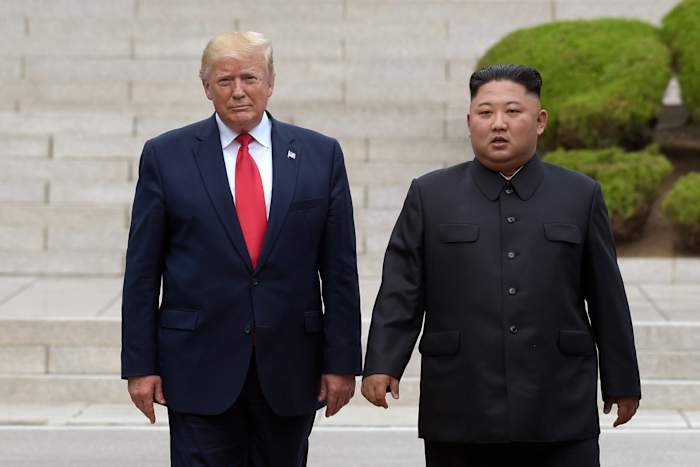
The U.S. military actions on Iran and Venezuela both came despite active negotiations. Analysts have differing views on how that might affect North Korea’s desire for diplomacy with the United States, which derailed in 2019 following the collapse of a summit between Kim and U.S. President Donald Trump.
At February’s ruling party congress, Kim left the door open to dialogue with the United States, reiterating Pyongyang’s earlier calls that Washington drop its demands for the North’s denuclearization as a precondition for reviving talks.
Hong said that while Kim is likely to maintain that position, the attack on Iran may have deepened his distrust of Washington and the leader could raise the bar for negotiations.
But Park Won Gon, a professor at Seoul’s Ewha Womans University, said Kim could feel greater urgency to seek a deal with Trump, viewing their unresolved diplomacy as a risk.
South Korean officials have suggested that Trump’s expected visit to China in late March or April may provide a possible opening with Pyongyang.
South Korea
South Korea, heavily dependent on trade and imported fuel, is alarmed by Iran’s attacks on energy infrastructure and attempts to close the Strait of Hormuz, through which roughly a fifth of global oil trade flows.
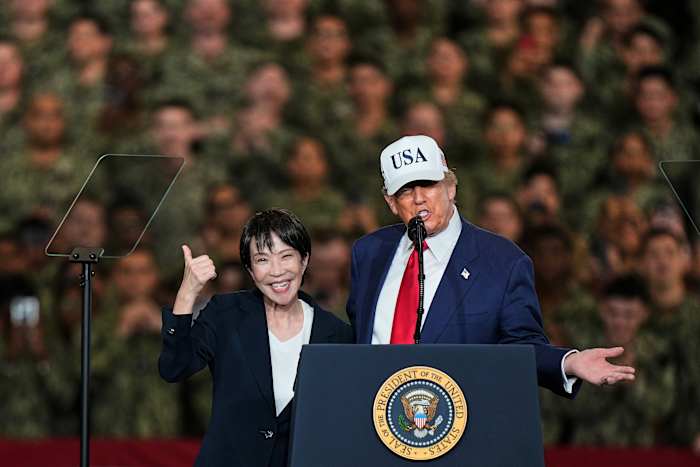
The war is also heightening unease in Seoul about its alliance with the United States. The Trump administration has shown a willingness to act militarily without broad coordination with allies.
The United States for decades has pledged full military — including nuclear — protection for its allies and stations about 28,000 troops in South Korea to deter North Korea. While a major reduction in that commitment is unlikely, Seoul must now consider the risk of being drawn into potential conflicts triggered by unilateral U.S. action, including beyond the Korean Peninsula, Hong said.
“Whether it’s Taiwan, North Korea or the U.S.-China competition, there have long been concerns in South Korea that the Trump administration could make overly aggressive decisions without fully considering the potentially serious consequences for its allies,” said Hong. “Those concerns are now significant.”
South Korea must “clearly define the actions it could take” under different scenarios, he said.
Japan
Japan, another key U.S. ally in Asia, is also wary of Trump’s aggressive military actions and worried about any disruption to the Strait of Hormuz.
While Tokyo has backed U.S. efforts to curb Iran’s nuclear development, the war has raised questions about its legitimacy and caused skepticism about Washington’s credibility as an ally, said Mitsuru Fukuda, a professor at Nihon University.
Prime Minister Sanae Takaichi and other senior officials have voiced strong support for U.S.-Iran negotiations but stopped short of endorsing the U.S.-Israeli strikes. Tokyo has shown no interest in military involvement, but some experts believe the conflict could bolster Takaichi’s push for a stronger military and expanded weapons sales.
U.S. nuclear deterrence remains crucial to Japan’s security amid worry about an increasingly assertive China and North Korea. Although global turmoil, including Russia’s war in Ukraine, has revived debate over Japan acquiring nuclear weapons, domestic support remains low because of legal and political constraints.
China
China could see the Iran war as an opportunity to carve out a more assertive role in the Middle East by styling itself as a more reliable power broker than the United States, said Seo Chang-bae, a professor at Busan’s Pukyung National University.
Beijing may view the U.S. military actions in Venezuela and Iran — both major oil suppliers to China — as partly intended to counter China, experts say.
While steadily expanding trade and technology ties with Gulf states, China has sought to position itself as a regional counterweight, most notably by brokering a 2023 agreement between Iran and Saudi Arabia to normalize relations. It’s part of a broader push to strengthen its global influence and challenge dollar-based financial orders.
Although Beijing may pursue geopolitical “spillover gains,” a prolonged conflict would harm China’s trade interests, Seo said. China could also study U.S. warfare capabilities and accelerate the integration of artificial intelligence into its military, he said.
___
AP writer Mari Yamaguchi contributed from Tokyo.
Copyright 2026 The Associated Press. All rights reserved. This material may not be published, broadcast, rewritten or redistributed without permission.