
Share this @internewscast.com
HONG KONG – Asian stock markets displayed a mixed performance on Friday, as Wall Street experienced a slight dip and oil prices fell by more than a dollar after reaching their peak since the summer of 2024.
U.S. futures showed signs of improvement as the conflict with Iran entered its seventh day, with Israel conducting airstrikes on the capitals of Iran and Lebanon. The S&P 500 futures rose by 0.2%, and the Dow Jones Industrial Average futures climbed 0.3%.
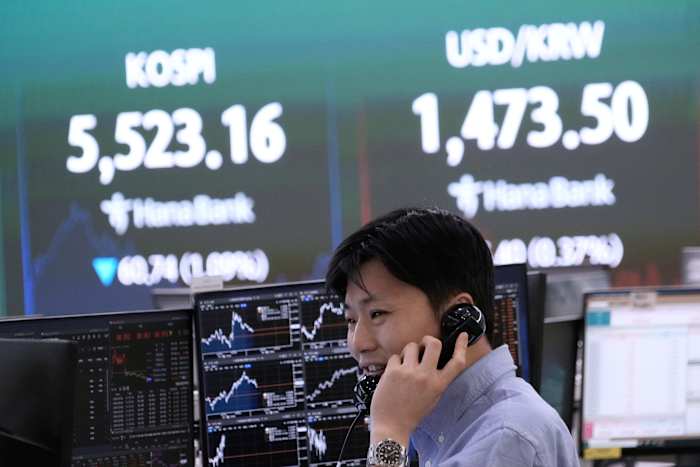
In South Korea, the Kospi index fell by 0.8% to 5,536.40, following a turbulent week marked by a 12% drop on Wednesday, offset by a near 10% recovery on Thursday. The index had previously surged past 6,000 before geopolitical tensions began unsettling the markets.
Meanwhile, Japan’s Nikkei 225 index saw a gain of 0.4%, closing at 55,518.63.
Hong Kong’s Hang Seng index experienced a substantial increase of 1.6%, reaching 25,713.49, while China’s Shanghai Composite index inched up by 0.1% to 4,113.70.
Conversely, Australia’s S&P/ASX 200 index faced a decline, dropping by 1.1% to 8,845.30.
Taiwan’s Taiex traded 0.4% lower, while India’s Sensex lost 0.6%.
Oil prices fell Friday in a reprieve from this week’s surges as production and supply worries over the war with Iran intensified. Benchmark U.S. crude lost 1.2% early Friday to $80.07 per barrel, after hitting $81.01 a barrel on Thursday.
Brent crude, the international standard, lost 1% to $84.59 per barrel, after reaching $85.41 a day earlier.
If oil prices spike further, like to $100 per barrel, and stay there, some analysts and investors say it could be too much for the global economy to withstand. Uncertainty about what will happen has caused frenetic swings across financial markets this week, sometimes hour by hour.
Friday’s easing of crude prices followed a 30-day temporary waiver from the U.S. for Indian refiners to buy Russian oil, analysts at ING Warren Patterson and Ewa Manthey said in a note. It’s not a “game-changer,” they said, but reflects U.S efforts to cap oil prices.
Oil prices will hinge on a steady resumption of oil flows through the Strait of Hormuz following disruptions of tanker activities there, ING analysts wrote. Roughly one fifth of the world’s seaborne oil is estimated to flow through the waterway located between Iran and Oman.
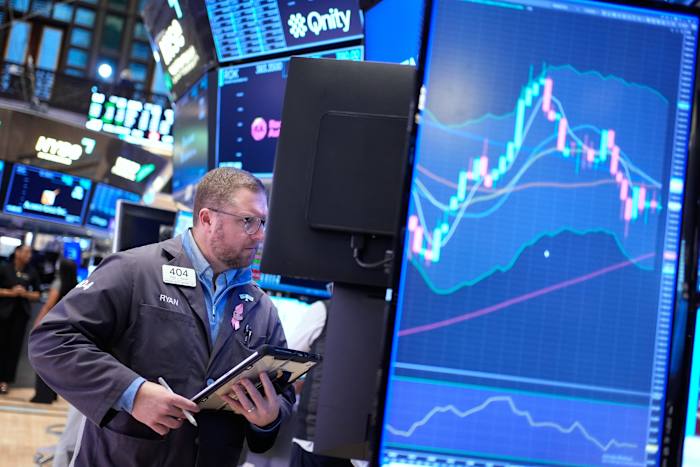
On Thursday, the S&P 500 fell 0.6% to 6,830.71. The Dow industrials lost 1.6% to 47,954.74, and the Nasdaq composite dropped 0.3% to 22,748.99.
Computer chip company Broadcom’s shares jumped 4.8% on stronger-than-expected quarterly profit and revenue, which helped contain the overall losses on Wall Street.
Airline stocks were among the U.S. market’s biggest losers, as higher oil prices pushed up fuel costs while hundreds of thousands of passengers have been stranded across the Middle East due to the war.
American Airlines fell 5.4%, United Airlines lost 5% and Delta Air Lines was down 3.9%.
In other dealings early Friday, the U.S. dollar rose to 157.80 Japanese yen from 157.56 yen. The euro was unchanged at $1.1611.
The price of gold rose 1.1% and the price of silver climbed 2.7%.
___
AP Business writer Stan Choe contributed.
Copyright 2026 The Associated Press. All rights reserved. This material may not be published, broadcast, rewritten or redistributed without permission.