
Share this @internewscast.com

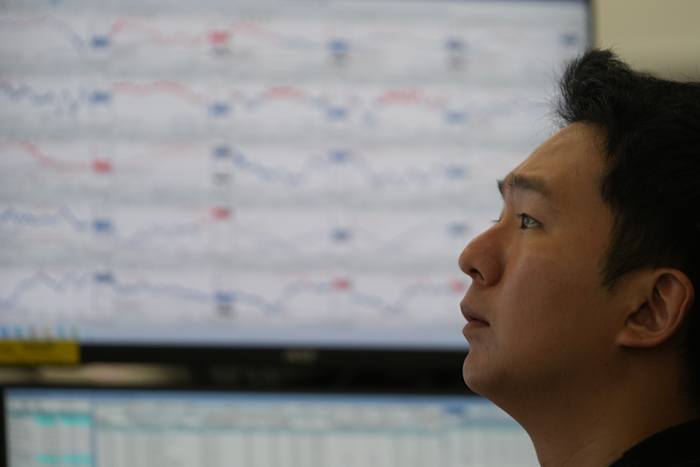
Asian markets largely advanced on Tuesday, buoyed by gains on Wall Street as the week kicked off, which is anticipated to be a relatively quiet one due to the holiday season.
Despite the positive momentum in stocks, oil prices and U.S. futures experienced a slight decline.
Japan’s Nikkei 225 saw a minor decrease of 0.1%, settling at 50,359.78. The Japanese yen appreciated against the U.S. dollar following Tokyo’s cautionary note regarding potential intervention if the yen weakens excessively.
The dollar was valued at 156.03 yen, a drop from 157.04 yen observed late on Monday. Meanwhile, the euro strengthened slightly, rising to $1.1777 from $1.1762.
In Hong Kong, the Hang Seng index reversed early gains to finish 0.1% lower at 25,762.64. Conversely, the Shanghai Composite index managed a modest rise of 0.1%, reaching 3,920.16.
Elsewhere in the region, South Korea’s Kospi climbed 0.3% to 4,117.15. In Australia, the S&P/ASX 200 enjoyed a significant boost, surging 1.1% to close at 8,795.70.
In Taiwan, the Taiex advanced 0.6%, while India’s Sensex was nearly unchanged.
Markets in the U.S. will close early on Wednesday for Christmas Eve and remain closed on Thursday for Christmas. The short week for trading includes several economic reports that could shed more light on the condition and direction of the U.S. economy.
On Tuesday, the government will release the first of three estimates on gross domestic product, a reflection of how the broader U.S. economy fared in the third quarter. On Wednesday, the Labor Department will release its weekly data on applications for jobless benefits, which stands as a proxy for U.S. layoffs.
The Conference Board offers up results from its December consumer confidence survey on Tuesday as well.
On Monday, the S&P 500 rose 0.6% to 6,878.49. The Dow Jones Industrial Average gained 0.5% to 48,362.68, and the Nasdaq composite picked up 0.5%, to 23,428.83.
Smaller company stocks did particularly well. The Russell 2000 index outpaced other major indexes with a 1.2% gain.
The gains also helped major indexes push further into winning territory for the month as a choppy December nears its end. Technology companies, especially those focused on artificial intelligence, have been the main force behind the market’s oscillations. The direction of AI-related stocks will likely determine whether the market closes out December with gains or losses.
Uber rose 2.5% and Lyft rose 2.7% after announcing plans to bring robotaxi services to London next year.
Paramount Skydance rose 4.3%. The company sweetened its hostile takeover bid for Warner Bros. Discovery with an “irrevocable personal guarantee” from Larry Ellison, the founder of Oracle and father of Paramount CEO David Ellison. He is putting up billions of dollars to back the deal as part of the latest move in Paramount’s bidding war against Netflix.
Warner Bros. Discovery rose 3.5% and Netflix fell 1.2%.
Dominion Energy fell 3.7% after the Trump administration said it is pausing leases for five large-scale offshore wind projects. They include Dominion’s Coastal Virginia Offshore Wind project.
Gold and silver touched records. Gold prices rose nearly 1% early Tuesday to 4,512.40, adding to its consistent gains throughout the year, on expectations for further interest rate cuts by the U.S. Federal Reserve. Silver rose 1.2%.
Oil prices jumped after the U.S. Coast Guard said it was pursuing another sanctioned oil tanker in the Caribbean.
U.S. benchmark crude oil fell back early Tuesday, shedding 23 cents to $57.78 per barrel. It jumped 2.4% to $58.01 a barrel on Monday.
The price of Brent crude, the international standard, declined 22 cents to $61.85 per barrel. It rose 2.6% on Monday.
Recent reports have shown that U.S. inflation remains elevated and consumer confidence has faded over the last year. Overall, the job market has been slowing and retail sales have weakened.
The ongoing and wide-ranging U.S. trade war has been hanging over consumers and businesses already squeezed and worried by higher prices. The mix of stubbornly high inflation and a weaker jobs market has also put the Fed in an awkward policy position moving forward.
Still, Wall Street is mostly betting that the Fed will hold steady on interest rates at its meeting in January. It has cut its benchmark interest rate at its last three meetings, even though inflation has remained stubbornly above its 2% target.
___
AP Business Writers Damian Troise and Matt Ott contributed to this story.
Copyright 2025 The Associated Press. All rights reserved. This material may not be published, broadcast, rewritten or redistributed without permission.