
Share this @internewscast.com

MELBOURNE, Australia (AP) Australia announced it will reduce restrictions on U.S. beef imports in a move President Donald Trump’s administration claimed as a major victory over “non-scientific trade barriers.”
Agriculture Minister Julie Collins said Thursday that relaxing the restrictions designed to keep Australia free of mad cow disease, also known as bovine spongiform encephalopathy or BSE, would not compromise biosecurity.
“Australia stands for open and free trade our cattle industry has significantly benefited from this,” Collins said in a statement.
Secretary of Agriculture Brooke L. Rollins responded to Australia’s announcement by congratulating Trump on a “major trade breakthrough that gives greater access to U.S. beef producers selling to Australia.”
She issued a statement under the leadline: Make Agriculture Great Again Trade Wins.
“American farmers and ranchers produce the safest, healthiest beef in the world. It’s absurd that non-scientific trade barriers prevented our beef from being sold to consumers in Australia for the last 20 years,” Rollins said.
“Gone are the days of putting American farmers on the sidelines. This is yet another example of the kind of market access the President negotiates to bring America into a new golden age of prosperity, with American agriculture leading the way,” she added.
Australia has allowed imports of beef grown in the United States since 2019. But Australia has not allowed imports from the U.S. of beef sourced from Canada or Mexico because of the disease risk.
But the U.S. has recently introduced additional movement controls that identify and trace all cattle from Mexico and Canada to their farms of origin.
US cattle import controls satisfy Australian authorities
Australian authorities were “satisfied the strengthened control measures put in place by the U.S. effectively manage biosecurity risks,” Collins said.
The timing of the new, reduced restrictions has not been finalized.
Trump attacked Australian import restrictions on U.S. beef when he announced in April that tariffs of at least 10% would be placed on Australian imports, with steel and aluminum facing a 50% tariff.
“Australia bans and they’re wonderful people, and wonderful everything but they ban American beef,” Trump told reporters then.
“Yet we imported $3 billion of Australian beef from them just last year alone. They won’t take any of our beef. They don’t want it because they don’t want it to affect their farmers and, you know, I don’t blame them, but we’re doing the same thing right now,” Trump added.
Lawmaker fears appeasing Trump endangers Australian cattle industry
Opposition lawmaker David Littleproud suspected the government was endangering Australia’s cattle industry to appease Trump.
“I want to see the science and it should be predicated on science. I’m suspicious of the speed at which this has been done,” Littleproud told reporters.
“We need to give confidence to the industry, but also to you (the public): this is not just about animal welfare, this is about human welfare, this is about BSE potentially coming into this country and having a human impact, so I think it’s important the government’s very transparent about the science and I don’t think it’s even beyond the question to have an independent panel review that science to give confidence to everybody,” he added.
Around 70% of Australian beef is exported. Producers fear that export market would vanish overnight if diseases including mad cow or foot-and-mouth disease infected Australian cattle.
Will Evans, chief executive of Cattle Australia who represents more than 52,000 grass-fed beef producers across the nation, said he was confident the agriculture department had taken a cautious approach toward U.S. imports.
“The department’s undertaken a technical scientific assessment and we have to put faith in them. They’ve made this assessment themselves. They’ve said: ‘We’ve looked at this, we’ve looked at the best science, this is a decision that we feel comfortable with,’” Evans said.
“When you have a $75 billion (Australian $50 billion) industry relying on them not making this mistake, I’m sure they’ve been very cautious in their decision-making,” he added.
US beef prices rise because of drought and a domestic cattle shortage
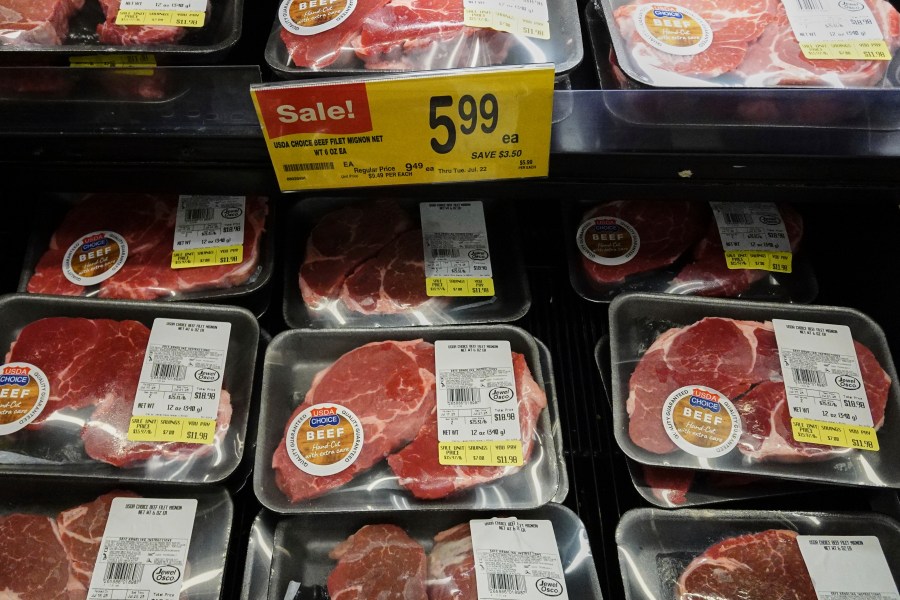
Beef prices have been rising in the U.S. due to factors that include drought and shrinking domestic herd numbers.
The average price of a pound of ground beef in the U.S. rose to $6.12 in June, up nearly 12% from a year ago, according to U.S. government data. The average price of all uncooked beef steaks rose 8% to $11.49 per pound.
Australian demand for U.S. beef is likely to remain low for reasons including a relatively weak Australian dollar.
Australia’s opposition to any U.S. tariffs will be high on the agenda when Prime Minister Anthony Albanese secures his first face-to-face meeting with Trump.
Albanese and Trump were to hold a one-on-one meeting on the sidelines of a Group of Seven summit in Canada last month, but the U.S. president left early.
Albanese expects the pair will meet this year, although no date has been announced.
The two countries have had a bilateral free trade deal for 20 years and the U.S. has maintained a trade surplus with Australia for decades.