

CARACAS – In the heart of Venezuela’s bustling capital, Mileidy Mendoza and Sandra Rosales held a silent vigil outside a detention center, their hopes tethered to the officer calling out names under the shroud of night.
As each name echoed through the air, a newly freed prisoner would emerge, reuniting with loved ones in emotional embraces. Among them were fifteen men and two women, all regarded as political prisoners. Their sudden release, on the eve of Valentine’s Day, was the result of relentless efforts by Mendoza, Rosales, and a coalition of determined women challenging the government’s authoritarian grip.
These mothers and wives, driven by desperation and hope, had transformed a Caracas street into a vibrant protest camp over 37 days. Through prayer, chants, social media campaigns, and even chaining themselves together, they sought to amplify the voices of those silenced within the concrete confines of the prison walls.
For Mendoza and Rosales, the morning’s release was a poignant mix of triumph and heartache. Each reunion they witnessed was a testament to their struggle, yet their own personal hopes were dashed as their husbands’ names remained uncalled.
Neither woman had any political background before becoming part of this grassroots movement, which emerged following a tumultuous period when the U.S. military intervened in Venezuela on January 3, capturing President Nicolás Maduro. Their protest not only tested their physical endurance but also highlighted the authoritarian government’s challenge in curbing its repressive nature.
In January, under international pressure, Venezuela had pledged to release political prisoners, sparking a glimmer of hope among the families of those detained. About 150 demonstrators, primarily wives and mothers, positioned themselves outside suspected detention facilities, their presence becoming a litmus test for the U.S.’s influence in reinstating civil liberties after the transition of power to Maduro’s vice president.
The Trump administration has praised the government of acting President Delcy Rodríguez for its pledge to release political prisoners. But human rights groups say Venezuelan authorities have been selective in deciding whom to free, and more than 400 political prisoners remain behind bars.
The Venezuelan government’s press office did not respond to a request for comment on its plans for prisoners or how it decides which detainees will be freed.
After learning their husbands and at least 40 other men would remain in the jail, they headed back to their tent. Dawn had not yet broken as they discussed their options over a breakfast of crackers and ham salad. This would be their last meal, they vowed, until their husbands were freed.
“We’ll be here as long as necessary,” Mendoza told Rosales, sitting on a mattress and wearing a facemask as a health precaution. “We must continue fighting for our goal, which is the release of all of them. Not one, not two, not 17, but all of them.”
How the protests began
Rosales and Mendoza did not know each other before they started fighting for their husbands’ freedom.
Mendoza lived in western Caracas with her husband and two children, while Rosales and her husband raised four children in the once-thriving industrial city of Valencia, in north-central Venezuela.
A stay-at-home mother, Mendoza, 30, sold handcrafts to supplement her husband’s pay as a driver. Rosales, 37, had a steady job as an elementary school teacher; her husband worked as an explosive’s technician for the state’s intelligence service. Neither were the type to socialize in their free time, much preferring to spend time with their kids.
Mendoza last saw her husband, Eric Díaz, on a November morning when he left the house to go to work. She learned of his arrest from a friend and panicked. He was not allowed to call her, and authorities refused to acknowledge his detention.
Weeks went by before she learned that he had been accused by the Venezuelan government of plotting to detonate a bomb in a public plaza in Caracas. The plan, according to the country’s feared Interior Minister Diosdado Cabello, was promoted by the U.S. and a faction of Venezuela’s opposition.
Rosales’ husband, Dionnys Quintero, had also been arrested that month and accused of being involved in the same plot. He, too, was not granted a phone call.
She was flummoxed by the accusations. She and Quintero firmly believed in the ideas of Hugo Chávez, the fiery Venezuelan leader who ushered in a self-proclaimed socialist revolution at the turn of the century and was Maduro’s mentor and predecessor. They consistently voted for the ruling party. She could only conclude that he had been “linked to the case because of his profession.”
“All police forces are organized like a ladder. The one at the top won’t fall; the one at the bottom will,” Rosales said. “And those at the top will always be careful not to fall.”
The Venezuelan government did not respond to questions about why it was detaining the pair’s husbands.
For her part, the allegations perplexed Mendoza. Her husband had not been politically active, nor had he worked for security services. She said he spent all of his time delivering equipment for an events company or at home.
The holidays were particularly hard on their children because the women had no answers when they were asked the same question:
“When am I going to see my dad?”
The two wives dared not complain publicly. They were each told by friends and family members to keep quiet because they risked being arrested and leaving their children to fend for themselves. Maduro’s government had a reputation for ruthlessly cracking down on dissent, especially in the aftermath of his 2024 reelection claim.
That calculus changed after the U.S. military rappelled down helicopters and captured Maduro on Jan. 3 in Caracas. Five days later, under pressure from the White House to free dissidents, the Venezuelan government announced the imminent release of prisoners in an effort “intended to seek peace” without specifying with whom.
By then, Mendoza had gone to multiple detention facilities to ask about Díaz. Outside a jail, she met a man who had recently been released from custody. She showed him pictures of Díaz and a cousin of his who had also been detained. The man recognized Díaz.
He told Mendoza that her husband was being held with dozens of other political prisoners at a police station on Calle Mara, a dead-end street in a neighborhood filled with warehouses, a furniture factory, a pharmaceutical laboratory and a Catholic school.
Hours after the government announced it intended to free detainees, Mendoza and a handful of other women went to the station expecting to comfort their husbands. They carried nothing more than a few fleece blankets.
When the men were not freed, the women decided to do something. They refused to leave, setting up a makeshift camp outside the station. A furniture factory employee gifted them foam cushions to make it a little easier to lay down at night.
A few days later, Rosales joined the effort, which at its height would grow to 30 women. She and Mendoza soon became close friends, finding a sort of balance in their opposite temperaments.
While Rosales was calm and rational, frequently keeping Mendoza from doing something impulsive, her friend was fiery and passionate, unafraid to push other wives out of their comfort zones to amp up their chants and sloganeering.
“We are much more than comrades; we are a family,” Mendoza said, describing Rosales and the other wives. “No matter what happens, I will always be there for them because I have learned so much from them, including to be brave.”
While they had different personalities, they agreed that they were facing a dangerous foe.
The Venezuelan authorities have “absolutely no humanity. They have no fear of God,” Rosales said. “Venezuelan society is facing a monster.”
The camp slowly expanded from the sidewalk into the street. Tents, palettes in which to set them, chairs, stools and food began to take up space. A warehouse gave the women water, and another ran an extension cord so they could charge their phones, make coffee, play music and heat hair straighteners. A business allowed them to use the restroom.
Under growing international pressure sparked by the protests, the Venezuelan government granted a concession, allowing the women to visit their loved ones – effectively acknowledging for the first time that the men had been held there all along.
They raced to collect the clothing the government required them to wear on the Jan. 27 visit – white T-shirts and blue jeans.
Mendoza, Rosales and about two dozen other women were giddy as they entered the station. All were optimistic they might walk out with their loved ones.
The men looked pale and had lost weight
The women entered the visitation area in small groups. What they saw shocked them.
Their men – and two detained women – were pale and had lost weight. They seemed to have aged. The female prisoners wore neon green uniforms while the men were all clad in baby blue, which the women considered was an effort to link the prisoners to the political party of opposition leader and Nobel Peace Prize laureate María Corina Machado.
The Venezuelan authorities have accused Machado’s party of being part of the bomb plot. Its official color is baby blue.
During the emotional get-together, some prisoners cried, and so did the wives, mothers and sisters. The prisoners asked about their children. The men knew Maduro had been deposed, but they were not aware of the sit-in protest outside the prison.
If Venezuelan government officials had hoped the visit might quelch the protests, they were mistaken. Concerned about the prisoners’ well-being, the women redoubled their efforts.
“I’m not satisfied with just one visit. I want my family member’s full freedom, and the other women feel the same way,” Rosales said a week after she saw her husband. “Weekly or biweekly visits? That’s a waste of time, and life is fleeting.”
They met with lawmakers debating a bill to grant amnesty to political prisoners. They filed paperwork with the court and spoke with lawyers. They held vigils and prayed at all hours.
As they listened to Christian music, which helped drown out the city’s bustle, Mendoza, Rosales and the other women talked and talked. They grew familiar with each other’s stories — hometowns, jobs, religions, favorite ring tones. They met each other’s children on videocalls or in person.
Their sisterhood strengthened when 10 of them began the hunger strike.
“What we have here is war dogs – courageous women, fighters – who despite the adversities are always together,” Mendoza said two days into her hunger strike.
Rosales lasted two days without food. Mendoza made it five. Sweat dripped down her forehead and she complained of heart palpitations when she quit and had to be taken to a hospital, weak, dizzy and dehydrated.
A stomach bug hit the camp, sending a few women home. Others, including Rosales, had to go back to work. Only another woman outlasted Mendoza, and only by a few hours. The strike ended on the camp’s 42nd day.
Hope faded slowly over the next two weeks.
Then, on the night of March 6, just as a police officer had done on Valentine’s Day, another had come outside and screamed the names of prisoners being released, and men began to shuffle out the gates.
“Freedom! Freedom!” the camp chanted as the releases extended into the first hours of March 7. Some knelt and thanked God.
Mendoza and Rosales again soaked in their achievement. Twenty-five men were freed. Yet, as they watched families embrace, reunited, they felt the familiar pang of emptiness. Their husbands remained behind bars.
One by one, reunited families drove away. Rosales crawled into a tent with a blinding headache. Mendoza stood silently by the dark gates of a warehouse.
Another prison, another visit
By sunrise, the tent city was mostly empty. Mendoza, Rosales and a few other women had a decision to make; they could continue their protests or head home.
As they weighed their next step, the wives learned their husbands had been transferred to a prison outside Caracas. They wondered if the men were being punished for their protests. The prison was much harsher than the police station. Notorious for sweltering conditions, physical and psychological abuse, insufficient food, and a particularly small cell in which new arrivals are crammed in for several days.
They decided to continue their vigil but lost more and more momentum over the next week. On March 13th, their 64th day of camping outside the police station, they gave up. Mendoza, Rosales and a few others folded up the tents and headed home.
The protest became a waiting game by their phones – hoping the government might grant them another visit. That call came two weeks later. This time, they could bring their children.
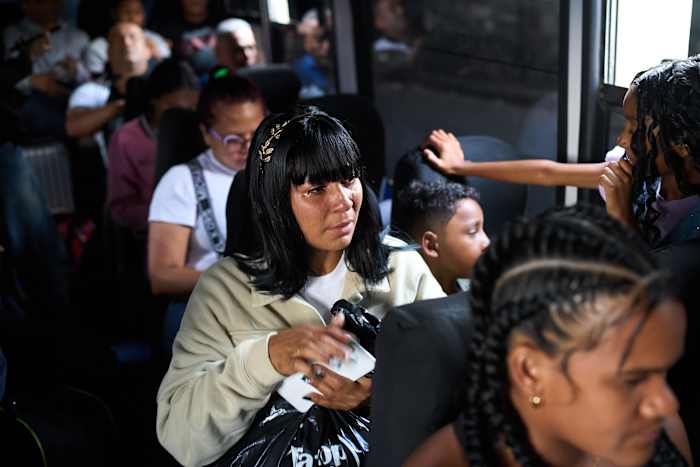
On April 5, Easter, the women took a bus from Caracas. Mendoza was joined by her son and daughter. Rosales escorted her two daughters and son, leaving her toddler home with a relative. Each family also carried something special for their prisoner.
Mendoza had some of her husband’s favorite snacks: popcorn and fried plantains. Rosales brought a sheet cake to celebrate the recent birthday of her eldest daughter, as well as her own, which was that very day.
The visit, the women and children said, was filled with conversations mostly about life and family. In between school and dentist appointment updates, the women assured their husbands they were not giving up on them. They just needed time to figure out another way to win their freedom.
After four hours, their reunion ended in hugs and tears –- the kind the wives have come to know those that say goodbye, not welcome home.
___
Copyright 2026 The Associated Press. All rights reserved. This material may not be published, broadcast, rewritten or redistributed without permission.


