
Share this @internewscast.com
SURIN – On Tuesday, Senate President Hun Sen of Cambodia pledged to engage fiercely in ongoing hostilities with Thailand, as the second consecutive day of intense clashes between the two nations prompted a mass exodus from their shared border regions.
The recent surge in violence erupted after a Thai soldier was killed in a skirmish on Sunday night. This incident occurred despite a previously established ceasefire that had paused hostilities in July. That ceasefire had come after a bloody five-day conflict over disputed territory, resulting in numerous casualties on both sides and displacing over 100,000 civilians.
Both Nations Stand Firm in Conflict
In messages posted on Facebook and Telegram, Hun Sen indicated that while Cambodian forces had withheld retaliation on Monday, they launched counterattacks against Thai troops overnight. He elaborated on a tactical approach focused on areas where Thai forces were making advances, aiming to “weaken and destroy enemy forces through counterattacks.”
Meanwhile, the Thai military reported that Cambodian artillery targeted a village in Sa Kaeo province early Tuesday, although no injuries were reported. Both nations accuse each other of instigating the latest rounds of fire, with Thailand alleging that Cambodian forces also engaged its troops on Sunday and Monday.
“Cambodia desires peace, but is compelled to defend its territory,” Hun Sen asserted. Though he stepped down as Cambodia’s prime minister in 2023, passing the role to his son Hun Manet, Hun Sen remains a significant and influential figure in Cambodian politics.
Cambodia’s military announced Tuesday that the new fighting had killed seven civilians and wounded 20. A spokesperson for the Thai military announced Tuesday that one solder had been killed and 29 wounded in the new fighting.
Speaking at a news conference, Thai Rear Adm. Surasant Kongsiri said the navy was strengthening its position in eastern Thailand near the border with Cambodia.
Thailand on Monday carried out airstrikes along the frontier, which it said were a defensive action targeting military installations. Surasant said such operation would continue “until attacks stop.”
Villagers on both sides flee to safety
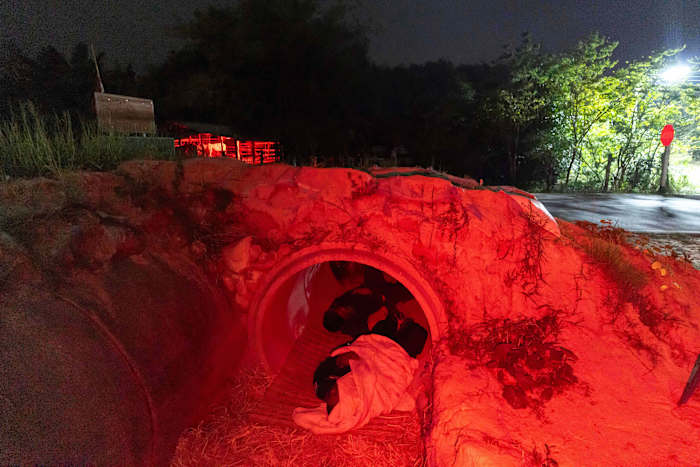
A separate statement from Thailand’s 2nd Army Region, situated along the border, said almost 500 temporary shelters have been set up in four border provinces, accommodating 125,838 people. Additional refugees from the fighting are expected to stay with relatives in safe areas.
It said Cambodia attacked Thai positions with rocket and drone attacks.
Cambodia said people fled villages near the border.
Thai Prime Minister Anutin Charnvirakul said Monday in a televised speech that military operations would be carried out as necessary to defend the country and protect public safety.
“Thailand has never wished for violence. I’d like to reiterate that Thailand has never initiated a fight or an invasion, but will never tolerate a violation of its sovereignty,” he said.
The two nations have a history of ill will
Thailand and Cambodia have a history of enmity over centuries and experience periodic tensions along their land border of more than 800 kilometers (500 miles).
The ceasefire that was agreed to end July’s fighting was brokered by Malaysia and pushed through by pressure from U.S. President Donald Trump, who threatened to withhold trade privileges from the two nations unless they agreed to it.
A more detailed agreement signed in October called for removing heavy weapons and equipment from the border; desisting from disseminating false information, accusations, and harmful rhetoric; implementing measures to restore mutual trust and full diplomatic relations; and coordinating operations to remove land mines.
None of these actions appear to have been implemented in full or in good faith by either side. After the ceasefire, both nations continued to fight a bitter propaganda war using disinformation, alongside minor outbreaks of cross-border violence.
Prisoners and land mines have been sticky issues
A major Cambodian complaint has been that Thailand continues to hold 18 prisoners taken prisoner when the ceasefire became active. Thailand accuses Cambodia of laying new land mines in the areas under dispute, in several cases maiming Thai soldiers. Cambodia says the mines are left over from decades of civil war that ended in 1999.
The mines issue caused Thailand to declare earlier this month that it was indefinitely pausing implementation of the details of the ceasefire until Cambodia apologized for the
U.N. Secretary-General Antonio Guterres expressed concern over the new fighting, especially the use of air strikes and heavy weapons, and called on the warring parties to recommit to the ceasefire.
___
Sopheng Cheang reported from Phnom Penh, Cambodia.
Copyright 2025 The Associated Press. All rights reserved. This material may not be published, broadcast, rewritten or redistributed without permission.