
Share this @internewscast.com
The United Nations Security Council is currently debating a resolution that seeks to ensure the Strait of Hormuz remains open to international navigation, a move that has sparked controversy due to its implicit suggestion of potential military action against Iran. According to three diplomats, the proposal has encountered resistance on these grounds.
Introduced by Bahrain, the draft resolution—acquired by The Associated Press—aims to counter Iran’s influence over this strategic waterway. This stranglehold has not only caused a surge in fuel prices but also posed a threat to the global economy. The proposal advocates for the authorization of countries or naval coalitions to employ military measures to guarantee safe passage and deter any attempts to disrupt navigation through the Strait.
It explicitly calls on Iran to “immediately cease all attacks against merchant and commercial vessels” and to stop obstructing the freedom of navigation in this pivotal region. The implications on international trade, energy security, and the broader global economy make this a pressing issue.
However, one diplomat mentioned that the resolution is under revision after several nations expressed concerns about its placement under Chapter Seven of the U.N. Charter. This chapter allows for a range of responses, from sanctions to military force, which has raised alarms about possible military escalation.
Bahrain, representing the Arab nations on the Security Council, has been directly affected by Iranian aggression, including drone and missile attacks, especially since the U.S. and Israel initiated strikes against Iran at the end of February. Whether the United States, presiding over the council this month, will endorse the resolution remains uncertain, although U.S. envoy Mike Waltz has highlighted a preference for regional leadership on this matter.
China and Russia, both with veto power on the 15-member council, have voiced opposition to the current draft, posing significant hurdles for the resolution’s passage. The diplomatic tug-of-war underscores the complexities of maintaining security in a region fraught with geopolitical tensions.
Another council diplomat said France introduced a separate resolution on Monday that made no mention of Iran and would not be placed under Chapter Seven. Instead, the text urges all parties to refrain from further escalation and return to the path of diplomacy. The French mission to the U.N. did not respond to requests for comment.
The diplomats spoke on the condition of anonymity to disclose private negotiations.
It is unlikely, given the disagreements, that either draft would be put to a vote this week. A separate Bahrain resolution condemning Iranian strikes on its territory received near unanimous support from the council two weeks ago, with China and Russia abstaining from the vote.
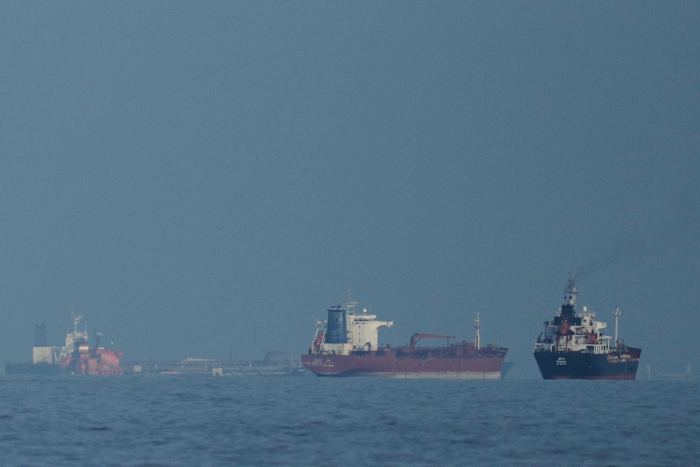
During the conflict, Iran has effectively closed the Strait of Hormuz, which connects the Persian Gulf to the rest of the world, while saying it allows safe passage for vessels from countries other than its enemies. Roughly one-fifth of global oil supply passes through the strait, but attacks on ships have stopped nearly all tanker traffic.
The U.S. first tried its hand at a diplomatic solution to the Strait of Hormuz problem last week when President Donald Trump called for a new international coalition to send warships to the strait. But America’s closest allies turned him down, resulting in Trump saying the U.S. could manage on its own.
On Friday he suggested other countries would have to take over as the U.S. eyes an exit from the war. Hours later he indicated the waterway would somehow “open itself.”
Copyright 2026 The Associated Press. All rights reserved. This material may not be published, broadcast, rewritten or redistributed without permission.