
Share this @internewscast.com
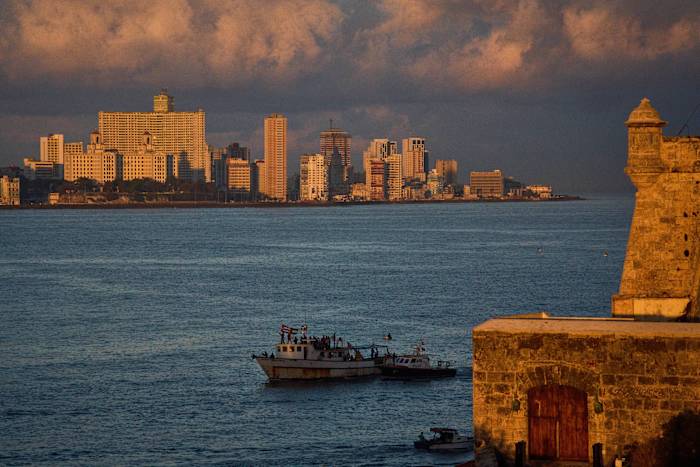
HAVANA – Raúl Castro, the former leader of Cuba, is actively participating in discussions between his country and the United States, as revealed by Cuban President Miguel Díaz-Canel on Wednesday.
The dialogue, which Díaz-Canel noted is still in its infancy, arises amid escalating tensions between the two countries. Cuba is grappling with widespread power outages due to a deteriorating electrical infrastructure and a U.S.-imposed oil embargo initiated by President Donald Trump. Trump has also threatened tariffs on nations supplying oil to Cuba and recently expressed a desire to “soon honor the taking of Cuba.”
Díaz-Canel made these remarks during a lengthy videotaped interview with Spanish leftist figure Pablo Iglesias, shared via state media. Although Díaz-Canel assumed the presidency in 2018, Raúl Castro, now 94 and a key figure in the Cuban revolution and Fidel Castro’s sibling, remains an influential force in the country.
Iglesias visited Cuba along with a group of approximately 600 activists from 33 different nations, who arrived the previous week to provide humanitarian relief.
“Negotiating a comprehensive agreement is a lengthy endeavor,” Díaz-Canel explained to Iglesias, who conducted the interview for his crowdfunded network, Canal RED.
“Initially, we need to establish a dialogue channel, followed by the creation of shared agendas that interest both parties. It is crucial for both sides to show willingness to advance and genuinely engage with the discussions surrounding these agendas,” Díaz-Canel elaborated.
In late January, Trump threatened tariffs on any country that sells or provides oil to Cuba as he pushes for a change in the island’s political model.
Although the initial threats were formally softened, the embargo has remained in place, and the island has not received any fuel shipments in the past three months.
Prolonged power outages and a near-paralysis of economic and social life are the visible consequences on the island, which in the last week experienced two nationwide blackouts that left millions without electricity as Cuba’s power grid continues to crumble.
The U.S. has said that Cuba was in negotiations, and Trump has threatened that he would take over the island soon.
Díaz-Canel was more nuanced in his response and said his officials and those from the U.S. State Department “held recent talks.”
He also addressed speculation surrounding the role that Castro, would be playing a role in these overture.
“The other thing they’ve tried to speculate about is that there are divisions within the leadership of the revolution,” Díaz-Canel said, not clarifying who he was referring to.
Castro “is one of those who, along with me and in collaboration with other branches of the (Communist) Party, the government, and the State, has guided how we should conduct this dialogue process, if this dialogue process takes place,” the president added.
He noted that Castro is “the historical leader of this revolution, even though he has relinquished his responsibilities,” and that he maintains a “prestige earned with the people” due to “historical recognition that no one can deny.”
Raúl Castro, who succeeded his brother, Fidel, as president, led historic talks with former U.S. President Barack Obama in 2014 that led to the reopening of embassies and re-establishment of diplomatic relations.
Trump has opposed such policy, tightening sanctions even further, exacerbating a deep economic crisis to the extreme of the current energy blockade.
Meanwhile, Francisco Pichón, resident coordinator of the United Nations in Cuba, warned that if the situation continued to spiral it could provoke a “humanitarian crisis”. Pichón and other officials said it would require $94 million to address the island’s energy crisis and hurricane damage from last year.
The crippled energy grid was slated to cut off 96,000 people, around 11,000 of them children, from getting surgeries they need, and cause 30,000 minors to fall behind of their vaccine schedules, he estimated.
It’s already cut around a million people who depend on water deliveries from trucks, off from access to water.
The Un officials highlighted the desperate need for fuel to enter Cuba, but also solar power as a potential solution to keep schools and hospitals up and running and to pump water for irrigation.
“If the current situation continues and the country’s fuel reserves are depleted, we do fear an accelerated deterioration with the possible loss of lives,” said Francisco Pichón, Resident Coordinator of the United Nations in Cuba.
___
Copyright 2026 The Associated Press. All rights reserved. This material may not be published, broadcast, rewritten or redistributed without permission.