
Share this @internewscast.com

BRUSSELS – The European Union is on the brink of enacting sanctions against Iran’s paramilitary Revolutionary Guard, a decisive move spurred by Tehran’s brutal suppression of widespread protests. This development further tightens the vise on the Islamic Republic, already on edge due to U.S. President Donald Trump’s ominous hints at a potential military strike.
In a show of force, the United States has strategically positioned the USS Abraham Lincoln, accompanied by several guided-missile destroyers, in the Middle East, ready to execute maritime attacks if necessary. In response, Iran has issued its own stern warnings, threatening preemptive strikes and stating it could target the broader region, including American military bases and Israel.
The path forward remains uncertain, with President Trump weighing his options regarding a military response. His threats have been a reaction to the lethal crackdown on peaceful demonstrators and the looming threat of mass executions. According to activists, the protests have tragically claimed at least 6,373 lives.
The EU’s contemplated sanctions will add another layer of hardship to Iran’s already faltering economy, heavily impacted by existing international sanctions. On Thursday, Iran’s currency, the rial, plummeted to an unprecedented low of 1.6 million to the dollar, a reflection of the economic turmoil that initially sparked the protests, which have since evolved into a challenge to the theocratic regime.
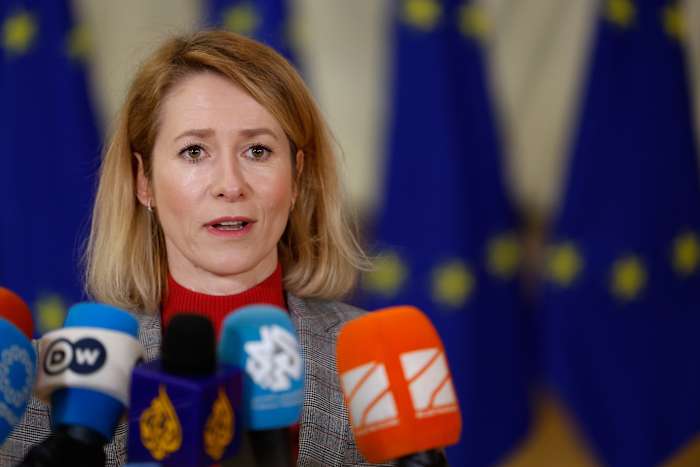
“This will place them on par with groups like al-Qaida, Hamas, and Daesh,” stated Kaja Kallas, the EU’s chief diplomat, invoking the Arabic acronym for the Islamic State group. “Those who engage in acts of terrorism should be classified and treated as terrorists.”
While Iran has not immediately responded to the EU’s impending decision, it has recently criticized European actions, following the precedent set by the U.S. in sanctioning the Revolutionary Guard.
By EU law, sanctions require unanimity across the bloc’s 27 nations. That’s at times hindered Brussels’ ability to flex its economic clout to crack down on Russia over its invasion of Ukraine.
For Iran, France had objected to listing the Guard as a terrorist organization over fears it would endanger French citizens detained in Iran, as well as diplomatic missions, which provide some of the few communication channels between the Islamic Republic and Europe and its allies. However, the office of President Emmanuel Macron on Wednesday signaled Paris backed the decision.
French Foreign Minister Jean-Noël Barrot said Thursday before the Foreign Affairs Council in Brussels that France supports more sanctions in Iran and the listing “because there can be no impunity for the crimes committed.”
“In Iran, the unbearable repression that has engulfed the peaceful revolt of the Iranian people cannot go unanswered,” he said.
___
Gambrell reported from Dubai, United Arab Emirates.
Copyright 2026 The Associated Press. All rights reserved. This material may not be published, broadcast, rewritten or redistributed without permission.