Share this @internewscast.com

In northern Europe, the chill has been intense enough that Estonians are now traversing a 20-kilometer (12.5-mile) expanse of frozen sea that connects the nation’s two primary islands.
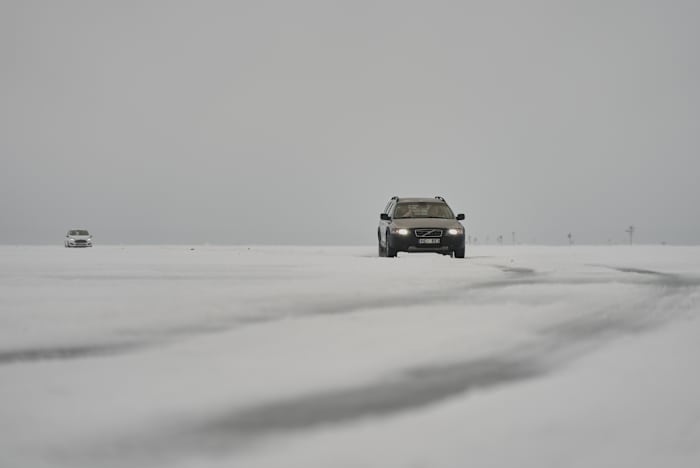
This “ice road,” linking Saaremaa and Hiiumaa islands in western Estonia, between the Baltic Sea and the Gulf of Riga, was officially opened on Sunday. By that afternoon, a queue of cars was ready to take advantage of this unique route.
The decision to open the ice road came after locals began making the treacherous journey across the frozen waters on their own, facing significant danger. With temperatures consistently plummeting to minus 10 degrees Celsius (14 degrees Fahrenheit), ferry services struggled to maintain regular operations through the ice-covered sea.
Hiiumaa, home to 9,000 residents, relies on access to the larger island of Saaremaa, where 31,000 people live, for everyday activities like shopping, coffee outings, and school commutes. This connection also links them to mainland Estonia.
While practicality drove the decision to open the ice road, Hiiumaa’s mayor, Hergo Tasuja, notes that it’s a cherished tradition. “It’s part of our culture,” he remarked.
Speaking to The Associated Press, Tasuja elaborated, “Generations here have a relationship with the sea—swimming and boating in summer, and in winter, it’s in their nature to venture onto the ice.”
The road is essentially a marked corridor on the frozen sea where specialists have determined the ice is thick enough to sustain the weight of driving cars.
Yet preparing the road is not easy, said Marek Koppel, a road maintenance supervisor at Verston Eesti, the Estonian construction company in charge of building and managing the ice road. Workers have to measure ice thickness every 100 meters (328 feet) to determine the areas with more than 24 centimeters (9 1/2 inches) of ice, the minimum required for safety. They also smooth over ridged ice and cracks. Weather conditions and the solidity of ice are monitored around the clock and the route amended accordingly.
A vehicle cannot be heavier than 2.5 tons (5,500 pounds) and it has to drive either below 20 kph (12.4 mph), or between 40 and 70 kph (25 and 43 mph) — anything in between can create a vibration that damages the ice. Cars are not allowed to stop and need to maintain a safe distance from one other. Passengers cannot wear seat belts and doors must be easy to open, to allow for fast exit in case of an accident.
“The road was pretty good, it was easy to ride,” said Alexei Ulyvanov, who lives in nearby Tallinn and traveled to the islands to show his children “that it’s possible to ride a car over the sea.”
According to Tasuja, an ice road was last used to connect the islands some eight years ago. Since then, the winters have been too warm.
Verston, the construction company, said authorities contracted them to open two more ice routes this week, this time linking mainland Estonia to two smaller islands.
Copyright 2026 The Associated Press. All rights reserved. This material may not be published, broadcast, rewritten or redistributed without permission.