
Share this @internewscast.com

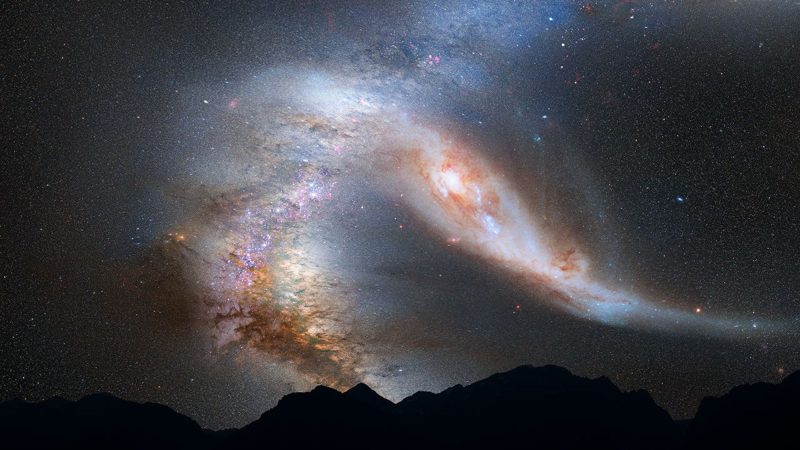
(NewsNation) — The once-anticipated collision between the Milky Way and Andromeda galaxies may be less certain than scientists originally predicted.
New findings reported by the Associated Press indicate that astronomers in Finland now believe the likelihood of our galaxy colliding with Andromeda is only 50-50 over the next 10 billion years. Previously, it was thought that a collision would occur within the next 5 billion years.
“Based on the best available data, the fate of our galaxy is still completely open,” the team wrote in the study, which appeared in Nature Astronomy.
Under the guidance of University of Helsinki researcher Til Sawala, a team conducted simulations based on current data from NASA’s Hubble Space Telescope and the European Space Agency’s Gaia star-tracking mission. Space.com notes that these simulations led to unexpected conclusions.
- Georgia authorities arrest man for killing his parents in their Largo home
“A head-on collision is very unlikely, we found a less than 2% chance for that,” Sawala said. “In most of the cases that lead to a merger, the two galaxies will indeed fly past each other at first, which will lead to a loss of orbital energy, and subsequently to a merger.
“How close they come on their first passage is very uncertain, however, and if they don’t come very close, meaning if their distance is more than around 500,000 light-years, they might not merge at all.”
Sawala said he was not prepared for what his team found.
“In short, the probability went from near-certainty to a coin flip,” the researcher said.
The study relied on newer and more precise information, and the team took into consideration a “more complete system,” including the potential effects of the Large Magellanic Cloud. The dwarf galaxy is the Milky Way’s largest satellite galaxy, Space.com reported.
Ultimately, the astronomers found that the Milky Way and Andromeda would inevitably collide if the two galaxies’ orbits come close enough to affect a gravitational pull on one another. If they stay well separated, the merger won’t happen.
While the scenarios indicated a less likely merger between the two, they found that the Milky Way is far more likely to cannibalize the Large Magellanic Cloud.
The research indicates that this newly theorized merger is likely to happen over the next two billion years.