
Share this @internewscast.com
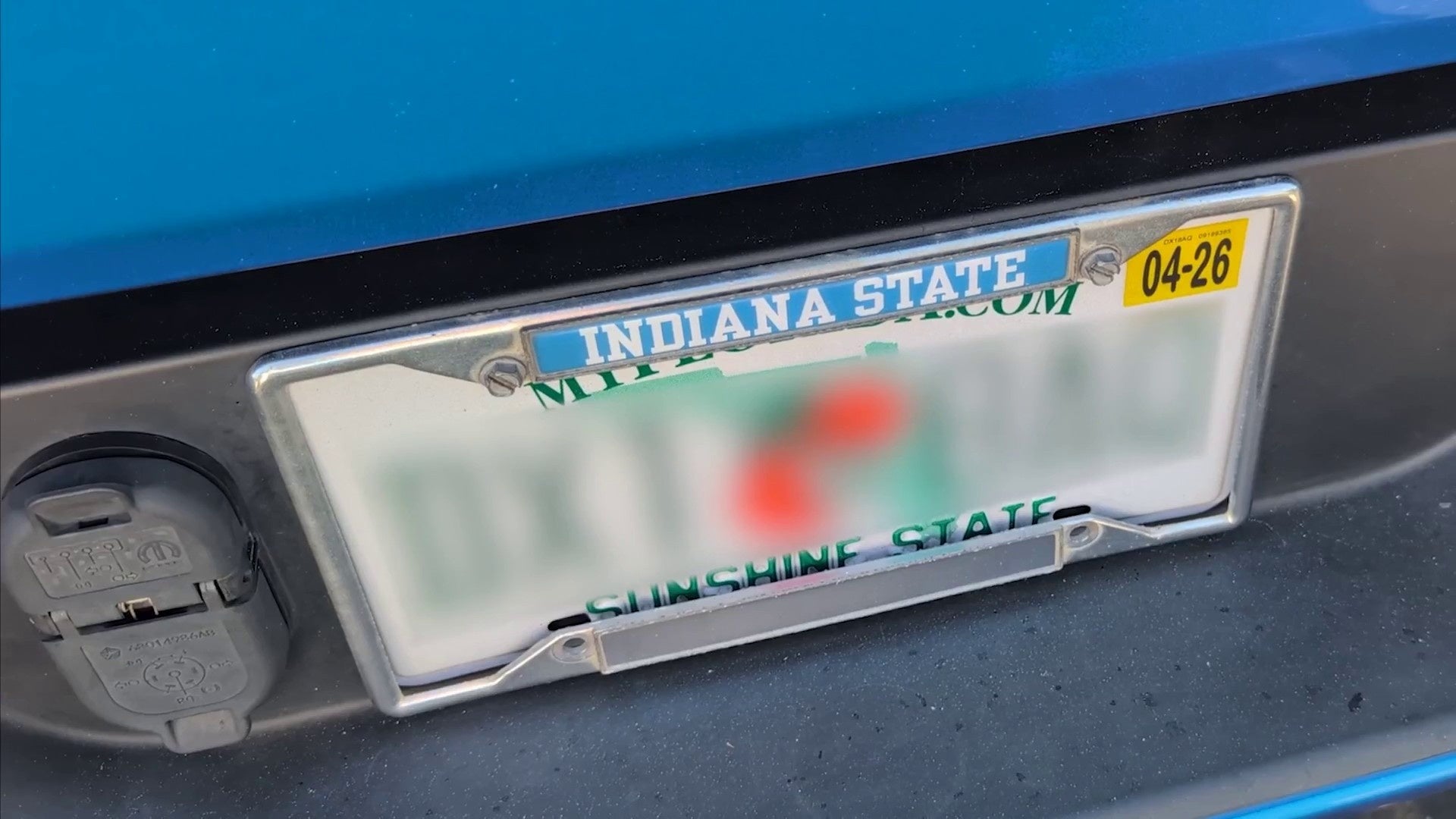
ORLANDO, Fla. – A new law that took effect on October 1 has left Florida drivers and law enforcement in a state of uncertainty: Is your license plate frame legal or not?
The confusion surrounding this new legislation prompted the state to release a clarification last week, as previously covered by News 6. The law in question, Florida Statute 320.262, now classifies it as a second-degree misdemeanor to obstruct or interfere with the visibility of a license plate’s key features. This specifically includes both the license plate number and the validation sticker located in the top right corner.
While the law’s aim seems clear, its enforcement and interpretation have varied significantly across the state. For instance, the Ocoee Police Department has advised motorists that even if a frame or cover obscures a small portion of the plate, it could result in a traffic stop and a citation. This stance is echoed by the State Attorney’s Office in Southwest Florida, which has issued similar warnings to drivers.
In contrast, the Volusia County Sheriff’s Office has taken a more lenient approach. They posted an extensive explanation online, indicating that as long as the alphanumerics and decal on the plate are visible and legible, there is no violation.
Some agencies, like the Ocoee Police Department, have told drivers that “if a frame or cover hides even a small section, it can lead to a traffic stop and a citation.” The State Attorney’s Office in Southwest Florida has issued a similar warning.
Meanwhile, the Volusia County Sheriff’s Office published a lengthy online post stating that, “as long as the alphanumerics and decal are visible and legible, there is no violation.”
Still, News 6 uncovered more than a dozen citations issued across Central Florida in the weeks following the law’s implementation. In Fruitland Park, several drivers received tickets for frames that only partially cover the plate, including one case involving this decorative palm tree frame.
Preventing the recording of plate information is the primary issue, according to Rachel Mattie, a criminal defense attorney with the Umansky Law Firm.
“So here is the thing with this new statute, it’s not actually changing much in what’s allowed or not allowed, the biggest difference is how it is now going to be penalized. So instead of a traffic infraction, now it’s a criminal offense,” Mattie said.
Mattie believes that the new statute is “vague,” specifically the language, “a person may not alter the original appearance of a license plate, whether by mutilation, alteration, defacement, or change of color or in any other manner.”
“The statute reads that you cannot alter the original appearance of your license plate whatsoever. So arguably, this could even be the border,” Mattie said
With the potential for criminal charges, Mattie’s advice is to “avoid the license plate frames altogether, not put yourself in that position. But if you do find yourself pulled over the time to fight that is in court with an attorney, not on the roadside with an officer.”
News 6 Traffic Safety Expert Steven Montiero said drivers need to understand the risk of being pulled over.
“Right now, the law is saying anything that obstructs that tag can get you pulled over,” Montiero said.
While Montiero noted that officers may not be actively looking to stop drivers for minor plate obstructions, the statute gives them the authority to do so.
“I would tell anybody right now, to be safe, as long as your tag frame is not covering any text, including the top where it says Florida or the bottom where it says the Sunshine State or your county, then you are good to go,” he said.
To help clarify the law, the Florida Department of Highway Safety and Motor Vehicles issued a memo to law enforcement agencies on Dec. 12.
In it, Executive Director Dave Kerner confirmed that license plate frames are allowed, but only if they do not obscure:
-
The alphanumeric characters; and
-
The decal located in the top right-hand corner of the plate.
The department clarified that any information at the bottom of the plate, such as the state website or county name, is not considered a “primary feature.” That means a frame covering that part may still be legal, as long as the plate’s key identifying elements are visible.
The memo also referenced a 2019 ruling from Florida’s Fourth District Court of Appeal, where a similar statute (s. 320.061 F.S.) was analyzed. In that case, a license plate frame was found permissible, even though it partially covered the bottom of the plate, because it did not interfere with any identifying information.
Law enforcement officers are still encouraged to consult their agency counsel if they need further guidance.
Copyright 2025 by WKMG ClickOrlando – All rights reserved.