
Share this @internewscast.com

WELLINGTON – In a chilling courtroom revelation, it was disclosed that Brenton Tarrant, the perpetrator behind New Zealand’s most horrific mass shooting, took pride in being labeled a terrorist. This unsettling detail emerged during a recent legal proceeding evaluating whether Tarrant was mentally competent when he confessed to his heinous actions.
Tarrant, now 35, was condemned to life imprisonment without the possibility of parole after admitting to charges of terrorism, murder, and attempted murder. His brutal attack in 2019 targeted worshippers, including children, at two Christchurch mosques during Friday prayers. Yet, in a shocking twist, the Australian national is now attempting to retract his 2020 confessions, arguing that the harsh conditions of solitary confinement rendered him mentally unstable and irrational.
The Court of Appeal in Wellington is currently deliberating Tarrant’s request in a detailed five-day hearing. Should the three-judge panel rule to overturn his guilty pleas, the entire case would be thrust back into the courtroom for a full trial.
The court is scrutinizing Tarrant’s sudden change of heart, delving into the factors that may have led to his initial admissions. Originally pleading not guilty, Tarrant shifted his stance just before his trial was set to commence. On Monday, he testified that the relentless isolation, constant surveillance, lack of reading materials, and minimal external contact pressured him into confessing due to “nervous exhaustion.”
His former legal representatives, who were present during both phases of his pleas, revealed on Tuesday that they had raised concerns about his prison conditions early in his confinement. However, prison authorities reportedly dismissed these grievances, offering little relief to the situation.
Lawyers who represented him during the period when he entered both sets of pleas told the court Tuesday that they had laid a complaint about his prison conditions early in his confinement. Prison officials were dismissive of his grievances, the lawyers said.
They said, however, that restrictions on Tarrant eased later and they didn’t think his environment had harmed his ability to make decisions. Tarrant said Monday that he had masked symptoms of serious mental illness in an effort not to appear weak or to reflect poorly on others who held his racist views.
Crown lawyers suggested to Tarrant on Monday that he had many opportunities to raise concerns about his mental health and or request a postponement of his trial. No witness has so far agreed with Tarrant that his conditions were so onerous and his mental state so poor that he wasn’t fit to plead guilty.
Shooter was told a political trial wasn’t possible
One issue at the heart of the case is whether Tarrant always intended to admit the charges or planned to contest them. Tarrant said Monday that he had meant to defend himself at a trial, while his lawyers said Tuesday that they were sure he intended to plead guilty due to the overwhelming evidence against him, which included his Facebook livestream of the massacre and a racist manifesto he posted online before the attack.
Shane Tait, who previously acted for Tarrant, said his client had wanted to argue during a trial that he had been defending New Zealand — a country he migrated to with a view to committing the attack — from immigrants. Tait assured Tarrant that such a defense wasn’t available under New Zealand law, he told the court.
“Brenton, what am I going to tell the jury if we go to trial?” Tait said he had asked Tarrant. His client had responded, “Don’t worry, it won’t get that far,” Tait said.
Both Tait and Tarrant’s other then-lawyer Jonathan Hudson said it was important to their client that he be convicted on the terrorism charge and he refused to allow his lawyers to attempt to negotiate it away in exchange for guilty pleas to the murder and attempted murder charges.
“He wanted to be described as a terrorist,” Hudson said.
The appeal outcome is due later
Bids to appeal convictions or sentences in New Zealand must be made within 20 working days. Tarrant was two years late in seeking an appeal, filing documents in 2022.
He told the court Monday that his bid had been late because he hadn’t had access to the information required to make it.
The judges are expected to release their decision at a later date. If they reject Tarrant’s attempt to have his guilty pleas discarded, a later hearing will focus on his bid to appeal his sentence.
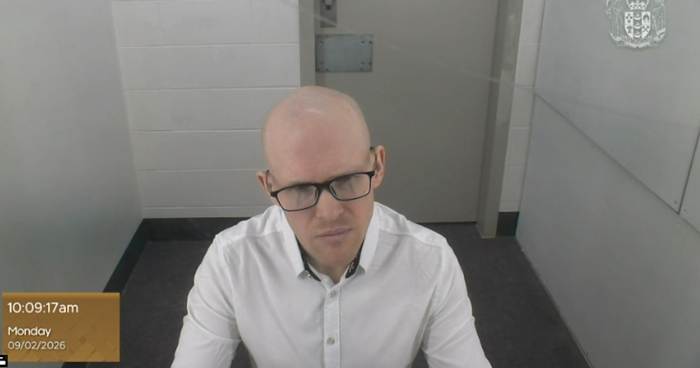
The hearing was the first time that Tarrant, who appeared by video conference from prison, had been seen or heard from in court for years. He appeared pale and thin, with a shaved head and black-framed glasses.
Some of those bereaved or injured by his violence watched a live feed of proceedings from a courtroom in Christchurch, telling reporters afterward of their exasperation and anger that he was allowed to keep revisiting his case in court.
“There’s definitely no remorse at all,” said Rashid Omar, whose son Tariq Omar was murdered, adding that the proceedings appeared to be a game to Tarrant.
“We are very, very strong,” Omar said. “We’re not going to be bullied by him.”
Copyright 2026 The Associated Press. All rights reserved. This material may not be published, broadcast, rewritten or redistributed without permission.