
Share this @internewscast.com
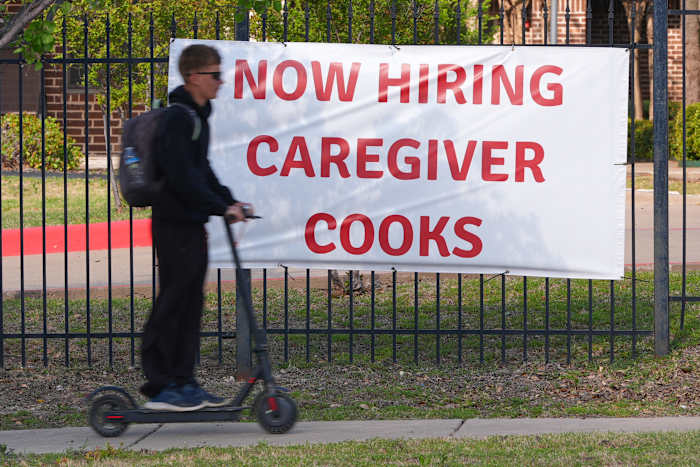
WASHINGTON – Despite a notably low unemployment rate, many Americans are increasingly doubtful about the job market as they grapple with a persistent slowdown in hiring. This sentiment is captured in a recent Gallup survey that reveals a significant shift in perception.
In a stark departure from optimism observed just a few years ago, only 28% of workers in the latest quarterly survey believe it’s a “good time” to find a quality job. A substantial 72% feel the opposite, marking a dramatic reversal from mid-2022 when a robust 70% expressed confidence in job prospects.
The growing pessimism is palpable. As recently as late 2024, nearly half of the workforce still held a positive outlook on job hunting. However, the latest findings, drawn from data collected in the last quarter of 2025, suggest a significant downturn long before the recent geopolitical tensions in Iran, which have caused oil and gas prices to spike, potentially impacting economic activity as Americans allocate more of their budget to fuel costs.
This sentiment underscores other reports indicating that, despite positive economic indicators and minimal job losses, Americans generally harbor a bleak view of the economy’s trajectory.
Particularly affected by this downturn in optimism are college graduates. Their disillusionment stems largely from a two-year stagnation in hiring across several white-collar sectors, including software development, customer service, and advertising, which traditionally promise robust employment opportunities.
Job pessimism is especially pronounced among college graduates. The shift is likely because hiring in many white-collar professions has been unusually weak for the past two years, in areas such as software, customer service and advertising.
The survey found a split based on education levels, with just 19% of workers with a college degree thinking that now is a good time to find a quality job, while 35% of workers without a college degree are optimistic.
A separate Gallup survey of U.S. adults overall found that college graduates’ optimism about the job market is the lowest it’s been since 2013. Meanwhile, the gap in job market sentiment between Americans with and without a college degree was at its widest in that survey since Gallup started asking the question in 2001.
Signs of broad discontent among young workers
Just about 2 in 10 workers ages 18-34 think now is a good time to find a job, compared to about 4 in 10 workers ages 65 and older who say the same.
Gallup’s survey is consistent with what economists call the “low-hire, low-fire” job market: Businesses are largely holding onto their workers and measures of layoffs remain quite low. As a result, older workers are largely secure in their jobs. But hiring is also quite sluggish, making it harder for younger workers to break in and find permanent work.
It also found that younger workers are much likelier than older workers to say they’re actively looking for a new job or watching for opportunities. Most Gen Z and Millennial workers say they’re at least watching for opportunities, while about three-quarters of baby boomers say they’re not looking at all.
Other surveys signal negative economic views
The Gallup results come as government data shows that overall hiring is at its weakest level in more than a decade. The Labor Department tracks a “hiring rate,” or the proportion of people who are hired each month as a percent of those with jobs. The hiring rate dropped to 3.2% last November, around when Gallup conducted its survey, the lowest since March 2013. It was 3.9% before the pandemic.
A hiring rate at that 3.2% is quite low: When it was last reached in March 2013, the unemployment rate was 7.5%, as millions of Americans were still struggling to find work after the 2008-2009 Great Recession. It suggests it is much harder to find a job now than the unemployment rate would indicate.
Government data also shows that there are more unemployed people — 7.4 million — than available jobs, at 6.9 million. That is a reversal from the first few years after the pandemic, when vacancies outnumbered those out of work.
Gallup’s survey also found that workers have a dimmer view of their current life and future prospects than at any point since 2009, when the firm began measuring the workforce’s life evaluations.
Other surveys echo Americans’ generally dark view of the economy. The Conference Board’s consumer confidence survey was just 91.2 in February, not far from its pandemic-era lows and down from nearly 130 before the pandemic.
More people believe jobs are “easy to get” than “hard to find,” the Conference Board’s survey finds, but the gap has narrowed steadily in recent years.
___
The Gallup poll of 22,368 U.S. adults who are working full-time and part-time for organizations in the U.S. was conducted Oct. 30-Nov. 13, 2025, using a sample drawn from Gallup’s probability-based panel. The margin of sampling error for all respondents is plus or minus 1.0 percentage points.
Copyright 2026 The Associated Press. All rights reserved. This material may not be published, broadcast, rewritten or redistributed without permission.