
Share this @internewscast.com
Greenland, an Arctic island known for its stark beauty and strategic importance, has recently found itself at the center of a geopolitical storm. This sudden attention comes courtesy of U.S. President Donald Trump, who has expressed an audacious interest in acquiring the island, even hinting at the possibility of using force. Such remarks have instantly made Greenland a hot topic on the international stage.
As a semiautonomous territory under Danish sovereignty, Greenland has been thrust into the limelight, creating palpable tension between Denmark and the U.S. A recent meeting at the White House revealed that Denmark’s foreign minister acknowledged a “fundamental disagreement” with Trump regarding Greenland’s status and future.
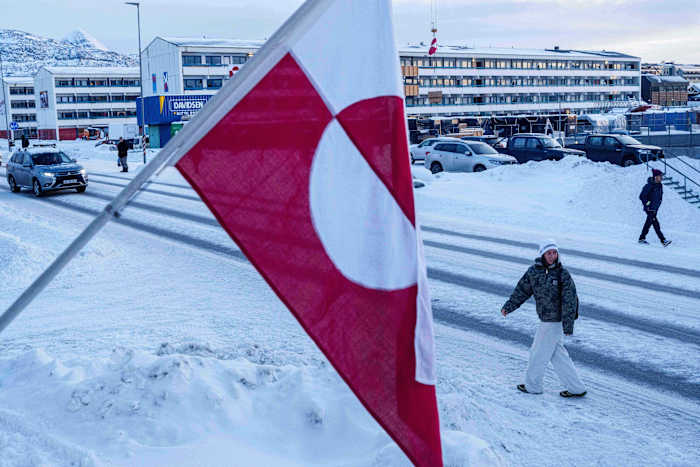
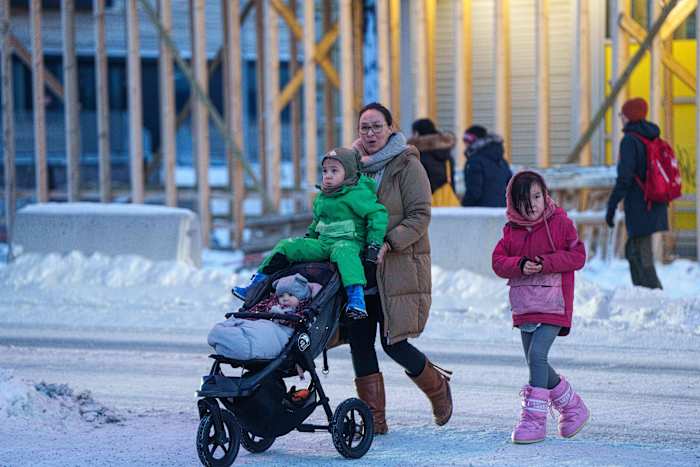
For Greenlanders, this international tug-of-war has deeply affected their everyday lives. Naaja Nathanielsen, a Greenlandic minister, recently articulated the community’s anxiety during a session with British lawmakers. “People are not sleeping, children are afraid, and it just fills everything these days,” she noted, highlighting the pervasive sense of unease and confusion among the populace.
As the debate rages on, the sentiments of Greenlanders have become a focal point. Many locals feel that Trump’s rhetoric undermines their culture and autonomy. His dismissive comments about Denmark’s defenses in Greenland, reducing them to “two dog sleds,” have only fueled concerns about cultural insensitivity and the trivialization of their home.
With tensions simmering and the world watching closely, the people of Greenland find themselves grappling with uncertainty about their future amid a backdrop of geopolitical maneuvering. The situation continues to unfold, leaving many to ponder the implications of such high-stakes diplomacy on their serene but now spotlighted island.
Trump has dismissed Denmark’s defenses in Greenland, suggesting it’s “two dog sleds.”
By saying that, Trump is “undermining us as a people,” Mari Laursen told AP.
Laursen said she used to work on a fishing trawler but is now studying law. She approached AP to say she thought previous examples of cooperation between Greenlanders and Americans are “often overlooked when Trump talks about dog sleds.”
She said during World War II, Greenlandic hunters on their dog sleds worked in conjunction with the U.S. military to detect Nazi German forces on the island.
“The Arctic climate and environment is so different from maybe what they (Americans) are used to with the warships and helicopters and tanks. A dog sled is more efficient. It can go where no warship and helicopter can go,” Laursen said.
Greenlanders don’t believe Trump’s claims
Trump has repeatedly claimed Russian and Chinese ships are swarming the seas around Greenland. Plenty of Greenlanders who spoke to AP dismissed that claim.
“I think he (Trump) should mind his own business,” said Lars Vintner, a heating engineer.
“What’s he going to do with Greenland? He speaks of Russians and Chinese and everything in Greenlandic waters or in our country. We are only 57,000 people. The only Chinese I see is when I go to the fast food market. And every summer we go sailing and we go hunting and I never saw Russian or Chinese ships here in Greenland,” he said.
Down at Nuuk’s small harbor, Gerth Josefsen spoke to AP as he attached small fish as bait to his lines. He said, “I don’t see them (the ships)” and said he had only seen “a Russian fishing boat ten years ago.”
Trump is interested in Greenland’s critical minerals
Maya Martinsen, 21, a shop worker, told AP she doesn’t believe Trump wants Greenland to enhance America’s security.
“I know it’s not national security. I think it’s for the oils and minerals that we have that are untouched,” she said, suggesting the Americans are treating her home like a “business trade.”
She said she thought it was good that American, Greenlandic and Danish officials met in the White House Wednesday and said she believes that “the Danish and Greenlandic people are mostly on the same side,” despite some Greenlanders wanting independence.
“It is nerve-wrecking, that the Americans aren’t changing their mind,” she said, adding that she welcomed the news that Denmark and its allies would be sending troops to Greenland because “it’s important that the people we work closest with, that they send support.”
Greenlanders get support from Denmark
Tuuta Mikaelsen, a 22-year-old student, told AP that she hopes the U.S. got the message from Danish and Greenlandic officials to “back off.”
She said she didn’t want to join the United States because in Greenland “there are laws and stuff, and health insurance .. .we can go to the doctors and nurses … we don’t have to pay anything,” she said adding “I don’t want the U.S. to take that away from us.”
Greenland is at the center of a media storm
In Greenland’s parliament, Juno Berthelsen, MP for the Naleraq opposition party that campaigns for independence in the Greenlandic parliament told AP that he has done multiple media interviews every day for the last two weeks.
When asked by AP what he would say to Trump and Vice President JD Vance if he had the chance, Berthelsen said:
“I would tell them, of course, that — as we’ve seen — a lot of Republicans as well as Democrats are not in favor of having such an aggressive rhetoric and talk about military intervention, invasion. So we would tell them to move beyond that and continue this diplomatic dialogue and making sure that the Greenlandic people are the ones who are at the very center of this conversation.”
“It is our country,” he said. “Greenland belongs to the Greenlandic people.”
___
Kwiyeon Ha and Evgeniy Maloletka contributed to this report.
Copyright 2026 The Associated Press. All rights reserved. This material may not be published, broadcast, rewritten or redistributed without permission.