
Share this @internewscast.com
PORT-AU-PRINCE – Recently, a video circulating on social media showed a large group advancing towards Haiti’s prime minister’s office. The footage drew surprise from many viewers because the protesters, who were openly HIV positive, revealed their identities—something uncommon in a country where the virus carries a significant stigma.
“Call the minister of health! We are dying!” the group chanted.
The demonstrators faced the possibility of social exclusion to highlight a critical issue: Haiti is nearing a shortage of HIV medication, a situation intensified by the recent move from U.S. President Donald Trump’s administration to cut more than 90% of USAID’s foreign assistance contracts, along with a $60 billion reduction in global aid.
At a hospital near the northern city of Cap-Haitien, Dr. Eugene Maklin said he struggles to share that reality with his more than 550 HIV patients.
“It’s hard to explain to them, to tell them that they’re not going to find medication,” he said. “It’s like a suicide.”
‘We can’t stay silent’
More than 150,000 people in Haiti have HIV or AIDS, according to official estimates, although nonprofits believe the number is much higher.
Included in the group is David Jeune, a 46-year-old hospital community worker. He contracted the virus 19 years ago following unprotected sex. “I was afraid to disclose my status because people would accuse you of spreading AIDS,” he explained.
His fear was so great that he didn’t tell anyone, not even his mother. But that fear dissipated with the support Jeune said he received from nonprofits. His confidence grew to the point where he participated in Monday’s protest.
“I hope Trump will change his mind,” he said, noting that his medication will run out in November. “Let the poor people get the medication they need.”
Patrick Jean Noël, a representative of Haiti’s Federation of Associations of HIV, said that at least five clinics, including one that served 2,500 patients, were forced to close after the USAID funding cuts.
“We can’t stay silent,” he said. “More people need to come out.”
But most people with HIV in Haiti are reluctant to do so, said Dr. Sabine Lustin, executive director of the Haiti-based nonprofit Promoters of Zero AIDS Goal.
The stigma is so strong that many patients are reluctant to pick up their medication in person. Instead, it is sent via packages wrapped as gifts to not arouse suspicion, Lustin said.
Lustin’s organization, which helps some 2,000 people across Haiti, receives funding from the U.S. Centers for Disease Control and Prevention. While their funding hasn’t been cut, she said that shortly after Trump was sworn in, the agency banned prevention activities because they targeted a group that is not a priority. By that, Lustin said she understood they were referring to gay men.
That means the organization can no longer distribute up to 200,000 free condoms a year or educate people about the disease.
“You risk an increase in infections,” she said. “You have a young population who is sexually active who can’t receive the prevention message and don’t have access to condoms.”
‘We only have medication until July’
On a recent sunny morning, a chorus of voices drowned out the din of traffic in Haiti’s capital, growing louder as protesters with HIV marched defiantly toward the office of Haiti’s prime minister.
“We are here to tell the government that we exist, and we are people like any other person,” one woman told reporters.
Another marching alongside her said, “Without medication, we are dying. This needs to change.”
Three days after Monday’s protest, the leader of Haiti’s transitional presidential council, Louis Gérald Gilles, announced that he had met with activists and would try to secure funding.
Meanwhile, nonprofit organizations across Haiti are fretting.
“I don’t know what we’re going to do,” said Marie Denis-Luque, founder and executive director of CHOAIDS, a nonprofit that cares for Haitian orphans with HIV/AIDS. “We only have medication until July.”
Her voice broke as she described her frantic search for donations for the orphans, who are cared for by HIV-positive women in Cap-Haitien after gang violence forced them to leave Port-au-Prince.
Denis-Luque said she has long advocated for the orphans’ visibility.
“We can’t keep hiding these children. They are part of society,” she said, adding that she smiled when she saw the video of Monday’s protest. “I was like, whoa, things have changed tremendously. The stigma is real, but I think what I saw … was very encouraging to me. They can’t be silenced.”
A dangerous combination
Experts say Haiti could see a rise in HIV infections because medications are dwindling at a time that gang violence and poverty are surging.
Dr. Alain Casseus, infectious disease division chief at Zamni Lasante, the largest non-governmental healthcare provider in Haiti, said they expected to see a surge in patients given the funding cuts, but that hasn’t happened because traveling by land in Haiti is dangerous since violent gangs control main roads and randomly open fire on vehicles.
He warned that abruptly stopping medication is dangerous, especially because many Haitians do not have access or cannot afford nutritious food to strengthen their immune system.
“It wouldn’t take long, especially given the situation in Haiti, to enter a very bad phase,” he said of HIV infections. And even if some funding becomes available, a lapse in medication could cause resistance to it, he said.
Casseus said gang violence also could accelerate the rates of infection via rapes or physical violence as medication runs out.
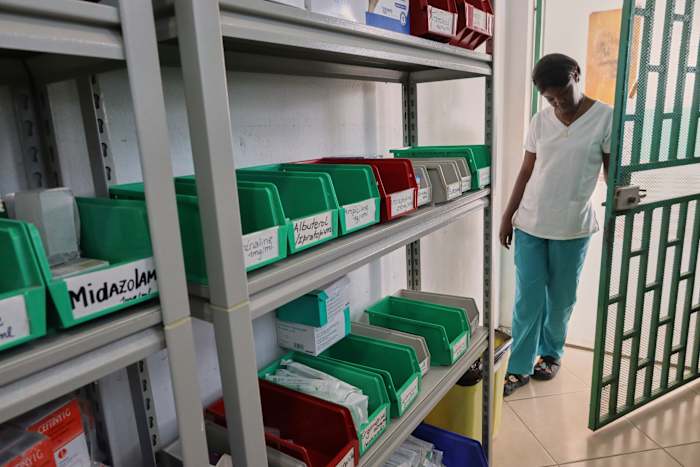
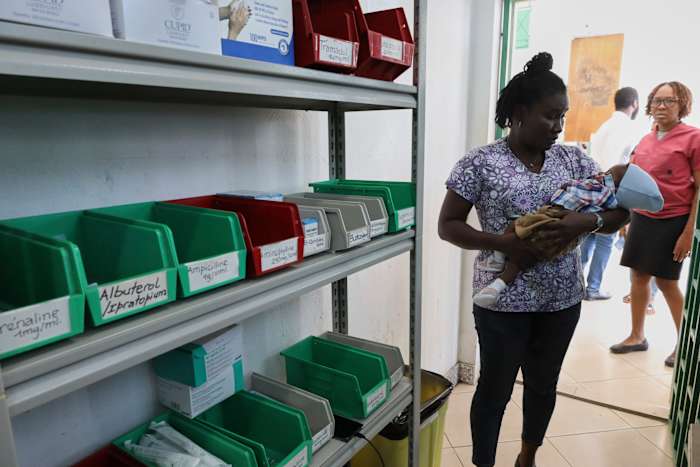
At the New Hope Hospital run by Maklin in Haiti’s northern region, shelves are running empty. He used to receive more than $165,000 a year to help HIV/AIDS patients. But that funding has dried up.
“Those people are going to die,” he said. “We don’t know how or where we’re going to get more medication.”
The medication controls the infection and allows many to have an average life expectancy. Without it, the virus attacks a person’s immune system, and they develop AIDS, the late stage of an HIV infection.
Reaction is swift when Dr. Maklin tells his patients that in two months, the hospital won’t have any HIV medication left.
“They say, ‘No, no, no, no!’” he said. “They want to keep living.”
___
Coto reported from San Juan, Puerto Rico.
____
Follow AP’s coverage of Latin America and the Caribbean at https://apnews.com/hub/latin-america
Copyright 2025 The Associated Press. All rights reserved. This material may not be published, broadcast, rewritten or redistributed without permission.