
Share this @internewscast.com
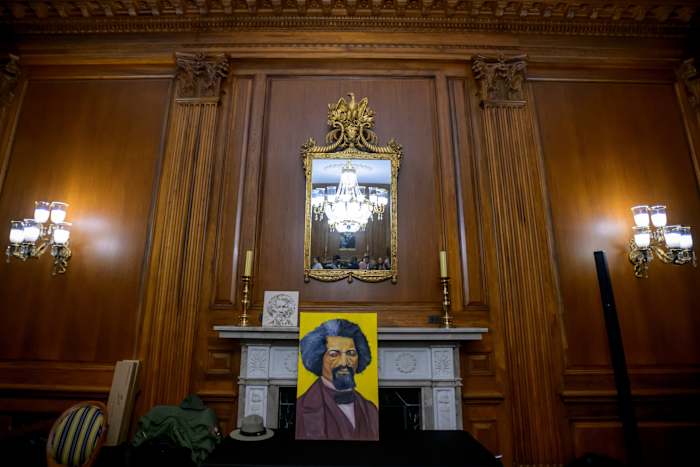
WASHINGTON – In a symbolic gesture of unity, the press gallery above the U.S. House chamber now bears the name of Frederick Douglass, an esteemed abolitionist, writer, and advisor to presidents, thanks to a collaborative effort led by Black legislators.
This initiative, championed by Rep. Byron Donalds, R-Fla., emerged over the past year. Donalds, along with his team, sought to honor notable figures in American history, particularly focusing on influential Black Americans, within the Capitol’s halls.
“Frederick Douglass epitomized a deep and unwavering belief in the American people and the nation’s ideals,” Donalds remarked during a speech marking the dedication.
History remembers Douglass for his writings on congressional activities during the Civil War. Through his powerful oratory and correspondence with President Abraham Lincoln and Republican congressmen from the North, he played a pivotal role in rallying support for the abolition of slavery.
“It is crucial that we bestow honor where it is rightfully due, a principle rooted in biblical teaching,” stated House Speaker Mike Johnson at the unveiling of a plaque now gracing the gallery entrance. “Frederick Douglass unquestionably merits this recognition.”
A rare show of bipartisan unity has emerged amidst the usual divisions in Washington.
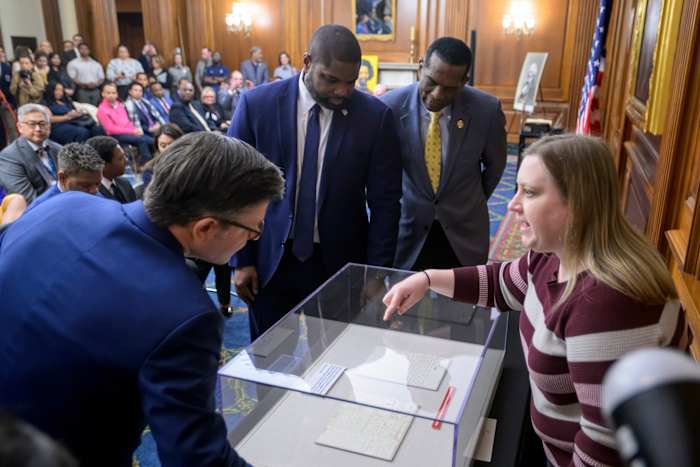
Prominent Black conservatives, including activists, faith leaders and senior Trump administration officials, mingled with lawmakers at a ceremony inside the U.S. Capitol. Staffers from the Library of Congress displayed artifacts from Douglass’ life.
The celebration, which came during Black History Month and the 100th anniversary of the earliest national observance of Black history, coincided with intense debate over how race, history and democracy are understood in the U.S.
President Donald Trump signed an executive order last year targeting the teaching of history in the Smithsonian Institution, which the order claimed had “come under the influence of a divisive, race-centered ideology” that “promoted narratives that portray American and Western values as inherently harmful and oppressive.”
Another order signed by the president claimed that in U.S. K-12 schools, “innocent children are compelled to adopt identities as either victims or oppressors.” Trump ordered federal agencies to develop a comprehensive strategy to end “indoctrination” by teachers who may promote “anti-American, subversive, harmful, and false ideologies on our nation’s children.”
Critics argued that the orders, with the removal of some public displays by the National Park Service related to race and identity, and the White House’s ongoing efforts to end diversity, equity and inclusion programs, represented a whitewashing of history that could ultimately fuel discrimination against minority communities.
But the administration’s allies argue that the policies are a corrective to an overly critical narrative about America’s past. Black conservatives, in particular, have defended the moves and argued that more positive stories of individual triumph, like Douglass’ life story, need to be more widely told.
“This is what we did when I was growing up. We knew about our Black heroes,” said Rep. Burgess Owens, a Utah Republican who is Black and attended the dedication. “When we stop telling the good, then people start thinking that we’re not the country that is the promise that we gave. So we need to talk about our history, our success.”
Rep. Steve Horsford, a Nevada Democrat who worked with Donalds on the renaming, said it was important to find bipartisan agreement where possible.
“I wouldn’t be here if it were not for the desire to want to work across the aisle, to not just recognize our history and culture, but to solve our problems that people face today,” Horsford said.
The life and legacy of Frederick Douglass
Born in Maryland, Douglass escaped slavery by fleeing to New York as a young man. He become one of the most influential activists for abolition and later moved to Capitol Hill in Washington, where he advocated for civil rights.
An estate he bought after emancipation in the Anacostia neighborhood of Washington is now a national park.
Douglass, who taught himself to read and write, fiercely condemned the dehumanization of people of African descent and delivered numerous influential speeches throughout his life. His 1852 speech “What to the Slave Is the Fourth of July?” denounced the contradictions of the country’s founding ideals with its embrace of slavery.
In an 1867 essay, Douglass urged Congress to allow Black men to vote and called for more aggressive Reconstruction efforts in the South to guarantee multiracial democracy.
“What, then, is the work before Congress? It is to save the people of the South from themselves,” Douglass wrote. “It must enfranchise the negro, and by means of the loyal negroes and the loyal white men of the South build till a national party there, and in time bridge the chasm between North and South, so that our country may have a common liberty and a common civilization.”
Douglass, who did not know the day he was born because records were rarely kept about enslaved people’s lives, celebrated his birthday on Valentine’s Day because his mother called him her “little Valentine” before he was separated from her as a child.
Donalds praised Douglass for his ability to “love this country enough to tell the truth about it.”
“His life story, from the field, from the slavery fields to the world stage, is one of the greatest narratives of perseverance in U.S. history,” Donalds said.
Copyright 2026 The Associated Press. All rights reserved. This material may not be published, broadcast, rewritten or redistributed without permission.