Share this @internewscast.com

Nuchi Nashoba spent her childhood gazing at a photograph of her great-grandfather, Ben Carterby, proudly displayed in her grandmother’s home in Oklahoma. Though she knew he had served in World War I, the details of his life remained largely a mystery to her.
It wasn’t until 1989, when Nashoba was in her late twenties, that she uncovered a remarkable secret about her great-grandfather.
Carterby had been one of the Choctaw code talkers, a group of 19 Native American soldiers who played a crucial role during World War I by using their native language to send encrypted messages to Allied forces in northern France. This group had been sworn to secrecy, keeping their extraordinary contributions hidden even from their own families for many years.
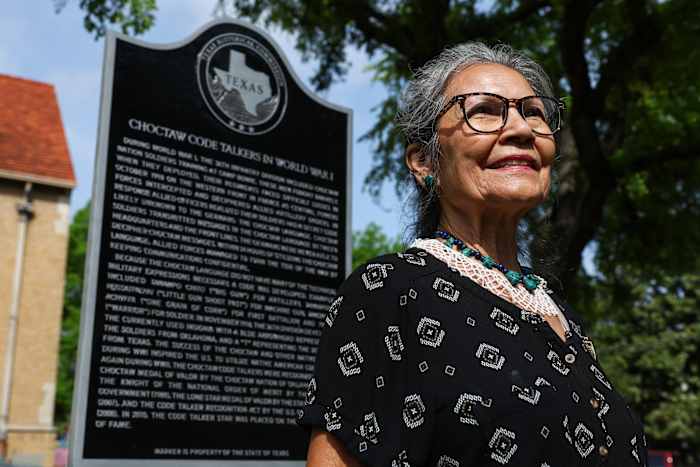
In the two decades since learning this piece of her family history, Nashoba has been a leading advocate for recognizing the legacy of these code talkers. As president of the Choctaw Code Talkers Association, she has worked tirelessly to ensure their achievements are honored. Her efforts have recently culminated in the installation of a plaque at Fort Worth’s Veterans Memorial Park, commemorating the soldiers’ invaluable contributions.
The Choctaw Code Talker Historical Marker was officially unveiled on April 1 in a ceremony co-hosted by the Oklahoma tribe, the Texas Historical Commission, and the local parks and recreation department. The event was attended by numerous descendants of these heroic Native American soldiers.
“Seeing the marker truly fills me with joy,” Nashoba expressed. “This will preserve our history for future generations.”
Choctaw code talkers’ ties to Fort Worth
Members of the Choctaw code talkers were men who volunteered to fight for the U.S. in World War I at a time when Native Americans were not recognized as citizens. Indigenous communities wouldn’t receive citizenship until 1924.
While in the battlefields in France, some of these men were overheard speaking their Choctaw language and were trained to use their words as “code.” They were placed on front lines and command posts so that messages could be transmitted to headquarters.
The soldiers shared words like “tanampo chito” for artillery and “tvshka” for warriors, according to the historical marker. The Germans famously failed to decipher these Choctaw transmissions within 24 hours throughout the war.
The Choctaw group is widely considered to be the first Native American code talkers to serve in the U.S. military. Their work paved the way for the Navajo code talkers during World War II.
“Their story is a testament to the resilience and patriotism of the Choctaw Nation,” Col. Brent Kemp, commander of the 56th Infantry Brigade Combat Team of the National Guard, said at the unveiling. “Their ingenuity and bravery reminds us of the power of cultural heritage and the importance of preserving Indigenous languages.”
The Native American soldiers were in the 36th Infantry Division at Camp Bowie, a westside training site for more than 100,000 soldiers during World War I.
Council member Macy Hill, who represents Camp Bowie, said it was only fitting for Fort Worth to honor the legacy of the code talkers since they walked on the site’s grounds.
“This is where the Choctaw code talkers were initially trained and where they will forever be remembered,” she said.
Descendants carry the torch
As Ta’Na Alexander — the great-great-granddaughter of Carterby — watched the marker’s unveiling in Fort Worth, she couldn’t help but feel proud that her family’s history is slowly spreading across the U.S.
“It’s pretty monumental to realize that more people are starting to recognize the significant part of these men who were sworn to secrecy,” said Alexander, who is Nashoba’s daughter. “This marker connects the past to the future.”
She credits her mother’s leadership for widespread education about the work of Native soldiers.
Last May, the Choctaw Code Talkers Association led the charge to place a bronze sculpture honoring the group at the Choctaw Cultural Center in southern Oklahoma. The artwork depicts three soldiers in the middle of battle.
The organization also advocated for 23 Oklahoma bridges to be renamed after the code talkers and other Native veterans.
The Fort Worth marker was the group’s first venture into Texas, Nashoba said. The group is exploring other statewide recognitions, she added.
For now, Alexander invites Fort Worth residents to stroll through the memorial park to learn that her ancestors’ stories aren’t just about being Native. They’re about what it means to be American, she said.
“You might not be Native or Choctaw, but what we do share in common is that we have the right to vote,” she said. “We have a voice. We have a freedom that exists here that doesn’t exist anywhere else.”
___
The Fort Worth Report’s arts and culture coverage is supported in part by the Meta Alice Keith Bratten Foundation and the Virginia Hobbs Charitable Trust. At the Report, news decisions are made independently of our board members and financial supporters. Read more about our editorial independence policy here.
___
This story was originally published by Fort Worth Report and distributed through a partnership with The Associated Press.
For copyright information, check with the distributor of this item, Fort Worth Report.