
Share this @internewscast.com

NEW DELHI – In a significant move to strengthen economic and strategic relations, Prime Minister Narendra Modi announced on Tuesday that India and the European Union have successfully negotiated a free trade agreement. This landmark deal, encompassing a staggering 2 billion people, marks a pivotal moment after nearly two decades of discussions, earning the moniker “mother of all deals” from both parties involved.
This agreement represents one of the most substantial bilateral trade engagements worldwide, particularly significant as the United States imposes steep import tariffs on both India and the EU. The timing of this deal highlights the shifting dynamics in global trade, as major economies seek new partnerships amidst changing tariff landscapes.
Prime Minister Modi, addressing an energy conference via video, remarked, “This agreement will bring major opportunities for the people of India and Europe. It represents 25% of the global GDP and one-third of global trade.” His words underscore the profound impact of this deal on the global economic stage.
The agreement emerges as a strategic response to Washington’s tariff policies, which have disrupted traditional trade flows. By fostering this partnership, India and the EU are paving the way for more resilient economic ties in a rapidly evolving global market.
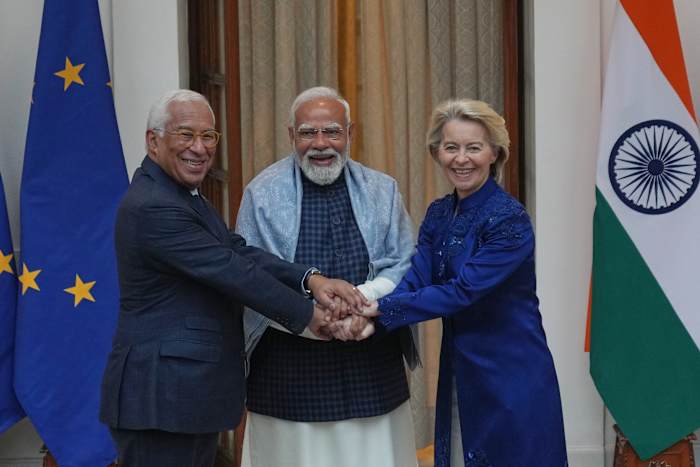
Later on Tuesday, Modi was expected to meet with European Commission President Ursula von der Leyen to formally announce and celebrate this historic agreement, cementing a new chapter in India-EU relations.
Modi was scheduled to meet with European Commission President Ursula von der Leyen later Tuesday to jointly announce the agreement.
India has stepped up efforts to diversify its export destinations as part of a broader strategy to offset the impact of higher U.S. tariffs.
The tariffs include an extra 25% levy on Indian goods for its unabated purchases of discounted Russian oil, bringing the combined tariffs imposed by the United States on its ally to 50%.
The deal gives the EU expanded access to one of the world’s fastest-growing major economies, helping European exporters and investors to reduce their reliance on more volatile markets.
Bilateral trade between India and EU stood at $136.5 billion in 2024-25. The two sides hope to increase that to about $200 billion by 2030, India’s Trade Ministry officials said.
“Ultimately, the agreement is about creating a stable commercial corridor between two major markets at a time the global trading system is fragmenting,” said Indian trade analyst Ajay Srivastava.
The EU is still reeling from the aggressive approach of its once-stalwart ally across the Atlantic. There’s a widespread sense of betrayal across the 27-nation bloc from U.S. President Donald Trump’s onslaught of higher tariffs, embrace of far-right parties, and belligerence over Greenland.
Brussels has accelerated its outreach to markets around the world: Over the past year, von der Leyen has signed deals with Japan, Indonesia, Mexico, and South America under the catchphrase “strategic autonomy,” which in practice is akin to decoupling from a U.S. seen by most European leaders as erratic.
“We are showing a fractured world that another way is possible,” she posted on X after arriving in India on Sunday.
___
Associated Press writer Sam McNeil contributed from Brussels.
Copyright 2026 The Associated Press. All rights reserved. This material may not be published, broadcast, rewritten or redistributed without permission.