Share this @internewscast.com

SURIN – Hostilities persisted on Saturday morning along the Thailand-Cambodia border, despite U.S. President Donald Trump announcing he had secured a ceasefire agreement between the two nations.
Thai authorities have denied consenting to a ceasefire, while Cambodian officials have remained silent on Trump’s assertion. Instead, Cambodia’s defense ministry claimed that Thai aircraft conducted airstrikes that morning. Cambodian media echoed Trump’s statement without offering further details.
The latest outbreak of significant conflict was triggered by a December 7 skirmish that injured two Thai soldiers, disrupting a ceasefire previously arranged by Trump. This truce had ended five days of clashes in July, rooted in protracted territorial disagreements.
The ceasefire in July was facilitated by Malaysia and reinforced by Trump, who leveraged trade benefits to compel Thailand and Cambodia into agreement. This arrangement was further detailed in October during a regional summit in Malaysia, attended by Trump.
In the past week, official reports indicate that around two dozen individuals have lost their lives in the renewed fighting, causing the displacement of hundreds of thousands from both sides of the border.
The Thai military has confirmed the deaths of 11 of its soldiers and estimates 165 Cambodian soldiers have been killed. While Cambodia has not disclosed its military casualties, it reports at least 11 civilian deaths and 76 injuries.
Trump on Friday, after speaking to Thai Prime Minister Anutin Charnvirakul and Cambodian Prime Minister Hun Manet, had announced an agreement to restart the ceasefire.
“They have agreed to CEASE all shooting effective this evening, and go back to the original Peace Accord made with me, and them, with the help of the Great Prime Minister of Malaysia, Anwar Ibrahim,” Trump said in his Truth Social post.
Trump’s claim came after midnight in Bangkok. Thai Prime Minister Anutin had after his call with Trump said he had explained Thailand’s reasons for fighting and said peace would depend on Cambodia ceasing its attacks first. The Thai foreign ministry later explicitly disputed Trump’s claim that a ceasefire had been reached. Anutin’s busy day on Friday including dissolving Parliament so new elections could be held early next year.
Cambodian Prime Minister Hun Manet, in comments posted early Saturday morning, also made no mention of a ceasefire.
He said he held phone conversations on Friday night with Trump, and a night earlier with Malaysia’s Prime Minister Anwar Ibrahim, and thanked both “for their continuous efforts to achieve a long-lasting peace between Cambodia and Thailand.”
“Cambodia is ready to cooperate in any way that is needed,’ Hun Manet wrote.
Thailand has been carrying out airstrikes on what it says are strictly military targets, while Cambodia has been firing thousands of medium-range BM-21 rockets that have caused havoc but relatively few casualties.
BM-21 rocket launchers can fire up to 40 rockets at a time with a range of 30-40 kilometers (19-25 miles). These rockets cannot be precisely targeted and have landed largely in areas from where most people have already been evacuated.
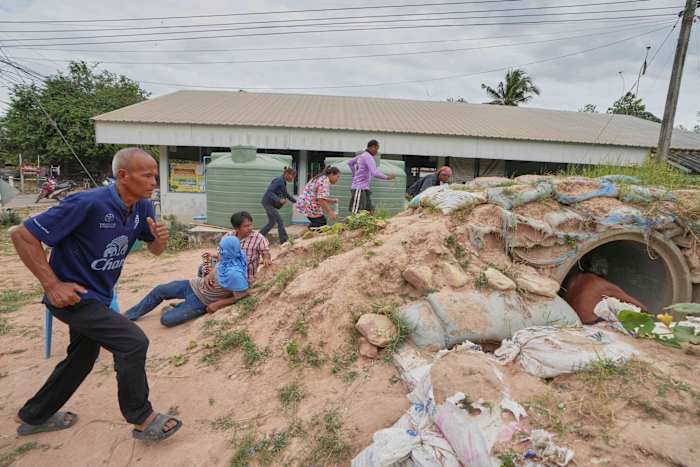
However, the Thai army announced Saturday that BM-21 rockets had hit a civilian area in Sisaket province, seriously injuring two civilians who had heard warning sirens and had been running toward a bunker for safety.
——
Peck reported from Bangkok. Sopheng Cheang in Serei Saophoan, Cambodia, and Matthew Lee in Washington contributed to this report.
Copyright 2025 The Associated Press. All rights reserved. This material may not be published, broadcast, rewritten or redistributed without permission.