
DEIR EL-BALAH – Rising early to line up under the hot August sun, Rana Odeh hurries back to her tent with a jug of unclear water. She dabs the sweat off her forehead and carefully decides how to distribute the water to her two young children. Just by the sight, she knows it is probably unsafe.
Thirst supersedes the fear of illness.
She fills small bottles for her son and daughter and pours a sip into a teacup for herself. What’s left she adds to a jerrycan for later.
“We have to give it to the kids because there’s no other choice,” says Odeh, who had to leave her residence in Khan Younis. “It leads to illnesses for both us and our children.”
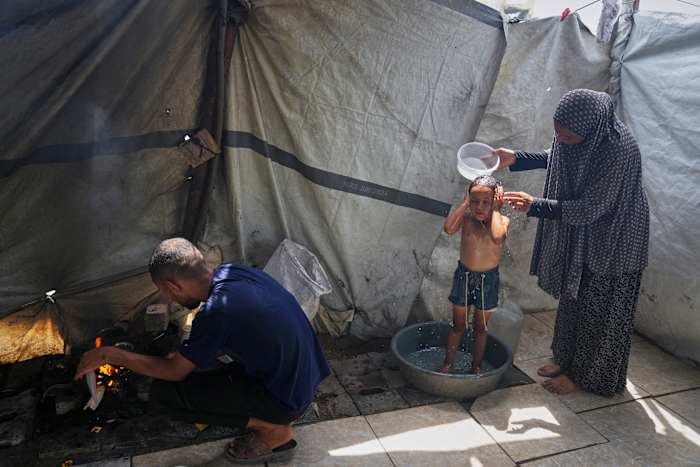
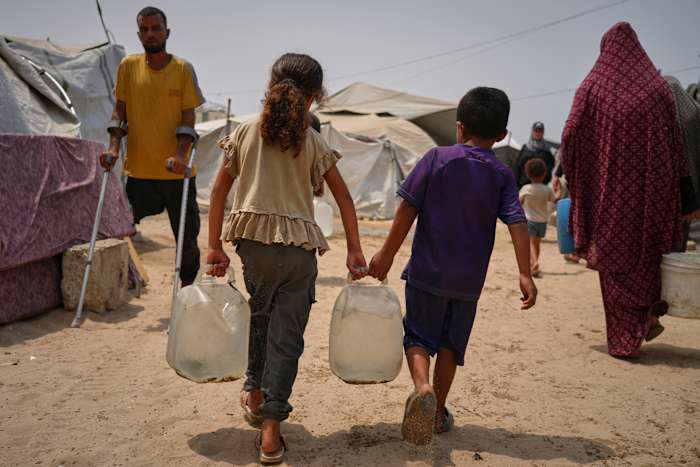
These moments have sadly become the everyday reality in Muwasi, a vast residential area for the displaced in central Gaza where many face the sweltering summer conditions. Covered in sweat and dust, families eagerly await the water trucks that arrive every couple of days, capturing the water in bottles, canisters, and buckets, then carrying them back, sometimes using donkey carts.
Every drop is carefully allocated for drinking, cooking, and washing. Some families reuse what they can, saving a small amount in their containers for what the next day might—or might not—bring.
When water fails to arrive, Odeh said, she and her son fill bottles from the sea.
In the 22 months since Israel’s offensive began, access to water in Gaza has been severely impacted. Fuel and electricity restrictions have slowed down desalination plants, while infrastructure bottlenecks and pipeline damage have reduced supply to a trickle. Polluted by waste and the rubble of bombed structures, Gaza’s aquifers have deteriorated, with most wells either unreachable or ruined, according to aid organizations and the local utility agency.
Moreover, the water shortage has contributed to a disease outbreak amid Gaza’s escalating hunger crisis. According to UNRWA — the U.N. agency assisting Palestinian refugees — its health facilities are now treating roughly 10,300 patients weekly for infectious diseases, predominantly diarrhea stemming from tainted water.
Efforts to ease the water shortage are in motion, but for many the prospect is still overshadowed by the risk of what may unfold before new supply comes.
And the thirst is only growing as a heat wave bears down, with humidity and temperatures in Gaza soaring on Friday to 35 degrees Celsius (95 degrees Fahrenheit).
Searing heat and sullied water
Mahmoud al-Dibs, a father displaced from Gaza City to Muwasi, dumped water over his head from a flimsy plastic bag — one of the vessels used to carry water in the camps.
“Outside the tents it is hot and inside the tents it is hot, so we are forced to drink this water wherever we go,” he said.
Al-Dibs was among many who told The Associated Press they knowingly drink non-potable water.
The few people still possessing rooftop tanks can’t muster enough water to clean them, so what flows from their taps is yellow and unsafe, said Bushra Khalidi, an official with Oxfam, an aid group working in Gaza.
Before the war, the coastal enclave’s more than 2 million residents got their water from a patchwork of sources. Some was piped in by Mekorot, Israel’s national water utility. Some came from desalination plants. Some was pulled from high-saline wells, and some imported in bottles.
Every source has been jeopardized.
Palestinians are relying more heavily on groundwater, which today makes up more than half of Gaza’s supply. The well water has historically been brackish, but still serviceable for cleaning, bathing, or farming, according to Palestinian water officials and aid groups.
Now people have to drink it.
The effects of drinking unclean water don’t always appear right away, said Mark Zeitoun, director general of the Geneva Water Hub, a policy institute.
“Untreated sewage mixes with drinking water, and you drink that or wash your food with it, then you’re drinking microbes and can get dysentery,” Zeitoun said. “If you’re forced to drink salty, brackish water, it just does your kidneys in, and then you’re on dialysis for decades.”
Deliveries average less than three liters (12.5 cups) per person per day — a fraction of the 15-liter (3.3-gallon) minimum humanitarian groups say is needed for drinking, cooking and basic hygiene. In February, acute watery diarrhea accounted for less than 20% of reported illnesses in Gaza. By July, it had surged to 44%, raising the risk of severe dehydration, according to UNICEF, the U.N. children’s agency.
System breakdown
Early in the war, residents said deliveries from Israel’s water company Mekorot were curtailed — a claim that Israel has denied. Airstrikes destroyed some of the transmission pipelines as well as one of Gaza’s three desalination plants.
Bombardment and advancing troops damaged or cut off wells – to the point that today only 137 of Gaza’s 392 wells are accessible, according to UNICEF. Water quality from some wells has deteriorated, fouled by sewage, the rubble of shattered buildings and the residue of spent munitions.
Fuel shortages have strained the system, slowing pumps at wells and the trucks that carry water. The remaining two desalination plants have operated far below capacity or ground to a halt at times, aid groups and officials say.
In recent weeks, Israel has taken some steps to reverse the damage. It delivers water via two of Mekorot’s three pipelines into Gaza and reconnected one of the desalination plants to Israel’s electricity grid, Deputy Foreign Minister Sharren Haskel told The Associated Press.
Still, the plants put out far less than before the war, Monther Shoblaq, head of Gaza’s Coastal Municipalities Water Utility, told AP. That has forced him to make impossible choices.
The utility prioritizes getting water to hospitals and to people. But that means sometimes withholding water needed for sewage treatment, which can trigger neighborhood backups and heighten health risks.
Water hasn’t sparked the same global outrage as limits on food entering Gaza. But Shoblaq warned of a direct line between the crisis and potential loss of life.
“It’s obvious that you can survive for some days without food, but not without water,” he said.
Supply’s future
Water access is steadying after Israel’s steps. Aid workers have grown hopeful that the situation won’t get worse and could improve.
Southern Gaza could get more relief from a United Arab Emirates-funded desalination plant just across the border in Egypt. COGAT, the Israeli military body in charge of humanitarian aid to Gaza, said it has allowed equipment into the enclave to build a pipeline from the plant and deliveries could start in a few weeks.
The plant wouldn’t depend on Israel for power, but since Israel holds the crossings, it will control the entry of water into Gaza for the foreseeable future.
But aid groups warn that access to water and other aid could be disrupted again by Israel’s plans to launch a new offensive on some of the last areas outside its military control. Those areas include Gaza City and Muwasi, where much of Gaza’s population is now located.
In Muwasi’s tent camps, people line up for the sporadic arrivals of water trucks.
Hosni Shaheen, whose family was also displaced from Khan Younis, already sees the water he drinks as a last resort.
“It causes stomach cramps for adults and children, without exception,” he said. “You don’t feel safe when your children drink it.”
___
Metz reported from Jerusalem. Alon Berstein contributed reporting from Kerem Shalom, Israel. ___
Copyright 2025 The Associated Press. All rights reserved. This material may not be published, broadcast, rewritten or redistributed without permission.


